Written By | International News Agencies
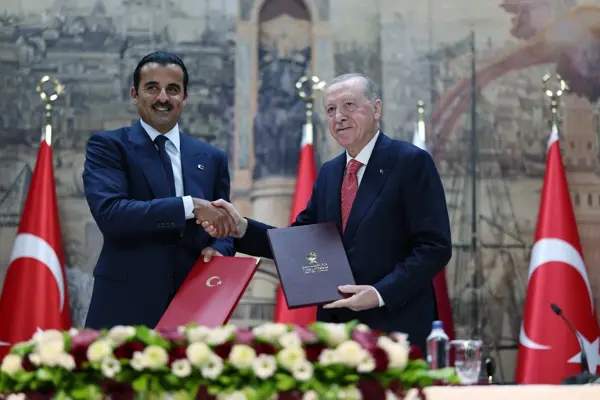
Under the pact, according to Qatar's Foreign Ministry, the two countries commit to "a unified stance in confronting any external armed attack targeting either party or both of them.
World Politics
Overview
In the gilded halls of Istanbul's Dolmabahçe Palace on Friday, November 13, Turkish President Recep Tayyip Erdoğan and Qatar's Emir, Sheikh Tamim bin Hamad Al Thani, signed a mutual defence agreement that formalises one of the Middle East's most consequential partnerships. Under the pact, according to Qatar's Foreign Ministry, the two countries commit to "a unified stance in confronting any external armed attack targeting either party or both of them." The signing, which took place during the 12th session of the two countries' Supreme Strategic Committee, came as the Gulf endures a grinding US-Iran war, a contested blockade of the Strait of Hormuz, and a wave of regional realignments in which Muslim-majority states are building security arrangements of their own.
Erdoğan said the countries would work together to "prevent the resurgence of war in the Gulf region," and that the deal would "add a new dimension" to relations between them. Sheikh Tamim described it as part of a "strategic partnership" that "continues to develop across various fields." The precise legal obligations of the treaty, however, have not been published, and several outlets noted that the official statements disclosed no details of its triggers, military commitments or implementation mechanisms.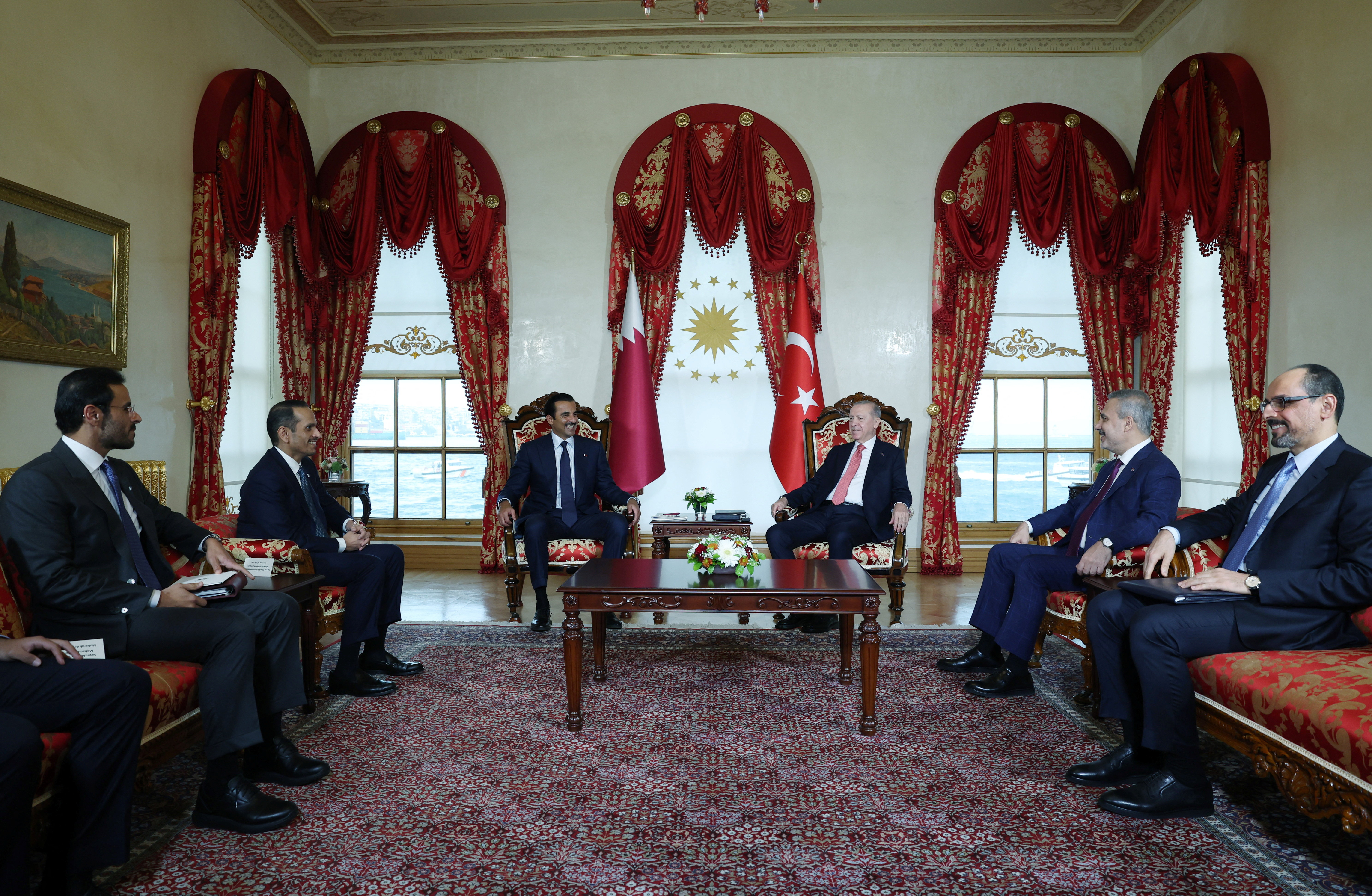
Background: A Decade of Turkish-Qatari Alignment
The partnership between Ankara and Doha is not new. The Supreme Strategic Committee that met on Friday was established in 2014, and Türkiye has maintained a military presence in Qatar since the middle of the last decade under a bilateral defence cooperation agreement. That presence became a lifeline in 2017, when Saudi Arabia, the United Arab Emirates, Bahrain and Egypt imposed a land, sea and air blockade on Qatar. Ankara accelerated troop deployments and supplied food and goods, cementing a relationship built on shared positions on political Islam, Gaza and the Muslim Brotherhood that set both countries apart from much of the Arab world.
The two countries' economic ties have deepened in parallel. Erdoğan said on Friday that a Trade and Economic Partnership Agreement that entered into force last year has moved them closer to their bilateral trade target. Qatar, one of the world's largest exporters of liquefied natural gas, has invested heavily in the Turkish economy, while Türkiye, which fields NATO's second-largest military, has become an increasingly important arms supplier to the Gulf.
What has changed is the security environment. Qatar hosts Al Udeid Air Base, the largest US military installation in the Middle East, and was designated a major non-NATO ally by Washington. For years, that relationship was assumed to be Doha's ultimate guarantee. But Qatar has been struck from more than one direction in recent years: Iran fired missiles at Al Udeid in June 2025 in retaliation for US strikes on its nuclear sites, and Israel carried out an airstrike in Doha in September 2025 targeting Hamas leaders, an attack that shocked Gulf capitals. The current US-Iran war, now in its second phase after the collapse of earlier ceasefires, has placed the entire Gulf in the line of fire, with tanker attacks, mines and drone strikes reported almost daily in and around the Strait of Hormuz.
Key Developments: What Was Signed
According to Turkish and Qatari official readouts and reporting by Al Jazeera, The Jerusalem Post, India TV and others, the defence accord was one of several agreements signed on Friday. Others included a memorandum of understanding on peace, reconciliation and conflict resolution, as well as accords on education cooperation and on consumer protection and market surveillance. Turkish Foreign Minister Hakan Fidan and Qatari Prime Minister and Foreign Minister Sheikh Mohammed bin Abdulrahman Al Thani signed the committee's joint statement. Reports differed on the total number of agreements, with some counting five.
Beyond the core mutual defence clause, the Qatari ministry said the two sides agreed to consult on security threats and on regional and global security issues, and to expand cooperation through joint military exercises, defence-industry collaboration and personnel training exchanges. The pact also extends to cultural, economic, humanitarian and educational cooperation. Whether the agreement obliges either party to provide military assistance automatically in the event of an attack, as in NATO's Article 5 or the Saudi-Pakistani pact of 2025, could not be confirmed from the published statements. Readers should treat descriptions of the pact as an "attack on one is an attack on both" arrangement with caution until the text is released.
The joint statement also addressed Gaza, where both countries are mediators alongside Egypt in the ceasefire arrangement endorsed by UN Security Council Resolution 2803. The two governments "expressed deep concern regarding the ongoing Israeli violations in Gaza that undermine the implementation" of the peace plan, called on Israel to "comply fully with all its obligations under the ceasefire agreement and international law," and demanded "full, safe and unhindered humanitarian access." They also "strongly condemned Israel's illegal settlement activities, settler violence and terrorism" in the occupied West Bank. The same week, the intelligence chiefs of Egypt, Türkiye and Qatar met in Cairo and agreed to advance the first phase of the Gaza ceasefire deal, according to Vietnam's Nhan Dan newspaper.
A Web of New Defence Pacts
Friday's agreement is the latest strand in an expanding web of security arrangements among Muslim-majority states. In September 2025, Saudi Arabia and Pakistan signed a mutual defence pact under which an attack on one is considered aggression against both. In August of this year, Türkiye, Saudi Arabia and Pakistan signed what has become known as the Mecca Joint Defence Agreement, which treats an attack on one party as an attack on all. The Turkish parliament ratified that agreement only last week, according to The Jerusalem Post, clearing the way for Turkish military support to Saudi Arabia as it faces Iran-backed Houthi attacks from Yemen. Ankara has said the Mecca pact is not aimed at any other country and is open to new members, including Egypt.
In October, Qatar, Indonesia, Pakistan and Türkiye signed a multilateral defence-cooperation memorandum in Doha known as "Badr," which the Istanbul joint statement welcomed as a step toward collective defence capacity built on indigenous capabilities, including joint production, technology development and defence-industrial supply chains. Taken together, these agreements place Türkiye at the hub of an emerging network that links the Gulf, South Asia and Southeast Asia, with Pakistan, the Muslim world's only nuclear-armed state, as another anchor.
Reactions and Interpretations
Official reactions from Washington, Tehran and Jerusalem were not reported in the coverage available on Saturday. Analysts, however, were quick to read the pact as a statement of hedging. Turkish security analyst Yusuf Alabarda told Al Jazeera that Gulf states are "feeling the effects of the war and no one is feeling secure," and that Gulf countries, "especially Qatar," had concluded that their security guarantees from the United States "are not working properly." He said "Turkish troops in Qatar are very important" and predicted that Turkish weapons and air-defence systems might be deployed to Qatar in the near term. That assessment is his own; neither government has announced any new deployment.
Media framing varied considerably. A comparison of more than a dozen outlets by the aggregator Newscord found that Al Jazeera foregrounded the analyst's claims about faltering US guarantees, while Reuters-based reports stuck to the signing ceremony and the absence of disclosed details, and state media in both countries, including Anadolu Agency and the Qatar News Agency, emphasised the official language of brotherhood and peace. Turkish outlets such as Hürriyet and TRT World described the agreement as "landmark," while others used the more cautious phrase "joint defence agreement."
Analysis: Hedging, Not Replacing
It would be a mistake to read the pact as Qatar abandoning the United States. Al Udeid remains central to US operations in the region, and Doha has continued to serve as a mediator in the US-Iran conflict, including through a two-stage plan to reopen Hormuz floated earlier this month. Türkiye, for its part, remains a NATO member whose own security is ultimately anchored in the Western alliance. What the agreement does signal is a growing conviction among regional governments that they cannot rely on a single external patron, particularly when that patron is itself a combatant in the war threatening their economies and when an American ally, Israel, has struck Qatari soil.
For Ankara, the pact extends Erdoğan's long-running ambition to make Türkiye an indispensable regional power, with military reach from the Gulf to the Horn of Africa and diplomatic roles in Gaza, Ukraine and Syria. For Doha, it adds a second layer of protection from a partner that has already proved its willingness to stand by Qatar under pressure, as in 2017. Both countries also gain leverage in Gaza diplomacy, where their joint criticism of Israel signals a coordinated stance as the ceasefire's first phase remains fragile.
What's Next
Several questions will determine how much weight the agreement carries. The first is whether its full text, and any automatic assistance clause, will be published or submitted for ratification by the Turkish parliament, as the Mecca pact was. The second is whether Türkiye follows through with expanded deployments or air-defence systems in Qatar, as analysts expect. The third is how Washington, Tehran and Israel respond, publicly or privately, to a NATO member committing itself to the defence of a Gulf state that sits at the centre of an active war zone. And finally, the agreement will be watched for its effect on the wider Gulf: whether Saudi Arabia, already linked to Türkiye through the Mecca pact, and other Gulf monarchies see it as complementary to their own arrangements or as a sign of Qatari-Turkish ambitions that cut across them. With the Strait of Hormuz still contested and the Gaza ceasefire unsteady, Friday's signing ensures that Türkiye will be a more visible military actor in the Gulf than at any point in modern history.