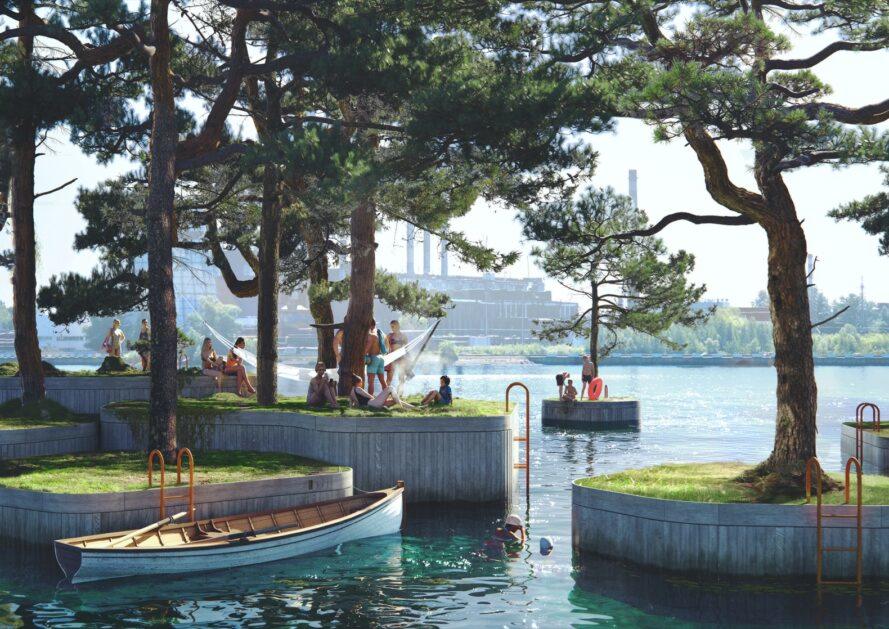
Firenze Little Island, a demountable summer platform ringed by mature trees, imagines a new kind of public space on one of Italy's most storied rivers. It is a proposal, and its future is uncertain.
DESIGN
Florence turned its back on the Arno long ago. The river that shaped the city is crossed by famous bridges and lined by embankments, but for most visitors it remains something to look at rather than something to use. A proposal from Renna Studio, led by architect Angelo Renna, asks what might happen if the river itself became a place to gather.
The scheme, called Firenze Little Island and featured by designboom, is a floating platform with a ring of 39 mature trees. The studio describes it as a 'demountable, seasonal public floating platform' meant to host cultural gatherings, orchestral performances and recreation.
How It Would Work
According to designboom, the island would sit along the Pescaia weir on the Arno, where the flow of water is regulated. At its center would be an open-air deck, surrounded by a segmented, circular planter ring about one meter, or 3.3 feet, high, holding the 39 trees. The trees are intended to provide shade and air circulation and to act as an environmental buffer.
Structurally, the island would be assembled from prefabricated floating pontoons, a timber beam substructure, timber decking modules and the segmented planters. Underwater cables would anchor it to the riverbed while allowing it to rise and fall with the water level, a necessary feature on a river that can change character quickly.
The project is designed to be seasonal. It would operate during the calmer months from May to September. Before autumn and winter floods, the components would be taken apart, transported and stored, while the trees' root systems would be kept in municipal nurseries until reassembly.

A Proposal With a Paper Trail
This is not a built project. designboom reports that the idea was first put forward with municipal backing in 2024 and received support from Heritage Superintendent Antonella Ranaldi in early 2026, but that municipal plans have since paused. Reasons for the pause were not specified. Details such as overall dimensions, capacity, cost and tree species were also not given, and the coverage included no direct quotes from the designer or officials.
That gap is worth stating plainly. Floating public space is easy to render and hard to deliver, and without published budgets or permits any timeline is guesswork. The proposal's real value right now is as an argument about what a riverfront could be.
The Wider Idea: Cities and Their Water
Designers have been drawn to urban rivers for years, whether through swimming sites, floating parks or temporary pavilions. The appeal is straightforward: waterfronts are among the few places in dense historic cities where new public space is physically possible without demolishing anything. A seasonal, removable structure also sidesteps many of the problems historic centers face with permanent additions.
There are also practical questions any floating public space has to answer, and the coverage does not resolve them. How many people could the deck safely hold? How would visitors board, and how would the platform be made accessible to wheelchair users and families with strollers? What happens when river levels change faster than expected? These are not criticisms of the concept so much as the checklist that a municipality would reasonably ask before approving it, and the absence of published answers may help explain why the plans are paused.
Even so, it is easy to see why the image resonates. A platform of living trees reads as a counterpoint to the hard stone and traffic that define much of the historic center, and a seasonal schedule from May to September matches the months when residents and visitors most want to be outdoors in the evening. If the project is revived, the most useful next step would be a transparent public brief with dimensions, costs and an environmental assessment, so the conversation can move from renderings to decisions.
Florence is an especially sensitive case. Its riverside views are among the most protected and photographed in the world, which is why the heritage superintendent's reported support is notable. A demountable design is easier to defend than a permanent one, because it leaves no lasting mark on the landscape once it is dismantled each autumn.
The trees are the most interesting design decision. A floating deck alone would be a stage; a ring of mature trees makes it a garden, giving shade in a Tuscan summer and a softer silhouette against the stone of the embankments. Caring for living trees on a moving platform is also the hardest part, and the plan to winter the root systems in municipal nurseries shows the designers have considered it.

What This Means for You
For travelers and Florentines alike, the proposal is a reminder that urban design is not only about buildings. If the project advances, it could change how summer evenings along the river are spent, with concerts or markets on the water. For now, nothing is scheduled, and visitors should not expect to see it this season.
For anyone interested in design, the takeaway is portable: temporary, reversible interventions are one of the most realistic ways to add public space to a historic city. They allow experiments, and they keep the door open to changing course.
Conclusion
Firenze Little Island may never leave the drawing board, and its pause suggests the obstacles are real. But its central image, a circle of trees drifting gently on the Arno, captures a persistent hope in contemporary design: that cities can give back their rivers, one summer at a time. Whether Florence chooses to restart the conversation is an open question, and the proposal deserves to stay on the table.
Published By | Design & Fashion Editor