DESIGN
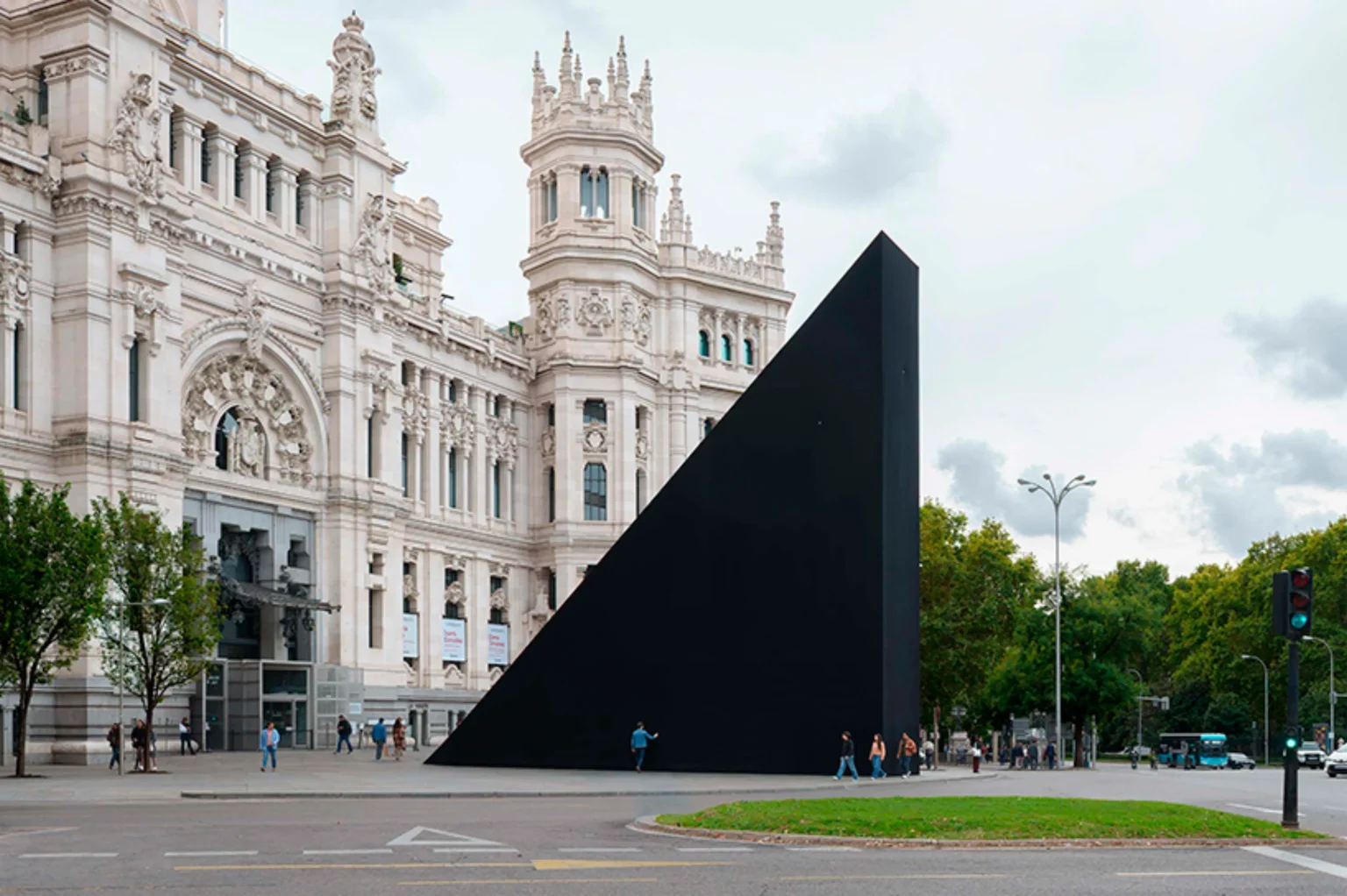
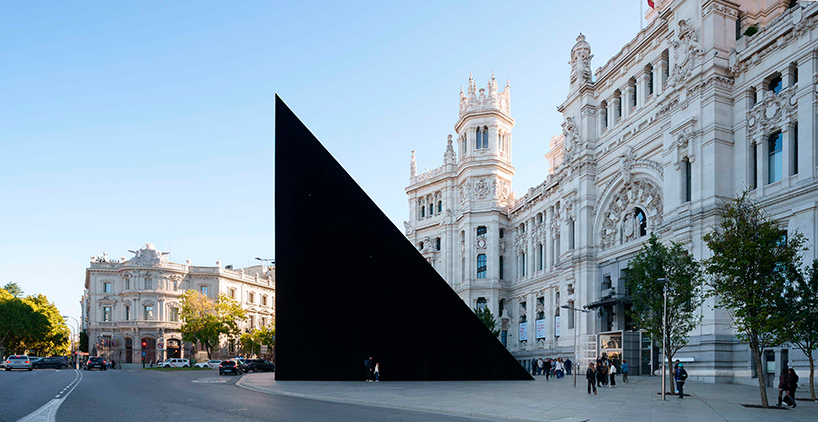
A 20-metre matte-black triangle set up in front of the Palacio de Cibeles let passers-by look through hidden peepholes at live CCTV footage of the square around them. Images of the installation have spread across design and tech media this week.
MADRID
Plaza de Cibeles is one of Madrid's grandest settings: a busy roundabout, a famous fountain, and behind it the ornate Palacio de Cibeles, a government building that opened in 1919. For a few days this autumn, a huge black triangle stood in front of the palace and appeared to be watching everyone.
The work is called PANOPTICON, and it's by SpY, the Spanish urban artist known for large interventions in public space. Images of the piece have spread widely this week. Designboom ran it on November 5, the Madrid-based architecture magazine Metalocus followed on November 7, and on November 8 Futurism ran it under the headline "Menacing Surveillance Obelisk Appears in Madrid." Tech site Cybernews compared it to a landed UFO.
A Monolith With Peepholes
The design is simple and unsettling. PANOPTICON is an equilateral triangle about 20 metres (roughly 65 feet) on each side, finished in matte black. CCTV cameras sit at its apex and along its upper rim, looking down on the square. Small viewing openings are set into its lower edge. When pedestrians lean in, they see monitors playing live, fragmented footage of the area around them: traffic on the roundabout, people crossing the plaza, and the facades of nearby buildings, all from unusual high angles.
According to Cybernews, the installation ran for four days in late October. The arrangement reverses the usual experience of public surveillance. People on the street are being watched without knowing it, while whoever is looking through a peephole can watch them without being seen. Metalocus describes the openings as "viewing apertures equipped with screens connected to CCTV surveillance cameras."
Bentham's Idea, Rebuilt for the Street
The title refers to the panopticon, the 18th-century prison design by English philosopher Jeremy Bentham. In his plan, a single central inspector could watch every inmate without the inmates ever knowing whether they were being observed at that moment. Later thinkers made the panopticon a shorthand for modern surveillance: you don't need to be watched all the time if you can never be sure you're not.
That's the idea SpY is working with. As quoted by Futurism, the artist says the work "introduces a reflection on the mechanisms of contemporary surveillance." The project text published by Metalocus says PANOPTICON "reflects on the way we observe contemporary space" and explores "how the possibility of being watched can lead individuals to internalize surveillance." Futurism also summarizes SpY's argument that people willingly take part in systems that expose them to other people's gaze, changing how they relate to privacy and control.
Why the Setting Matters
A large part of the piece's power comes from where it stood. Designboom noted that the black form looked especially jarring against the palace's elaborate backdrop, and Futurism described how it took over the square and made pedestrians walk around it. It wasn't decorative public art. It had no ornament, no visible entrance and no obvious function, so it read like a piece of infrastructure dropped from somewhere else, which seems to be the point.
This is familiar ground for SpY. The artist has worked in public space since the mid-1980s, first in graffiti and later in large installations, and has returned often to themes of watching and being watched. In 2021 SpY placed an enormous black sphere in Madrid, and earlier work includes a kinetic sculpture made of 20 surveillance mirrors. Designboom's archive lists more than 30 of the artist's projects, from rotating halos in a Florence atrium to a split sphere in Xi'an.
Design as Provocation
PANOPTICON belongs to a growing body of work in which artists and designers make surveillance, something normally invisible, physical and visible. Its timing is apt. Cameras, facial recognition and connected doorbells are now an ordinary part of city life, and surveillance in public space keeps coming up in news coverage, as Futurism's own related links on AI facial recognition and police camera systems show. Most of these systems are designed to go unnoticed. PANOPTICON is designed to be impossible to miss.
From a design perspective, the work shows how much can be said with very little. It uses one material finish, one pure geometric shape and a handful of off-the-shelf cameras and screens. Its effect comes almost entirely from scale, contrast and the decision to hand the cameras' view to the public. Cybernews reports that some onlookers who didn't realize they were being watched from inside found the experience eerie, and that discomfort is what the work is after.

What This Means for You
You don't need to travel to Madrid to take something from PANOPTICON. Next time you cross a plaza, a station concourse or a shopping street, count the cameras. Most people never do. The installation's simple trick, letting the watched become the watchers, invites a useful question: who is looking at this footage, and what are they doing with it?
For designers and architects, the piece is a reminder that public space is never neutral. Lighting, sightlines, benches and now cameras all shape how people behave, often without their knowing it. SpY's triangle makes that hidden layer visible for a moment, which is exactly what good critical design does.
A Brief, Lasting Shadow
Like many of SpY's interventions, PANOPTICON was temporary, and the square has presumably returned to normal. The images, though, have travelled far beyond Madrid, which may be the most fitting outcome for a work about watching: a monolith that observed the city for a few days is now being viewed on screens around the world.
Published By | Features Editor