Written By | Fashion and Design Desk
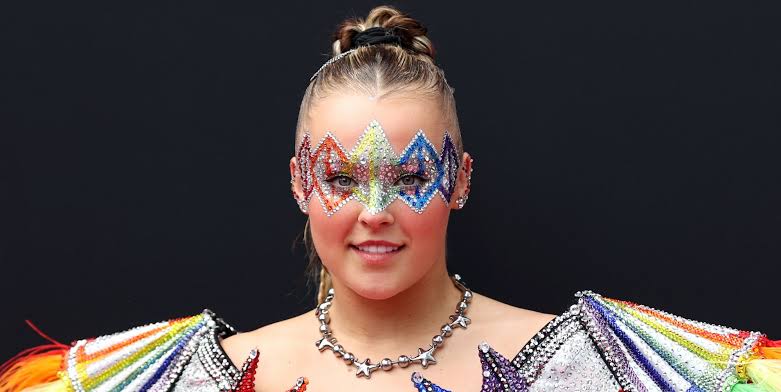
The former Nickelodeon star is done being boxed into a label she chose at eighteen — even as she insists she isn't going anywhere.
Los Angeles
JoJo Siwa has spent the better part of the past year explaining herself, and this week she did it again — not because she owes anyone an explanation, she'll tell you, but because the questions keep coming. In a new round of interviews making the rounds this week, the 33-year-old, who came out as a lesbian in 2021 and has spent 2026 in a very public relationship with British reality star Chris Hughes, revisited the moment that has followed her all year: why a woman who once described herself in one specific, settled term now insists that sexuality — hers, at least — was never that simple to begin with.
"Sexuality is fluid," Siwa said, describing how the label she chose at eighteen came to feel like a box rather than an identity. It's a sentence that, on its own, might not have made headlines. Coming from Siwa, whose coming-out five years ago was treated as a milestone moment for a generation of young fans, it has reopened a conversation that shows no sign of settling down.
From Big Brother to a Very Public Relationship
The current chapter traces back to April 2025, when Siwa entered the Celebrity Big Brother UK house while dating influencer Kath Ebbs. Inside the house, she met Chris Hughes, the show's eventual runner-up and a familiar face from British reality television. By the time the pair left the house three weeks later, their dynamic had shifted, and Siwa and Ebbs's relationship ended at the show's after-party. What followed was a slow-building romance that Siwa has since described, more than once, as one of the most transformative relationships of her life — not because it changed who she's attracted to in some simple, reversible sense, but because it forced her to sit with a truth she says she'd been avoiding: that the label she picked as a teenager didn't fully capture who she is now.
Siwa has said she'd "dated girl, dated non-binary, and now date boy," and that if she had to put a single label on her sexuality "just to basically shut people down," she would probably choose pansexual. But she has also been careful, repeatedly, to draw a line between changing a label and abandoning a community. "I could never say that I'm straight," she said earlier this year, a line she has returned to often since.
“It Feels Like My Own Family Turned on Me a Little Bit”
What has made this particular identity conversation combustible isn't the outside world — it's the reaction from within LGBTQ+ spaces themselves, where Siwa says she has felt the sharpest edge of the backlash. She has described feeling "pressured" after 2021 to keep performing the specific identity she announced then, as though coming out once meant she owed the label permanence. "In a weird way, I think it came a little bit from inside the community at times," she said. "You just get put in this world where you feel like, because you now have said, 'Oh, I'm a lesbian,' you have to be a lesbian."
The comment landed hard, and criticism followed swiftly from some corners of the community who read it as Siwa deflecting accountability for dating a man onto the very people who had celebrated her coming-out. Siwa has pushed back on that reading directly, framing the moment less as an accusation and more as an appeal for room to change. "It feels like my own family turned a little bit," she said of the response, before adding a broader point about who gets to claim queerness: "We are the LGBTQIA+ family, not the LG community, and it's a beautiful rainbow." Asked point blank whether she was distancing herself from the community altogether, her answer was unambiguous: "I will fight for the queer community until it's over. It's my people."
A Generational Argument, Playing Out in Public
Strip away the tabloid framing and what's happening is a fairly familiar generational argument about identity, just conducted with an unusually large, unusually young audience watching. Younger LGBTQ+ people have increasingly embraced fluidity and rejected fixed labels as a matter of course; older frameworks, forged in eras when a stable, legible identity was itself a form of protection and political leverage, can read that fluidity as instability or retreat. Siwa, whose fan base skews toward tweens and teens who grew up watching her, has effectively become an accidental spokesperson for that tension — a role she has said she never auditioned for but won't run from either.
It doesn't help, or maybe it does, that her relationship with Hughes has been conducted almost entirely in public, down to red carpet debuts and tabloid-chronicled outings, giving commentators a constant stream of new material to react to. Hughes, for his part, has said he'd "love to marry" Siwa and has publicly dismissed the idea that dating him says anything definitive about her sexuality one way or the other.
What This Means for You
Whatever one makes of the specifics, Siwa's saga is a useful, high-profile illustration of a broader shift: sexuality, for a growing number of people — particularly under 35 — is increasingly understood as something that can genuinely change shape over a lifetime rather than something declared once and defended forever. That shift creates friction, precisely because visibility movements of the past two decades were often built around the political power of a stable, countable identity. Siwa's very public discomfort with being permanently pinned to a 2021 label is, in that sense, less a scandal than a preview of conversations plenty of families, workplaces, and friend groups are likely to keep having as the language around identity continues to evolve.
For now, Siwa says she has no interest in resolving the ambiguity for anyone else's comfort. She's still with Hughes, still calling herself part of the queer community, and still, by her own account, figuring out exactly what any of that should be called — publicly, in real time, with millions of people watching her do it.
We are the LGBTQIA+ family, not the LG community, and it's a beautiful rainbow. I will fight for the queer community until it's over. It's my people. — JoJo Siwa



