Background
Since February 28, 2026, the United States and Israel have been at war with Iran, a conflict that opened with a wave of joint American-Israeli strikes on Iranian military, nuclear and government sites, including the killing of longtime Supreme Leader Ali Khamenei. Iran's response was immediate and consequential for the global economy: Tehran shut the Strait of Hormuz, the narrow waterway between Iran and Oman through which roughly one-fifth of the world's seaborne oil and about a fifth of its liquefied natural gas passed before the war. Nearly six months later, the strait remains the fulcrum of the conflict, and the war itself has cycled through repeated ceasefires and collapses rather than reaching a durable end.
A June 17 memorandum of understanding briefly raised hopes of a wind-down, but it frayed within weeks. A mid-July missile strike killed American service members at a base in Jordan, prompting renewed US bombing of Iranian targets, and Iran subsequently declared the strait fully closed at various points, triggering fresh rounds of tit-for-tat attacks across the Gulf. Washington has since alternated between military pressure and economic coercion. On July 13, President Donald Trump announced the US Navy would resume blockading Iranian ports and unveiled a plan to charge a 20 percent "Guardian of the Hormuz Strait" fee on all cargo transiting the waterway. That proposal collapsed within a day after Gulf allies objected, with Trump saying he would instead pursue "Trade and Investment Deals" with Gulf states. Maritime law specialists were blunt about the legal problems: Lloyd's List editor Richard Meade noted there is no legal basis for charging vessels exercising their right of transit passage through an international strait, a right protected under the UN Convention on the Law of the Sea (UNCLOS) regardless of whose territorial waters a strait runs through.

Key Developments
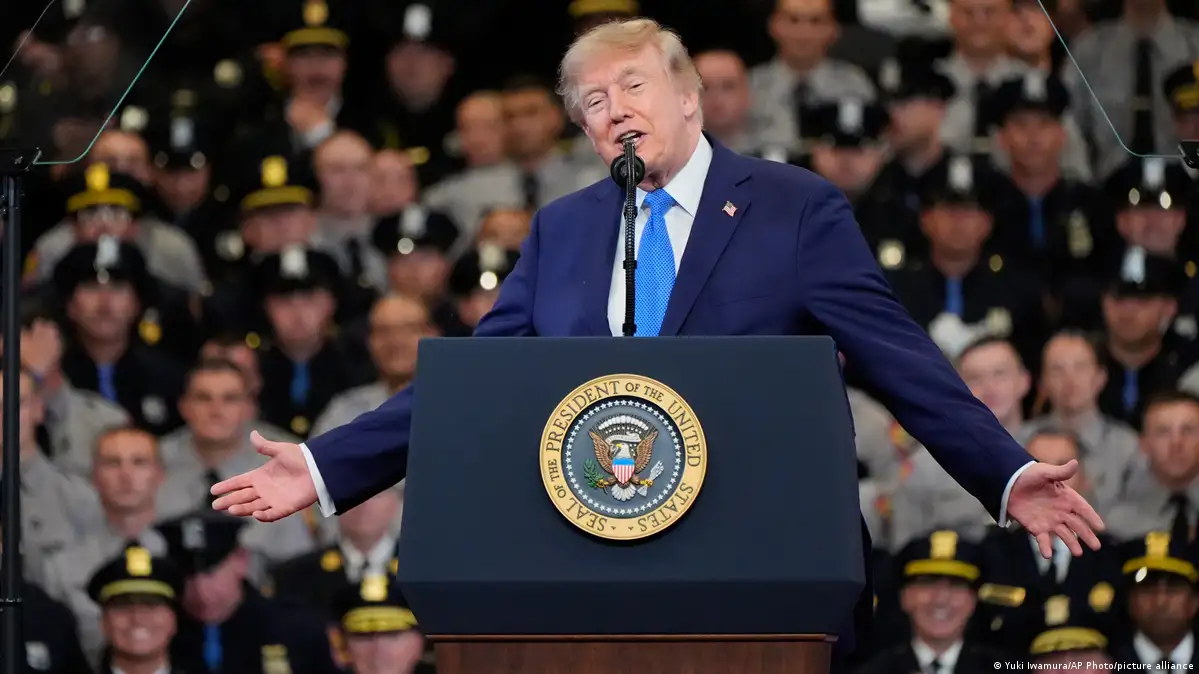
Speaking to supporters in New York on August 14, Trump escalated well beyond the fee proposal, telling the crowd: "After we finish defeating Iran, which is being very badly defeated, pretty soon I'll be declaring the Hormuz Strait a territory of the United States." The remark, delivered without elaboration on legal or military mechanics, was covered widely by US and international outlets, from CNN and NBC News to Al Jazeera and Fox News, and quickly became the dominant story of the war's latest phase.
The claim runs directly against the international legal framework governing the strait. Under the law of the sea, no single state owns or controls the Strait of Hormuz: its navigable shipping lanes run through the territorial waters of Iran on the north side and Oman on the south, but because it is recognized as an international strait used for global navigation, it is subject to UNCLOS's transit-passage regime, which overrides normal territorial sovereignty and guarantees free passage to all vessels, including warships. Analysts and international-law scholars have pointed out that a US declaration of "territory" over the strait would have no recognized legal standing and would mark an extraordinary and unprecedented assertion of unilateral control over a waterway that borders two sovereign states, neither of which is the United States.
The statement lands amid a period of intensified, unresolved fighting rather than a clear military resolution that would make Trump's "after we finish defeating Iran" framing operative any time soon. Ship attacks in and around the strait have continued through August: the Abu Dhabi National Oil Company (ADNOC) reported one of its vessels was attacked while transiting Hormuz on August 14, part of a pattern the UK Maritime Trade Operations organization says includes at least 20 reported projectile-strike incidents on shipping since early July, causing bridge, engine-room and structural damage. Traffic through the strait has collapsed to a fraction of pre-war levels — as few as eight to fifteen vessels a day in early August, compared with roughly 130 transits daily before the war. War-risk shipping insurance premiums have surged to between 3 and 10 percent of a vessel's hull value, up from about a quarter of one percent before the conflict, and very large crude carrier charter rates on the Middle East-to-Asia route are approaching $500,000 a day. Brent crude has climbed to roughly $89–90 a barrel, up about 24 percent since the war began in late February.
Diplomatically, the picture is muddled. Oman has spent more than three weeks mediating talks between Washington and Tehran aimed at reopening the strait, and by early August the two sides had reportedly reached broad agreement on proposed inbound and outbound shipping lanes. But on August 15 — the day after Trump's New York remarks — Iranian officials said any Oman-brokered arrangement to reopen the strait remained contingent on the United States first lifting its naval blockade of Iranian ports, underscoring that a comprehensive deal is not yet in hand despite periodic optimistic signals from both sides over the preceding two weeks.

Reactions
Iran's response was swift and dismissive. Deputy Foreign Minister Kazem Gharibabadi said the strait, which handles roughly a fifth of the world's oil, "cannot be seized with a tweet, nor with an aircraft carrier, nor by issuing an order, nor through an election speech," and insisted it "will remain Iranian." Iranian state and semi-official media described Trump's comments as "delusions," and parliament speaker Mohammad Bagher Ghalibaf — who has repeatedly cast the broader war's outcome as an Iranian "genuine victory" on both military and political fronts — used the moment to reinforce Tehran's narrative that Washington has failed to achieve its aims despite months of bombing.
In Washington, reaction broke along familiar lines but was notably light on full-throated Republican defense of the specific territorial claim. Democratic Representative Ted Lieu of California mocked the announcement, quipping, "Awesome! And the Easter Bunny is real." Legal commentators and maritime-industry voices reiterated that any attempt to toll or annex the strait would be widely viewed as illegal under international law and would open, as one analysis put it, "a very dangerous Pandora's box" for freedom-of-navigation norms globally, given that dozens of other international straits — from the Bosphorus to the Strait of Malacca — rely on the same transit-passage principle Trump's claim would undermine.
Gulf states, several of which have been directly targeted by Iranian strikes over the course of the war, have continued to avoid joining the US-Israeli military campaign, prioritizing restraint and diplomacy over escalation, even as they quietly lobby Washington — as they did successfully against the 20 percent fee in July — to avoid measures that could further destabilize regional trade and energy markets. Saudi Arabia has been described by Trump himself as believing a broader US-Iran deal is "imminent," and Riyadh was among the governments that reportedly urged the US to call off a larger planned bombing campaign against Iranian energy infrastructure earlier in the month.
What's Next
The immediate test is whether the Oman-mediated talks can convert "broad agreement" on shipping lanes into an actual reopening of the strait, and whether Iran's demand to end the US naval blockade first proves a bridgeable gap or another stalling point in a negotiation that has already cycled through multiple false dawns since June. Trump's declaration adds a new and legally fraught variable to that process: it is unclear whether the administration intends to pursue the territorial claim through any formal mechanism, or whether it functions primarily as leverage and domestic political messaging aimed at a war that has dragged on far longer, and with far less resolution, than the administration originally suggested it would.
Regionally, the strait's near-paralysis continues to impose real costs — on global energy prices, on shipping and insurance markets, and on the Gulf economies that depend on tanker traffic — regardless of how the territorial rhetoric resolves. Any formal US move to assert control over the waterway would almost certainly draw immediate condemnation not just from Iran and Oman but from the broader international community and shipping industry, given the precedent it would set for freedom of navigation elsewhere in the world. For now, the practical situation on the water — sporadic attacks, diverted tankers, soaring insurance costs and a fraction of normal traffic — remains unchanged, even as the political rhetoric around who will ultimately control the strait grows more extreme.
Published By | News Editor