The 12th International Architecture Biennale Rotterdam opens in a former blind factory built on the site of a 1716 quarantine hospital. Its centrepiece is a 4,980-kilo sandstone carving that has not been properly displayed in over a century.
ROTTERDAM
Some exhibitions borrow objects. This one repatriates one. Tomorrow, when the 12th International Architecture Biennale Rotterdam opens its doors, visitors will walk into a former industrial hall in Feijenoord and find a 9.4-metre sandstone tympanum, more than two metres high and weighing 4,980 kilos, standing roughly where it was installed in 1717. It has taken 309 years and a biennale to get it back.
The stone
The tympanum was carved for Rotterdam's plague house — a quarantine hospital built on what was then a sandbank in the river, deliberately sited far outside the crowded city. Seven family coats of arms, belonging to members of the old Rotterdam city council, run across its face. Two river gods flank them, a reference to the Maas and the Rotte and the water that made and threatened the city in roughly equal measure.
The building was completed in 1716 and never served its intended purpose; no plague arrived to fill it. Over the following centuries it was repurposed repeatedly, and in 1825 the Nederlandsche Stoomboot Maatschappij set up on the site, beginning Feijenoord's long transformation into one of Rotterdam's great industrial districts. The plague house disappeared around 1900. The tympanum survived, entering the collection of Museum Rotterdam in 1910, where its sheer size and mass have kept it largely out of public view ever since.
"It is fantastic that a masterpiece from our city history collection can once again be fully displayed after more than a hundred years," said Rob Noordhoek, conservator at Museum Rotterdam. "Its immense size and weight had always made this a challenge. It is especially wonderful that it is returning to the very place it came from." The stone stays in the museum's collection, on long-term loan.
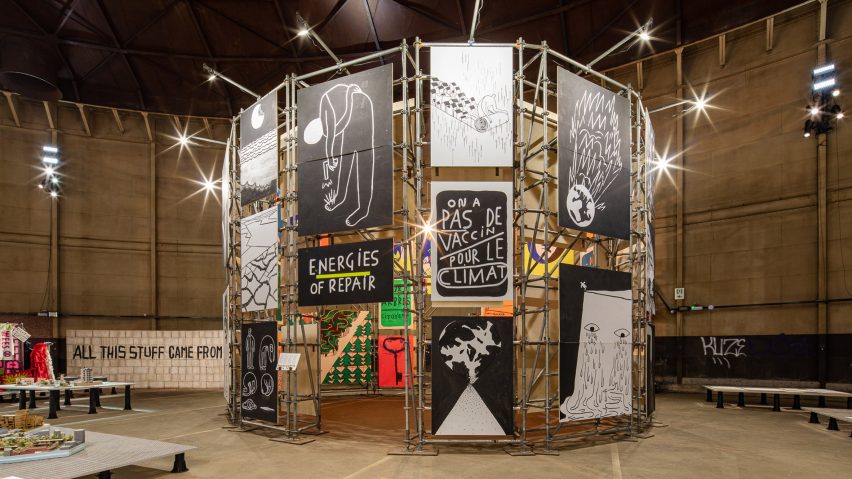
It is not displayed as heritage, either. The tympanum is embedded in an installation by the architecture studio LNML interrogating the use and reuse of stone — a 1717 carving pressed into service as evidence in a contemporary argument about material supply.
Systems of Support
That move is characteristic of the whole edition. The biennale, running from 18 September to 29 November, is titled SYSTEMS OF SUPPORT, and it is about infrastructure in the broadest sense: water, energy, materials, housing, mobility — the systems that make ordinary life possible and that are, almost all of them, under strain.
The curatorial team is unusually heavyweight. Chief curator Wouter Veldhuis co-founded the design office MUST and served from 2020 to 2025 as the Netherlands' Chief Government Advisor on the Physical Living Environment, advising under the slogan "The 22nd century starts now." Carola Hein holds the chair in History of Architecture and Urban Planning at TU Delft and the UNESCO Chair in Water, Ports and Historic Cities. Martina Muzi leads the Technogeographies studio at Design Academy Eindhoven. Saskia van Stein is IABR's general and artistic director.
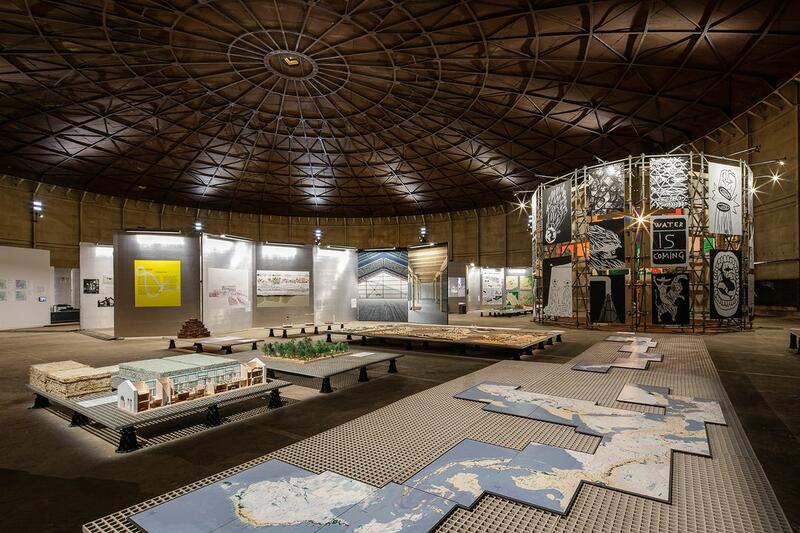
More than fifty designs, research projects, installations, films and spatial presentations make up the exhibition, drawn from the Netherlands and abroad. The ambition is not to catalogue failure but to demonstrate alternatives: what becomes possible when designers question and redesign systems rather than decorating their outputs. A public programme of symposia and tours runs alongside, announced in phases through the autumn.
One project has already generated its own campaign: a petition titled "Sign Now! Right to Housing! Now and Forever," circulated by participants ahead of the opening — a reminder that this is an advocacy platform rather than a trade fair.

The venue is the thesis
The exhibition is staged in the Piekfabriek, at Piekstraat 2, on the former Hunter Douglas site — the complex best known in the Netherlands for manufacturing Luxaflex blinds, and further back for warship work. It sits on the exact ground the plague house occupied. Before that, the sandbank served as the gallows field of the Rotterdam Admiralty from the end of the sixteenth century.
So the site has cycled through execution, quarantine, steamships, blinds and now a biennale — and is about to cycle again. The Hunter Douglas terrain is at the front end of a major redevelopment into a district of housing, workplaces and amenities. Which makes the location less a backdrop than an argument.
"Understanding the history of a place helps us understand what futures are possible," said Saskia van Stein. "The Piekfabriek shows how the industrial past does not have to disappear, but can instead provide inspiration and identity for a new neighbourhood in our city."
The IABR has made this case for more than twenty years, convening designers, researchers, policymakers, institutions and residents around spatial questions. What is new is how much of the talking the venue does. The building raises the edition's themes without a wall text: where the housing goes, where the energy comes from, what happens to the materials already standing on the site, and who in the surrounding neighbourhood benefits from the answer.
Why this matters beyond Rotterdam
Architecture biennales have a reputation, not undeserved, as places where the profession talks to itself in a decommissioned building. This edition attempts something narrower and more useful: making the invisible systems behind a home legible to the people living in one.
The themes are not abstract anywhere. Housing shortages, grid constraints, water management and the carbon cost of construction materials are live political questions across Europe and beyond, and the Netherlands — a country that has spent eight centuries negotiating with water and is now negotiating with its own electricity network — is a reasonable place to watch the arguments tested at full scale.
The reuse question has a direct domestic echo. Anyone who has tried to renovate rather than demolish, source reclaimed material rather than new, or keep a building's structure while changing everything inside it has hit the same economics the LNML stone installation is picking at. It is nearly always cheaper to start over. The case for not doing so is being made this autumn by a factory that refused to be knocked down and a piece of a hospital that was never needed.
A carving, returned
Tickets are on sale; the exhibition runs to the end of November. The temptation, for anyone visiting, will be to treat the tympanum as the gift shop of the show — the picturesque object among the diagrams.
That would be a mistake. Seven coats of arms belonging to men who governed Rotterdam three centuries ago, carried by two river gods, carved for a hospital built to hold people the city wanted at a distance, standing in a factory about to become housing. If SYSTEMS OF SUPPORT has a single exhibit, it is that one — and it took a crane to install it.
Published By | Features Editor