Written By | International News Agencies
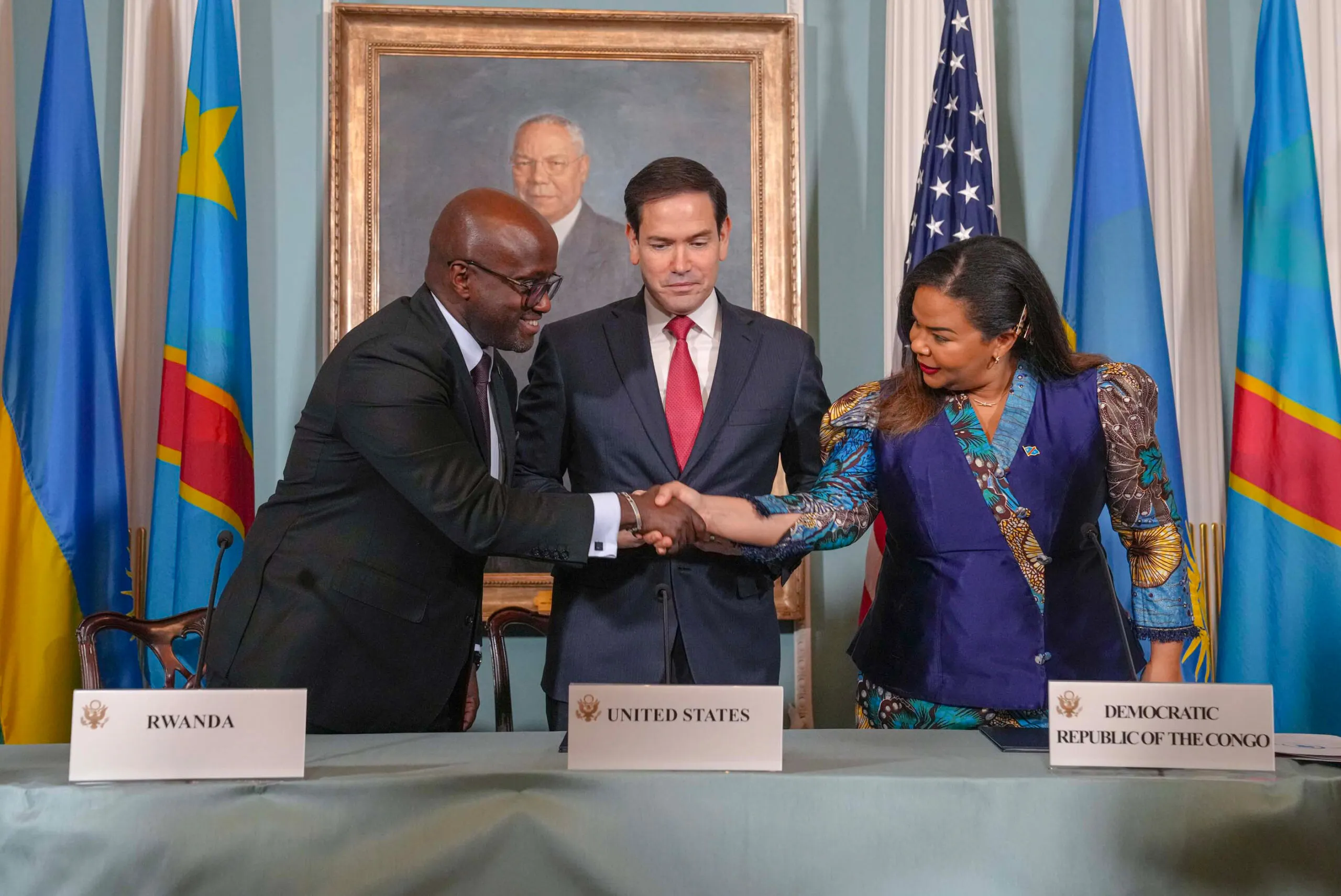
Delegations from the Democratic Republic of the Congo and Rwanda sat down in Geneva on Wednesday for a two-day session
Kinshasa/Kigali/Geneva
Delegations from the Democratic Republic of the Congo and Rwanda sat down in Geneva on Wednesday for a two-day session that diplomats and analysts alike are calling the most consequential checkpoint yet for the Washington Accords, the U.S.-brokered peace framework that was supposed to end nearly three decades of conflict in eastern Congo. The talks, convened under the Joint Security Coordination Mechanism (JSCM), come amid renewed fighting in North and South Kivu provinces, dueling accusations of bad faith between Kinshasa and Kigali, and a rebel drone strike that has cast fresh doubt on whether the accords can survive contact with the war they were designed to end.
The stakes could hardly be higher. More than a year after President Felix Tshisekedi of the Democratic Republic of the Congo and President Paul Kagame of Rwanda signed the Washington Accords for Peace and Prosperity on June 27, 2025 — a deal reaffirmed in a formal signing ceremony in Washington on Dec. 4, 2025 that was championed by the Trump administration and witnessed by Kenyan President William Ruto — the core security bargain at the heart of the agreement remains unresolved. Congo has not neutralized the Democratic Forces for the Liberation of Rwanda (FDLR), an armed group with roots among Hutu fighters who fled Rwanda after the 1994 genocide, to Kigali's satisfaction. Rwanda has not fully disengaged its forces or lifted what it calls defensive measures along the border, to Kinshasa's satisfaction. Each side blames the other for the impasse, and the fighting on the ground has not stopped.
What the Geneva session is meant to resolve
The Joint Security Coordination Mechanism, staffed with representatives from both governments along with mediators from the United States, Qatar, Togo and the African Union Commission, exists specifically to referee disputes over implementation of the Washington Accords. Wednesday and Thursday's session in Geneva follows an Aug. 12-13 round in which the two sides agreed to advance joint monitoring and verification mechanisms; Congo also presented its long-awaited disarmament, demobilization and reintegration (DDR) plan for the FDLR at that meeting, and the parties penciled in an October trilateral planning conference to build on it.
But the goodwill generated in August has since curdled. On July 28, Congo's government announced that a faction of the FDLR had accepted a disarmament protocol — a development Kinshasa presented as evidence of progress. Rwanda rejected that framing outright, arguing that the Washington Accords require the FDLR to be neutralized, not negotiated with, and accusing Congo of continuing to tolerate or even support the group's presence on its territory. Kagame has since called the FDLR neutralization effort "insufficient." Congo's Minister of Information, Patrick Muyaya, pushed back directly, telling reporters that "the work of neutralizing the FDLR through demobilization is being carried out in accordance with the Washington agreements" — a sign of just how differently the two governments are reading the same document.
That dispute sits atop a more fundamental disagreement that has bedeviled Congolese-Rwandan relations for years: Rwanda wants binding guarantees that armed groups hostile to it — chiefly the FDLR — cannot operate from Congolese soil, while Congo regards any continued Rwandan military presence or influence inside its borders, even framed as a defensive necessity, as a violation of its sovereignty. Kigali has long said its troops entered eastern Congo to counter the FDLR threat; Kinshasa and independent monitors have accused Rwanda of using that justification to support the M23 rebel movement, a charge Rwanda denies.
A parallel track, and a rebel group that answers to neither government
Complicating the Geneva talks is the fact that M23 — the rebel movement that seized the provincial capital Goma in January 2025 and later took Bukavu, and which now controls large stretches of North and South Kivu under the banner of the Congo River Alliance (AFC-M23) — is not a party to the Washington process at all. Its fighters are addressed through a separate, Qatar-mediated track rooted in a framework agreement signed in Doha in November 2025.
That track produced its own breakthrough on Aug. 23, when Congolese and AFC-M23 negotiators, meeting in Switzerland from Aug. 17-21 alongside mediators from the United States, Qatar, Togo, Switzerland and the African Union, announced a roadmap setting out sequenced steps and timelines for further negotiations. The roadmap includes a standardized method for reporting ceasefire violations and a mechanism to resolve disputes over implementation of the Doha framework. It also called for a ceasefire verification mission to deploy to Minembwe, in South Kivu — a deployment that was scheduled to begin the following Monday.
The announcement was immediately overshadowed by violence. AFC-M23 spokesman Lawrence Kanyuka said that on the very day the roadmap was announced, Congolese forces carried out drone strikes on Minembwe that caused "civilian casualties and significant damage to civilian infrastructure," an allegation Kinshasa has not substantively addressed in public statements reviewed for this story. The rebel alliance has separately accused the Congolese army of attacking civilians and violating the ceasefire more broadly, even as fighting continues across both Kivu provinces.
The human toll behind the diplomacy
The scale of suffering underlying the negotiations is difficult to overstate. An estimated 5.3 million people have been displaced by the conflict in eastern Congo, and thousands have been killed in the fighting since M23's renewed offensive began. The crisis has been compounded by a concurrent Ebola outbreak that has killed roughly 2,500 people since it began in May 2026, according to figures cited alongside the August roadmap announcement — a grim reminder that Congo's war and its humanitarian emergencies are now feeding one another, as displacement camps strain health systems and combat disrupts outbreak response.
Hervé Amani, a civil society activist quoted in regional reporting on the Geneva talks, captured the mood among Congolese observers: dialogue remains preferable to escalation, he said, but deep mistrust persists between the two governments — mistrust that no single meeting, however high-profile, is likely to dissolve.
Why Washington — and the minerals question — loom over the talks
The Trump administration's direct involvement in brokering the Washington Accords reflected an economic as well as a security calculation. Eastern Congo sits atop vast reserves of cobalt, tantalum, tin and other minerals critical to global electronics and battery supply chains, and the accords were explicitly framed by U.S. officials as opening the door to regional economic integration alongside a security settlement — a sequencing that has fueled skepticism among some Congolese critics who fear resource access is being prioritized over a durable end to the fighting. A State Department official said in connection with the accords that they "reaffirm the parties' commitment to implement the Peace Agreement" and to pursue regional economic integration, language that underscores how closely security guarantees and investment prospects have been bundled together in Washington's approach.
What to watch next
Three things will determine whether the Geneva round amounts to more than a diplomatic pause. First, whether Congo and Rwanda can agree on a shared, verifiable definition of FDLR "neutralization" — the single issue that has derailed progress twice in the past two months. Second, whether the Minembwe ceasefire verification mission under the Doha track actually deploys and holds, given the drone-strike allegations that emerged the moment the roadmap was signed. Third, whether the promised October trilateral planning conference takes place on schedule and produces enforcement mechanisms with teeth, rather than another round of dueling statements.
For the millions of displaced Congolese and for a region where two previous wars already killed millions of people between the 1990s and 2000s, the diplomatic choreography in Geneva is not an abstraction. It is, for now, the only alternative on offer to a conflict that mediators, rebels and governments alike agree has already gone on far too long — even as none of them can yet agree on how to end it.
Analysts following the process say the structural problem is that the Washington Accords and the Doha framework, while formally separate, cannot succeed in isolation from one another. Congo's government has consistently argued that it cannot be expected to fully implement security guarantees toward Rwanda while M23 — which Kinshasa and independent researchers say receives support from Rwandan forces, a charge Kigali denies — continues to hold Goma and Bukavu and expand its territorial control in the Kivus. Rwanda, for its part, has resisted linking the two tracks formally, wary that doing so would let Congo use the M23 dispute as leverage to slow-walk FDLR neutralization indefinitely. That structural standoff, more than any single technical disagreement over verification protocols, is what mediators in Geneva are ultimately trying to break.
There is also a domestic political dimension on both sides of the border. Tshisekedi faces pressure at home from Congolese lawmakers and civil society groups who view any accommodation with Kigali as a betrayal, given widespread public anger over M23's territorial gains and the humanitarian catastrophe that has followed. Kagame, for his part, has built much of his government's regional standing on the claim that Rwanda's security posture toward Congo is a defensive necessity rather than an act of aggression — a framing that both the roadmap negotiations and any eventual FDLR neutralization will be measured against by his domestic audience as much as by international observers.



