Written By | Staff Writer
The oil sector itself is the mechanism behind most of that projected acceleration
Uganda's oil sector is approaching the milestone the country has anticipated for more than a decade: first commercial crude production from its Lake Albert fields, targeted for late July 2026, with the first export cargoes expected to leave via the East African Crude Oil Pipeline (EACOP) in October. The story dominating Uganda's business pages this month is not simply the arrival of oil revenue, but the tension between an economy whose official growth outlook increasingly leans on that single sector, and a legal and environmental reckoning over how the pipeline that will carry that oil to market was built.
The headline economic numbers are, on their face, encouraging. Uganda's gross domestic product is projected to reach roughly $66 billion in 2026, and the Bank of Uganda and government planners expect real GDP growth to accelerate sharply to 10.2 percent in the 2026/27 financial year, a jump attributed substantially to first oil production coming online. The country posted a balance of payments surplus of $2.47 billion in the twelve months to March 2026, the largest in fifteen years, driven by rising exports and stronger investor confidence. The Ugandan shilling has been the best-performing currency in the East African Community against the US dollar in recent months, appreciating 1.9 percent between May and June 2026 alone. Business sentiment indicators tell a similar story: the Purchasing Managers' Index and Business Tendency Index averaged 53.7 and 57.6, respectively, across the first three quarters of the 2025/26 financial year, both comfortably above the 50-point threshold that separates expansion from contraction.
Underneath those headline figures, however, growth has actually been cooling. The economy expanded 5.8 percent year-on-year in the third quarter of the 2025/26 financial year, according to the Uganda Bureau of Statistics, down sharply from 8.5 percent growth in the same quarter a year earlier. Inflation has also ticked upward, from 3.2 percent in May 2026 to 3.7 percent in June, driven largely by higher transport and energy costs tied to rising international oil prices amid tensions in the Middle East — a reminder of how exposed Uganda's own economy remains to global energy markets even as it prepares to become an oil producer itself. Even so, inflation remains within the Bank of Uganda's medium-term target of 5 percent, and officials continue to describe the broader outlook as robust heading into the new financial year.
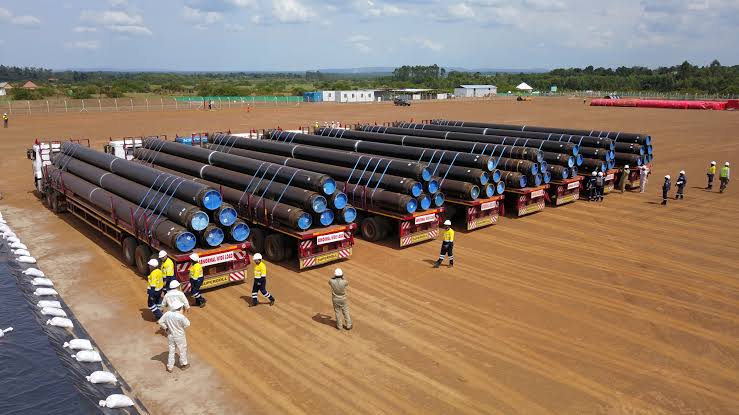
The oil sector itself is the mechanism behind most of that projected acceleration. Uganda's two flagship upstream developments are TotalEnergies' Tilenga project, a roughly 190,000-barrel-per-day operation spread across six onshore fields holding an estimated 836 million barrels of recoverable reserves, and the China National Offshore Oil Corporation's (CNOOC) Kingfisher project, holding an estimated 214 million barrels. Together, the Lake Albert developments are expected to reach a plateau production rate of 230,000 barrels per day within two years of first oil, sustained for five to six years. Getting that crude to international markets depends on the 1,443-kilometer EACOP, which will carry Ugandan crude to the port of Tanga on Tanzania's coast, with a peak carrying capacity of 216,000 barrels per day.
Progress on the ground has been uneven across the three linked projects. As of the most recent reporting, EACOP construction stood at roughly 79 percent complete, keeping first exports on track for October 2026. Kingfisher, the CNOOC-operated field, is further along, sitting above 90 percent completion and widely seen by industry analysts as the likely starting point for Uganda's actual first oil. Tilenga, the larger TotalEnergies-led development, is lagging at just above 60 percent completion, a gap analysts describe as the single most critical bottleneck standing between Uganda and its July 2026 first-oil target. Trade publications including African Energy and Enerdata have both flagged the Tilenga shortfall as the swing factor in whether the timeline holds through the second half of the year.
The other half of the story is the mounting legal and social cost of building that infrastructure. On July 7, 2026, four Ugandan farmers filed a lawsuit in the High Court in London against the East African Crude Oil Pipeline project, adding a new international legal front to years of local criticism. More than 100,000 people, the great majority of them farmers, have been displaced to make way for the pipeline and its associated infrastructure, according to figures cited in the reporting on the case. The pipeline's route crosses sixteen protected natural areas and passes through the Lake Victoria Basin, a watershed that more than 40 million people across the region depend on for water. The Tilenga and Kingfisher fields themselves sit adjacent to Murchison Falls National Park, Uganda's largest protected area, a proximity that has drawn years of objection from conservation groups worried about the risk of spills and habitat disruption in one of East Africa's most significant wildlife reserves.
TotalEnergies, which operates Tilenga and holds a substantial stake in EACOP, has published material describing its resettlement and compensation program as transparent and says it has worked to address concerns raised by displaced communities and civil society groups. Critics, including the farmers now suing in London, argue that compensation has in many cases been inadequate or delayed, and that the scale of displacement has not been matched by adequate remedy. The case joins earlier legal challenges brought in French and East African courts against the pipeline in recent years, none of which have so far halted construction.
Separately, Uganda's downstream oil ambitions continue to take shape alongside the upstream projects. Reporting from Pan African Visions indicates Uganda's planned oil refinery remains on course even as Nigerian conglomerate Dangote expands its own refining footprint into East Africa, a development that could eventually reshape regional fuel supply chains and competition once Uganda's own refining capacity comes online.
Why this matters: Uganda has waited since the discovery of commercially viable oil reserves around Lake Albert in 2006 for this moment, and the revenue implications are substantial for a government budget that has long depended heavily on donor support and domestic taxation. A successful first-oil milestone this year would validate nearly two decades of negotiation, infrastructure planning, and financing arrangements involving TotalEnergies, CNOOC, the Ugandan and Tanzanian governments, and a consortium of regional and international lenders. But the London lawsuit signals that the human and environmental costs of reaching that milestone remain contested, and that Uganda's oil story will continue to be told in courtrooms as well as in GDP forecasts.
What to watch next: whether Tilenga closes its completion gap with Kingfisher quickly enough to preserve the late-July first-oil target; whether the October export timeline through EACOP holds; how the London High Court proceeds with the farmers' case and whether it prompts any change in compensation practices; and whether the anticipated oil-driven growth acceleration to 10.2 percent in the 2026/27 financial year materializes as forecast, or whether the same global oil-price volatility now pushing up Uganda's own inflation ends up complicating the economics of the country's newest export industry.



