Written By | Sports Desk
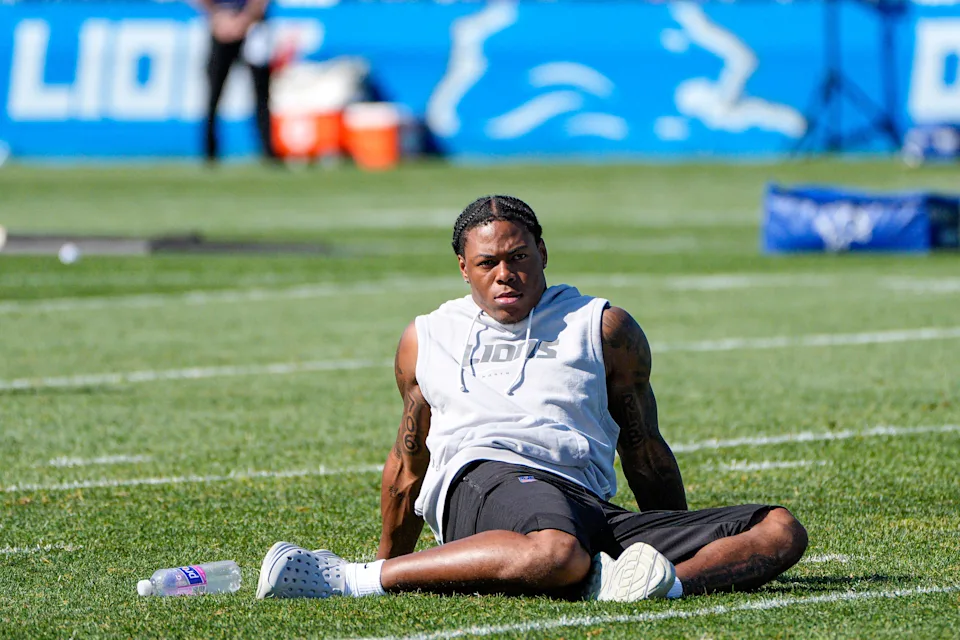
Detroit's do-it-all back landed a $67.5 million extension that toppled Bijan Robinson's six-day-old record, forcing the NFL to reckon with how it values its most versatile weapons.
DETROIT
For exactly 148 hours, Bijan Robinson held the title of the highest-paid running back in NFL history. Then Jahmyr Gibbs picked up the phone.
On Aug. 6, the Detroit Lions and their 24-year-old dynamo agreed to a three-year extension worth up to $75.75 million, including a base of $67.5 million and $51.5 million guaranteed — figures that work out to $22.5 million per year, just enough to edge past the $22.25 million average Robinson secured from the Atlanta Falcons on Aug. 4. It is the second time in less than a week that the position's pay ceiling has been rewritten, and the second time a young, pass-catching, home-run-hitting back has forced a front office's hand rather than the other way around.
For years, the conventional wisdom in NFL circles was that running backs were interchangeable, disposable, replaceable by a rookie on a fourth-round contract. Gibbs and Robinson, drafted a year apart and now forever linked by their leapfrogging contracts, are the clearest rebuttal yet.
A Deal Years in the Making
Detroit never really had a choice. Since arriving as a first-round pick out of Alabama in 2023, Gibbs has made three Pro Bowls, caught more than 50 passes in each of his first three seasons, and averaged an eye-popping 5.3 yards per carry. Along the way he broke a Barry Sanders franchise record, reaching 49 total touchdowns before his 24th birthday — a mark the Lions legend himself needed longer to hit.
Gibbs plays running back the way modern offenses actually want the position played: as a receiver who happens to also carry the ball 200-plus times a season, a matchup nightmare who can line up in the slot, motion out of the backfield, and turn a screen pass into a 60-yard house call. That versatility is precisely why his camp could argue, credibly, that he belongs in a different pay bracket than the bruising, early-down-only backs the market has historically undervalued.
Negotiations were not without friction. Gibbs skipped portions of the offseason program and admitted afterward that the process "was extremely stressful," telling reporters he "just wanted to play ball" rather than spend the summer as a storyline. General manager Brad Holmes and head coach Dan Campbell, for their part, were reportedly caught off guard when details of the talks leaked onto social media before the deal closed — a modern negotiating hazard that has become almost routine in the smartphone era of team-building.
None of that friction shows in the aftermath. "I love being here. I'm glad I get to be here for the next five years," Gibbs said once the extension was finalized, locking him into Detroit's plans through the 2030 season — a statement of both relief and genuine affection for a Lions culture that has, under Campbell, transformed from perennial punchline to perennial contender.
Robinson's Record, Briefly
The contract's timing is what makes it a story rather than just a transaction. Robinson's $22.25 million-per-year deal with Atlanta, announced after a brief training-camp hold-in, was framed at the time as a landmark — the moment the Falcons locked up the league's most electrifying young runner and reset the position's economics for the first time in years. Robinson had led the NFL in scrimmage yards in 2025 with 2,298, an absurd figure for a player who didn't even start every game as a rookie.
Six days later, Gibbs' camp used that exact number as the floor, not the ceiling. League executives and agents describe this kind of rapid one-upmanship as increasingly common at premium positions, but it is almost unheard of for a group — running backs — that spent the better part of a decade being told there was no market left to reset.
Why It Matters Beyond Detroit
The Gibbs and Robinson deals arrive at a pivotal moment for the position. As recently as 2023, star backs like Saquon Barkley and Josh Jacobs were forced to play out contract years on the franchise tag, unable to find teams willing to pay top dollar for a job many considered devalued by youth, injury risk, and the rise of committee backfields. Barkley's eventual return to elite form with the Philadelphia Eagles helped shift the conversation; Robinson and Gibbs' back-to-back deals may be the clearest sign yet that the shift has stuck.
"This resets the market once again," multiple league sources noted following the Gibbs signing, a sentiment echoed across NFL front offices bracing for what comes next. Rising juniors like Ashton Jeanty and Bucky Irving, both entering extension-eligible windows within the next two seasons, are watching closely. So are the agents representing them, who now have two comparable contracts — both north of $22 million annually, both heavy on guarantees — to point to at the negotiating table.
What This Means for Fans
For Lions fans, the calculus is simple: Detroit, fresh off consecutive deep playoff runs, has now locked up its two most explosive offensive building blocks (quarterback Jared Goff's extension came a year earlier) through the back half of the decade, buying the front office runway to build around a core rather than patch holes year to year.
For the league at large, it's a signal that the running back renaissance predicted after Barkley's 2024 resurgence wasn't a blip. Teams that bet against paying their best backs risk losing them the way Atlanta nearly risked losing Robinson to a holdout, or watching a division rival like Detroit set a number they then have to match.
The Bottom Line
Two record-breaking running back contracts in less than a week isn't a coincidence — it's a market correction six years in the making. Whether the pendulum keeps swinging toward the position's biggest stars, or snaps back the moment one of these deals goes sideways, may be next season's biggest storyline. For now, Jahmyr Gibbs is $67.5 million richer, Detroit's backfield is secure through 2030, and the NFL's cheapest position just got a lot more expensive.



