Focus: Mauritania, Senegal, Ghana (West Africa) — small-scale fisheries, fishmeal, access agreements and food security
A deadline in the water
On 14 November 2026, the protocol that lets European vessels fish in Mauritanian waters expires. The agreement, in force since 15 November 2021, allows vessels flagged in ten EU member states to take up to 280,050 tonnes a year of shrimp, demersal fish, tuna and small pelagic species, in exchange for an EU financial contribution of €60.8 million a year. Pelagic freezer trawlers hold the largest share of that allocation, 225,000 tonnes a year for a maximum of 19 vessels. With barely two weeks left, no successor has been signed. A fourth negotiating round took place in Las Palmas in June, and on 23 October the industry association Europêche asked EU Fisheries Commissioner Costas Kadis for an extension of at least six months, warning that its fleet has "no alternative fishing grounds."
The headline is about European boats, but the larger story is about who captures the value of one of the world's richest upwelling systems, and whether that value turns into jobs, protein and public revenue on the West African coast. Across Mauritania, Senegal and Ghana, governments in 2026 are pulling different levers on the same problem: stocks of small pelagic fish such as sardinella are overexploited, coastal communities depend on them for income and nutrition, and the continent's need for fish is growing faster than its supply.
The arithmetic of scarcity
The Food and Agriculture Organization's State of World Fisheries and Aquaculture 2026 (SOFIA), launched in Mombasa, sets the continental context. Global fisheries and aquaculture output reached a record 235 million tonnes in 2024, including 195 million tonnes of aquatic animals, and world per-capita consumption hit a record 21.3 kg. Africa sits well below that line. According to coverage of the report's regional findings, African capture fisheries produced about 10.8 million tonnes in 2024, roughly 12% of global capture, of which marine capture contributed 7.1 million tonnes. Morocco led with nearly 1.4 million tonnes, followed by Mauritania, Angola, Senegal and South Africa. Yet average per-capita availability of aquatic food in Africa was only about 9.1 kg, less than half the world average.
The forward-looking figure matters even more. FAO estimates that Africa must raise aquatic food supply by 67% by 2050 just to hold per-capita consumption at today's level, compared with a 19% increase needed globally. And the stock base is under strain: worldwide, 62.4% of assessed marine stocks are fished within biologically sustainable limits, meaning almost 38% are overfished. In West Africa, the small pelagics that feed the coast have long been flagged as overexploited by the regional scientific working group under FAO's Fishery Committee for the Eastern Central Atlantic.
Put simply, the region is trying to feed a fast-growing population from a resource that is already fully used, while a large share of the catch leaves as frozen exports, fishmeal or fish oil. That is the tension every policy decision of 2026 is trying to manage.

Mauritania: shutting down the fishmeal boom
Mauritania offers the clearest example of a government reversing a policy that once looked like industrialisation. In the late 2000s and 2010s, fishmeal plants were welcomed as a way to process catch onshore. By 2015, 35 plants were authorised; by 2021 there were 44, giving the country, at the boom's peak, the second-highest number of fishmeal plants in the world after Peru. Production reached 111,866 tonnes of fishmeal in 2017, 124,961 tonnes in 2018 and 128,789 tonnes in 2020. Because it takes roughly 5 kg of raw fish to make 1 kg of fishmeal, the plants were consuming an enormous share of landings; in 2021, more than half of the country's total pelagic catch went to fishmeal, according to an investigation published by Mongabay in January 2026. About 68% of fishmeal and fish oil exports by volume went to China in 2023.
The reversal began with a 2015 sector strategy that criticised the industry's "uncontrolled development," followed by plant-level quotas in 2016, a May 2021 decree requiring freezing capacity and banning round sardinella, horse mackerel, chub mackerel and yellow mullet from fishmeal, a 2022 extension of the ban to flat sardinella and bonga shad, and a November 2022 small pelagics management plan that pushed large vessels and fishmeal-supplying pirogues out of inshore waters. No new fishmeal licences have been issued since 2021. The number of purse seiners operating in Mauritanian waters fell from 59 in 2022 to 40 in 2023 and 32 in 2024.
The results are visible. Mongabay's survey found that only eight plants were operating as of September 2025; none of the 14 plants at the PK28 and Port Tanit zones near Nouakchott were active. Fishmeal output fell by more than half from its 2020 peak, to 59,158 tonnes in 2024. A senior fisheries ministry official, Mohamed Ould M'Bareck, put the policy bluntly: "For us, fishmeal production is not value creation, it is destruction." Operators are shifting to freezing fish for human consumption; one plant director said a tonne of fish frozen for food now earns roughly double what it earns as meal.
Implementation is imperfect. Data from Mauritania's oceanographic institute IMROP indicated that banned flat sardinella still made up about 17% of fishmeal inputs in 2023 and 15% in 2024, much of it arriving as "waste fish" from pirogues. Officials acknowledge enforcement gaps and cite social considerations. But the direction is clear: a policy designed to keep more of the catch as food, and to move up the value chain through freezing and processing, rather than grinding it into feed for overseas aquaculture.
That direction shapes the EU negotiation. The European Commission's own assessment noted that EU vessels have used, on average, only about 55% of the fishing opportunities in the current protocol, and has signalled it wants to align quotas more closely with actual use. For Nouakchott, the €60.8 million annual payment, which includes sectoral support for monitoring, science and the fight against illegal fishing, is a meaningful fiscal and institutional resource. The question is whether a new protocol pays for access in a way that reinforces the food-first management plan, or simply prices tonnage.
Senegal: a coast under pressure
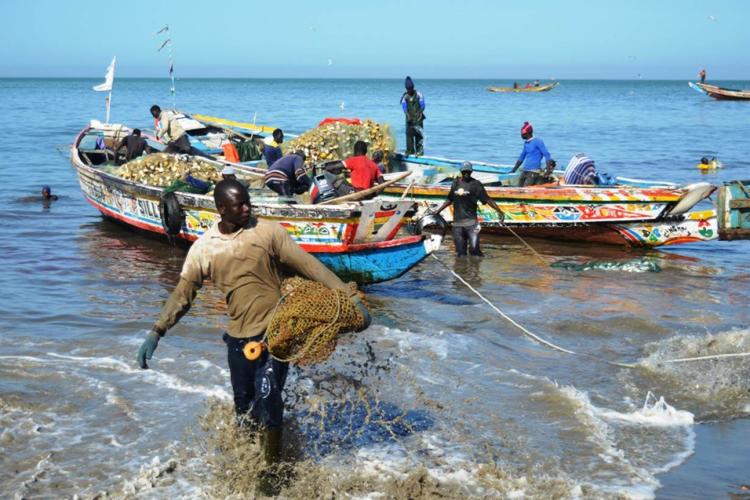
South of the border, Senegal shows what happens when the resource thins faster than the institutions governing it. More than 82,000 people work in fishing according to the latest census information cited by AFP, about 2% of the workforce in 2023, and a much wider web of cart drivers, ice sellers, fishmongers and women processors depends on the landings. Estimates of the artisanal pirogue fleet range from 12,000 to 19,000 canoes. A 2025 report by the Environmental Justice Foundation suggested that 57% of fish populations exploited in Senegal are in a state of collapse. One wharf official in Rufisque told AFP in April 2026 that what a pirogue once caught in two months now takes six or seven.
Several pressures compound. Industrial trawlers, often flagged to Senegal but with beneficial owners who are hard to trace, export much of their catch; EJF's country manager has pointed to fishing in prohibited zones, non-compliant nets, ignored marine protected area rules and "abusive granting of licences." The government's 2024 decision to publish the list of authorised vessels, 151 in total, including 132 national and 19 foreign, was a first step toward transparency, but artisanal fishers' organisations such as CAOPA continue to press for a full audit of fleet ownership. Climate change is also pushing small pelagic species northward, reducing availability off Senegal. And the decline is tied directly to migration: fishing communities have supplied many of the passengers on the dangerous Atlantic pirogue route toward the Canary Islands.
Senegal's fisheries crisis also unfolds against acute fiscal stress, which narrows the state's room to fund surveillance, compensate fishers or invest in cold chains and processing. In practice, that means the country's most important policy tools in 2026 are cheap ones: transparency on licences, enforcement against illegal gear, and regional coordination with Mauritania and The Gambia on shared sardinella stocks.

Ghana: protecting canoes, policing trawlers
Ghana's 2026 approach illustrates the social politics of conservation. Canoe fisheries supply roughly 80% of locally consumed fish and account for about 60% of the nation's animal protein, according to Fisheries and Aquaculture Minister Emelia Arthur. In April 2026 the government exempted canoe operators from the marine closed season, arguing that closing them would cause hardship and trigger a post-closure fishing surge. Industrial tuna vessels observed a closure from 17 March to 30 April 2026; industrial trawlers were closed from 1 July to 31 August; semi-industrial vessels from 1 to 31 July.
Critics, including fisheries scientists, have argued that exempting canoes weakens the biological purpose of the closure, which was extended to artisanal fishers in 2019 after first being applied to trawlers in 2016. The ministry has paired the exemption with a tighter compliance package: prosecution under the Fisheries and Aquaculture Act 2025 for light fishing and dynamite use, Ghana's first marine protected area, tracking and communication systems for canoes, and a promised protection package covering vessel licensing, asset insurance, social security and transparent access to the premix fuel subsidy. Premix dealers were ordered to submit bank statements within 24 hours or face suspension, after audits exposed lapses in the premix fund.
Ghana is also testing whether sanctions on industrial operators bite. Four trawlers had their licences suspended from April 2025 to March 2026 for unauthorised transshipment (the practice known locally as saiko), dumping and juvenile catch, before being reinstated in April 2026; canoe fishers' representatives called the penalty insufficiently punitive.
Three lessons for the region
First, value addition must mean food, not just processing. Mauritania's experience shows that onshore industry can destroy value if it converts edible fish into low-value feed. Freezing, smoking and processing for regional human consumption keep more protein and more jobs, particularly for women processors, on the coast.
Second, access agreements are fiscal and governance instruments, not only trade deals. The EU's €60.8 million a year to Mauritania funds monitoring, research and enforcement capacity that coastal states struggle to finance. Renewals should be judged on whether they reinforce national management plans and regional stock sharing, and whether quotas reflect scientific advice rather than historic allocations that go unused.
Third, protecting livelihoods and protecting stocks are only compatible if fishers get alternatives. Ghana's canoe exemption, Senegal's licence transparency and Mauritania's tolerance of pirogue "waste fish" all reflect the same reality: governments will not impose closures that push hundreds of thousands of households into poverty without compensation, insurance or other income. Social protection for fishing communities, credible enforcement against industrial vessels and investment in aquaculture are the pieces that could break the trade-off.
What to watch
In the coming weeks, the immediate signal is whether Brussels and Nouakchott agree an extension or a new protocol before 14 November, and on what terms for small pelagics. Beyond that, watch whether Mauritania closes the pirogue loophole in its fishmeal rules, whether Senegal follows its licence list with a published audit of beneficial ownership, and whether Ghana's Fisheries Commission data show the canoe exemption has increased pressure on stocks. With FAO projecting that Africa needs 67% more aquatic food by 2050, how West Africa manages its shared sardinella stocks is no longer just a fisheries question. It is a food-security, jobs and migration question.
Published By | Business News Editor