Written By | Entertainment Desk
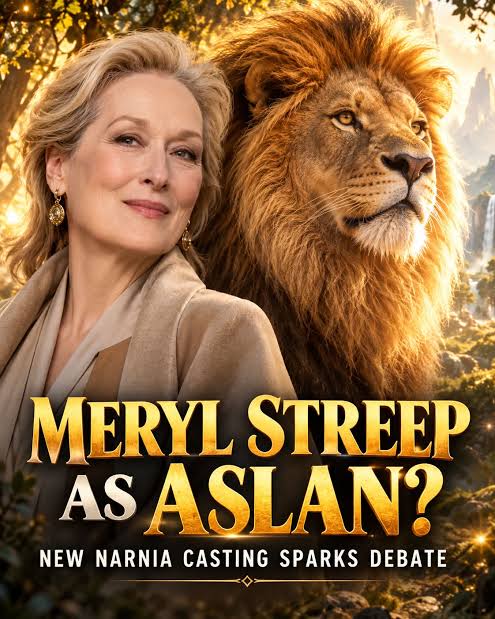
A Netflix film with no public footage yet is already one of the loudest conversations in entertainment.
LOS ANGELES
There is no trailer, no teaser and no poster for Greta Gerwig's Narnia: The Magician's Nephew. There is, however, a casting decision, and it has been enough to set off one of the fall's most heated entertainment debates. Meryl Streep, the three-time Oscar winner, will voice Aslan, the great lion of C.S. Lewis's Chronicles of Narnia, and the reaction has ranged from delight to outrage.
The Netflix production is scheduled for theatrical release in February, according to an Associated Press report published Oct. 4. The casting was announced in late September, and the conversation has only grown since, reaching celebrity headlines again this week.
Why Aslan is different
Aslan is not an ordinary animated lion. Lewis's books treat him as a literary representation of Jesus Christ, and Lewis wrote the character as male. The Magician's Nephew itself was published in 1955. The series has sold about 120 million copies worldwide, and the first volume was published 75 years ago this month, so the anniversary has added extra spotlight.
The AP notes that casting Streep does not necessarily mean Aslan will be female; a woman can voice a male character. Even so, the choice has been read by some as a signal.
The critics
The strongest criticism has come from conservative Christian commentators. Seth Udinsky, in a Christian Post column, called the casting part of a tactic by "enemies of God" to undermine Christian symbols, and claimed Gerwig is making Aslan "transgender," citing a promotional photo showing rainbow-tinted whiskers. Ted Baehr, founder of Movieguide, said a woman voicing Aslan challenges Christian doctrine about the nature of God. He praised Gerwig's directing but said she may not grasp how much the issue matters to Christians, adding, "The Gospel is not a myth."
The AP also reported outrage in replies to Netflix's Instagram post announcing the casting. Another report, from Empire, said Gerwig drew inspiration from David Bowie, whose "bold red-striped visage" informs the lion's design, which the AP says added fuel to the backlash.
The measured voices
Not everyone sees a crisis. Kat Coffin, a Lewis scholar, said she has questions about the casting but is more troubled by people who are violently opposed to any feminine suggestion of God's incarnation. She noted that in the books Aslan appears as a lamb with a "sweet milky voice," which she described as a feminine presentation.
Christin Ditchfield Lazo, an author on Lewis, urged reserving judgment, saying there is a large difference between a woman voicing a male character and a director changing the character's gender. The answer, she said, will come with the film.
Lazo's distinction is useful because it separates two questions that the online debate has often merged: who speaks, and what the character is. The first is a casting choice; the second is a story choice, and only the finished film can answer it.
What Gerwig and the rights holders have said
Gerwig has not directly addressed the gender question. She has said Streep was one of the few actors who could meet her criteria for Aslan's voice, which required depth, wisdom and "fresh wonder." The filmmaker is also moving the story's setting from around 1900 to the 1950s.
Official voices have been supportive. The family of Lewis's late wife, Joy Davidman Gresham, praised Gerwig's "sincere passion" for the Narnia works, and the C.S. Lewis Co., which holds Lewis's intellectual property rights and is a producer on the film, praised her embrace of Lewis's world.
A familiar pattern
Gerwig is known for feminist interpretations in Barbie and Little Women, which makes her a natural lightning rod for debates of this kind. There is also a precedent that cuts the other way: Liam Neeson voiced Aslan in the early-2000s films, which many evangelicals embraced. That earlier casting is a reminder that audiences' comfort with Aslan has often hinged on tone and reverence rather than on any single actor.
The fight also shows how fandom now works. A film's reception begins the moment its casting is announced, and the discussion happens in comment sections long before there is anything to watch. Netflix has the added challenge of selling a theatrical release for a streaming-first company, which raises the stakes of getting audiences on side.
What this means for you
If you grew up with Narnia, this is a chance to revisit the books before the film arrives. The Magician's Nephew, the origin story, explains how Narnia and Aslan's voice came to be, and it is short enough to read in a weekend. If you are a parent planning a family outing in February, it is worth waiting for reviews and trailers rather than forming a view from social media threads.
For viewers who care about the faith dimension, the scholars quoted here suggest patience is the common ground: even those with reservations say the actual film matters more than the announcement. For everyone else, it is a case study in how a single casting choice can dominate a news cycle.
The bottom line
Streep's Aslan will be judged by one thing in the end: how it sounds when the lion speaks. Until then, the debate says as much about how we feel about beloved stories as it does about this one. The film arrives in February, and the voice, finally, will get to answer for itself.



