LONDON
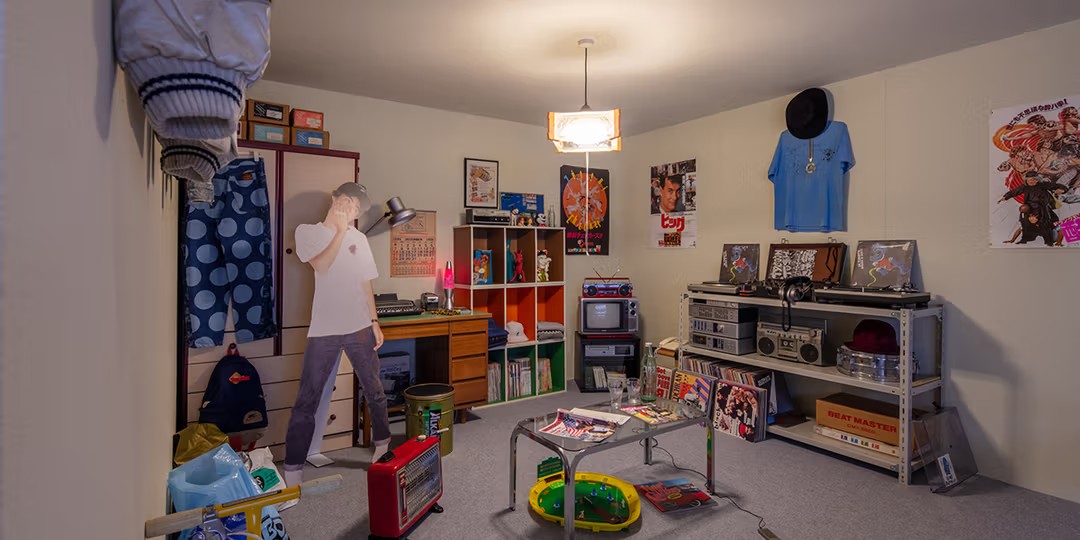
Walk into the Design Museum in Kensington this summer and you won't find a typical fashion retrospective of mannequins in glass cases. You'll find, among other things, a life-size glass tea house, ceramics hand-thrown by the exhibition's subject, and — most disarming of all — a full recreation of a teenage bedroom in suburban Japan, walls plastered with cassette tapes, sneakers and American pop culture ephemera. This is "NIGO: From Japan with Love," running May 1 through October 4, 2026, and it is, by design, less a survey of clothing than an attempt to map the interior world of one of the most quietly influential creative figures of the last three decades.
NIGO — born Tomoaki Nagao, though he has long operated under the single mononym — is not a household name in the way that, say, Virgil Abloh or Kim Jones became. But within the worlds of streetwear, hip-hop and contemporary fashion, his fingerprints are almost impossible to avoid. This is the first-ever museum retrospective dedicated to his career staged anywhere outside Japan, and the Design Museum has treated the assignment with the scale it deserves: more than 700 objects pulled from NIGO's own personal archive, tracing a five-decade arc from obsessive teenage collector to global creative director.

From Bootlegger to Icon-Maker
NIGO's origin story is, in its own way, a case study in how obsession becomes influence. As a teenager in Japan in the 1980s and '90s, he became consumed with American culture — hip-hop, vintage denim, military surplus, skate and surf brands largely unavailable in Japan at the time. Rather than simply consuming that culture from a distance, he began importing it, reinterpreting it, and eventually manufacturing his own version of it. In 1993, that obsession became A Bathing Ape, known globally as BAPE, the streetwear label whose camouflage prints and Ape Head logo would go on to become one of the most recognizable — and most imitated — symbols in contemporary fashion, embraced everywhere from Tokyo's Harajuku district to hip-hop's biggest stages in the United States.
BAPE was only the beginning. In 2003, NIGO co-founded Billionaire Boys Club alongside Pharrell Williams, further cementing his role as a bridge between Japanese subculture and American hip-hop's growing fashion influence. In 2010, he launched Human Made, a label that traded some of BAPE's loud maximalism for a gentler, more nostalgic Americana aesthetic — flannel, vintage-inspired graphics, a reverence for craft over hype. And in 2021, in perhaps the most establishment-facing move of his career, NIGO was named artistic director of Kenzo, becoming the first Japanese designer to hold that role since the house's founder, Kenzo Takada, stepping into one of French fashion's most storied ateliers and reshaping it through his own hybridized lens.
That trajectory — from bootleg-adjacent teenage collector to the creative helm of a major Paris house — is precisely what the Design Museum's exhibition is built to illuminate. Curators have structured the show not chronologically in a dry, academic sense, but experientially, allowing visitors to move through the same evolution NIGO himself underwent: from acquisitive hype-culture teenager to a designer now more interested in ceramics, tea ceremony and what curators describe as "a quieter kind of luxury."
A Bedroom as Museum Piece
The exhibition's most talked-about element is almost certainly the recreated teenage bedroom, an unusually intimate curatorial choice for a major museum retrospective. Rather than opening with finished garments or glossy campaign imagery, the show invites visitors directly into the formative clutter of NIGO's adolescence — cassette tapes, sneakers, imported magazines, the raw material of a collector's mind before any of it became a business. It's a curatorial gamble that pays off precisely because it reframes everything that follows: the exhibition isn't asking visitors to admire finished products so much as to understand the collecting impulse that produced them.
That same intimacy carries through the exhibition's later sections, which include rare archival pieces from across NIGO's career and newly commissioned works made specifically for the show, including ceramics thrown by NIGO's own hand and the aforementioned glass tea house — an object that visually and thematically signals just how far his aesthetic sensibilities have traveled from BAPE's shark-hoodie maximalism toward something closer to Japanese craft traditions and meditative ritual.
Critics and design writers have responded warmly. Coverage has framed the show as essential viewing not just for streetwear devotees but for anyone interested in how subcultural taste gets absorbed into, and eventually reshapes, mainstream design and fashion systems. Several reviewers have singled out the exhibition's willingness to treat hype culture — often dismissed by traditional design institutions as commercially driven and intellectually shallow — with the same curatorial seriousness typically reserved for haute couture or industrial design pioneers.

Why a Design Museum, Not a Fashion Museum
There's a meaningful curatorial statement embedded in the choice of venue. By staging this retrospective at the Design Museum rather than a fashion-specific institution, London has effectively made an argument: that NIGO's work belongs in conversation with product design, graphic design and material culture more broadly, not simply within the more narrowly bounded category of fashion history. That framing tracks with how NIGO himself has always operated — his career has never respected clean boundaries between fashion, music, collecting and object-making, and the exhibition's design-forward framing honors that refusal to stay in one lane.
It's also a signal about where design institutions see cultural weight shifting. Streetwear, once dismissed by traditional taste-makers as a passing commercial trend, has spent the past two decades proving itself a legitimate and enormously influential design language — one that has reshaped everything from luxury fashion's collaboration culture to how major museums think about what belongs in their galleries at all.
What This Means for Readers
For anyone who has ever bought a graphic tee, followed a sneaker drop, or watched a luxury house partner with a streetwear label, "From Japan with Love" offers a rare chance to trace that entire cultural infrastructure back to one of its most important architects. You don't need to own a single BAPE hoodie to find the show compelling; the exhibition works as a broader lesson in how personal obsession, given enough time and conviction, can rewire entire industries.
For design and fashion followers specifically, the show is also a useful corrective to industry hierarchies that have long placed streetwear beneath "serious" design and craft. NIGO's ceramics and tea house sit in the same galleries as his sneakers and jackets for a reason: the exhibition insists these are not separate impulses, but variations on the same collector's eye, applied across five decades and just as many mediums.
"NIGO: From Japan with Love" runs at London's Design Museum through October 4, 2026 — plenty of time, curators note, for the show to do exactly what NIGO's career has always done best: quietly convince skeptics that what looked like a niche obsession was, all along, something much bigger.
Published By | FASHION EDITOR