Background
The conflict between Pakistan and Afghanistan's Taliban government — now openly described by both sides as a war — traces back to tensions far older than this year's fighting. The two countries have disputed the legitimacy of the Durand Line, the colonial-era border separating them, since Pakistan's founding in 1947. Relations soured further after the Taliban returned to power in Kabul in 2021 following the U.S. withdrawal.
Islamabad had hoped a Taliban government would crack down on militant groups operating from Afghan soil. Instead, Pakistan has accused the Taliban of providing safe haven to the Tehreek-e-Taliban Pakistan (TTP) , a separate but ideologically aligned insurgency seeking to establish its own Islamic emirate inside Pakistan. Afghan authorities have consistently denied harboring the group. The TTP's campaign has been intense: it was linked to more than 1,000 attacks inside Pakistan in 2025 alone.
Open warfare broke out in late February 2026, when Pakistani airstrikes hit what officials described as TTP and ISIS-K camps in Afghanistan's Nangarhar, Paktika, and Khost provinces. Afghan Taliban forces responded on February 26 with retaliatory attacks, prompting Pakistan to formally declare "open war" and launch Operation Ghazab lil Haq — a large-scale air and ground campaign across eastern Afghanistan. Since then, the UN has recorded at least 289 civilian casualties inside Afghanistan (76 deaths, 213 injuries), alongside the displacement of more than 115,000 people. A particularly devastating incident on March 16, when a Pakistani airstrike hit a drug rehabilitation facility, is believed to have killed or injured hundreds on its own.
Key Developments
The latest flashpoint began late on June 27 with an attack inside Pakistan. According to the military's Inter-Services Public Relations (ISPR), militants rammed a vehicle-borne IED into the main gate of a Rangers facility in Karachi's Gulistan-i-Jauhar neighborhood. Three Rangers personnel were killed in the ensuing exchange of fire. Security forces killed three attackers and captured a fourth, who identified himself as Usman Ali and told investigators the group had traveled from Jalalabad, Afghanistan. ISPR attributed the attack to Jamaat-ul-Ahrar (JuA) , describing it as an "Indian proxy" — a characterization Pakistani officials routinely apply to anti-state militant groups, though it has not been independently substantiated.
Pakistan responded on June 28 with what it called an intelligence-based ground operation in Bajaur district, near the Afghan border. ISPR said the operation killed a "high-value Khwarji commander" identified as Khan Farosh, alias Zabal, along with three other JuA-linked militants. Pakistani officials said the ground raid and follow-on "calibrated strikes" brought the total number of fighters killed to 29, and vowed the counterterrorism campaign would continue.
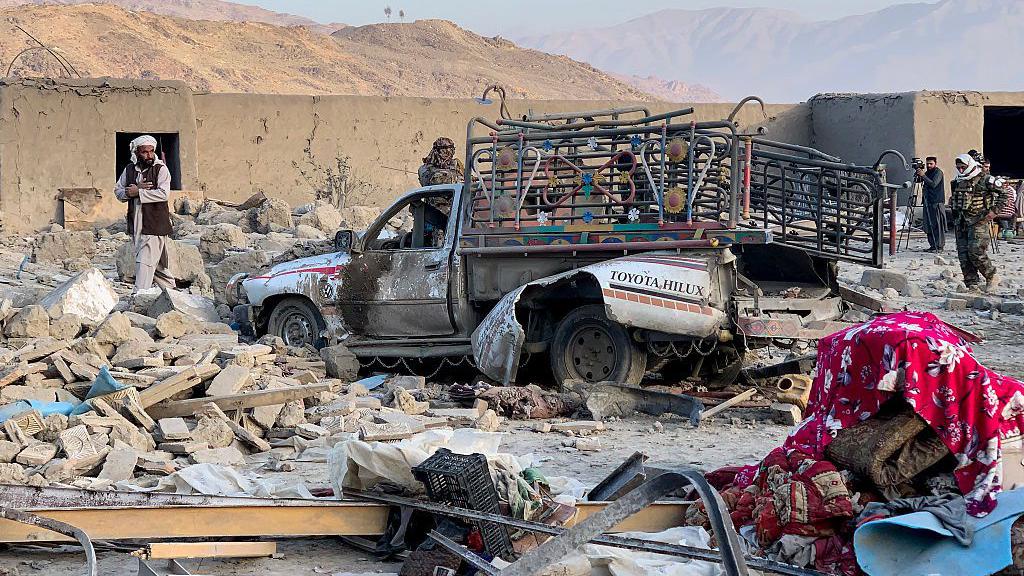
Afghan officials offered a starkly different account. The Taliban government said overnight Pakistani airstrikes had killed at least 36 civilians, including women and children, and wounded more than 160 others across Paktia, Paktika, and Kunar provinces. According to Afghan officials, strikes hit a home in Paktia's Chamkani district, killing an elderly man and a child; when neighbors gathered to help, the area was struck a second time, killing 28 villagers and wounding 158 more. Taliban chief spokesman Zabihullah Mujahid branded the strikes a "cowardly act of aggression," while Deputy Information Minister Hayatullah Mohajer Farahi called the bombing an "act of brutality" and said Afghanistan would respond "in due time."
Pakistan disputed the Afghan account, maintaining its operation had killed militants rather than civilians — leaving the two governments in direct disagreement over the most basic facts of the strike, a pattern that has recurred throughout the conflict since February.
Reactions
The United Nations has been the most consistent outside voice calling for an end to the fighting. In March, UN human rights experts urged both sides to commit to a permanent ceasefire, address root causes, and ensure accountability for violations of international law. The experts went further than most diplomatic statements, explicitly stating that "Pakistan's attack on Afghanistan violates the prohibition on the use of force under article 2 of the United Nations Charter," arguing that Pakistan had no clear right of self-defense unless the Taliban itself had directed the TTP's attacks — a legal question that remains hotly contested.
The latest strikes have triggered a fresh diplomatic row, with Kabul accusing Islamabad of indiscriminately targeting civilians and Islamabad accusing the Taliban of continuing to shelter militants responsible for attacks inside Pakistan.
Regional and international rights organizations continue to express alarm over the mounting civilian toll — more than 115,000 uprooted since February — even as the conflict has received comparatively less Western media attention than other ongoing crises.
UN Secretary-General António Guterres weighed in directly following the latest strikes, stressing that civilians "must be protected" regardless of the military justification offered by either side.
What's Next
With civilian casualty disputes deepening rather than resolving, prospects for a "permanent ceasefire" appear distant. Pakistan has shown no indication it will halt cross-border operations as long as it continues to suffer attacks like the one on the Karachi Rangers headquarters. The Taliban government continues to deny harboring the TTP and characterizes Pakistani strikes as violations of Afghan sovereignty.
Analysts tracking the conflict expect the cycle that has defined the war since February — a militant attack inside Pakistan, followed by Pakistani cross-border strikes, followed by disputed Afghan claims of civilian casualties — to continue absent a significant diplomatic intervention. The continued displacement of civilians and the difficulty of independently verifying events along the remote, mountainous border raise the likelihood that the true civilian toll will remain disputed long after any eventual ceasefire.
For now, with Operation Ghazab lil Haq ongoing and the TTP showing no signs of curtailing its campaign inside Pakistan, the war shows little sign of approaching a negotiated end.
Published By | News Editor