Washington and the Strait of Hormuz
Background
The war between the United States and Iran began on February 28, 2026, with a joint American-Israeli air campaign, and by early September had passed its 185th day. Its defining feature has not been a ground invasion or a decisive battle but a contest over a waterway: the Strait of Hormuz, through which roughly a fifth of the world's seaborne oil passed before the war and through which, by the end of August, only an estimated six to eight million barrels a day were still moving, against a pre-war figure near twenty million.
Iran has maintained an effective closure of the strait since the war's opening days, mining approaches and attacking shipping; the United States has answered with its own blockade of Iranian exports, a demining campaign, and a naval escort operation that Central Command says has assisted nearly 1,500 vessels. Both sides describe the other's account of the strait as fiction. Most shipowners, absent a clear signal, simply stay away: independent trackers put roughly 80 percent of remaining traffic operating dark, with war-risk premiums at 7.5 to 10 percent of hull value.
Through most of August, the shooting largely stopped. A month-long pause in American strikes on Iranian territory reached thirty-one consecutive nights while mediators — principally Oman and Qatar — worked on a list of Iranian conditions for a settlement. Oil prices fell 5.3 percent in the final full week of August, the steepest weekly decline of the war, on the strength of that quiet. It ended on August 30.
Key Developments
On August 30, Central Command announced that United States forces had struck two Iranian rocket launchers on Larak Island, the Revolutionary Guard-garrisoned island commanding the eastern approaches to the strait. Captain Tim Hawkins, a Central Command spokesman, said Guard Corps forces "were observed preparing to launch rockets with sea mines into the Strait of Hormuz," and characterised the operation as "limited, precise action against IRGC minelaying forces posing an imminent threat," undertaken to protect civilian mariners and commercial shipping. It was the first publicly acknowledged American strike on Iranian territory since late July.
The Revolutionary Guard acknowledged "the martyrdom and injury of several of our fighters and compatriots" without providing figures, and promised that the attack would "result in the punishment of the aggressor." That promise was discharged within hours. Jordanian state media reported eight Iranian missiles intercepted in Jordanian airspace on the evening of August 30; two Jordanian security sources told ABC News the following day that some missiles were not intercepted but caused no casualties, declining to specify impact points. Iranian media identified the targets as King Hussein and Al-Azraq air bases, and Iran's foreign ministry said the bases "had been used to launch and support attacks on Iran."
Iranian media also claimed missiles were fired at Al Minhad Air Base south of Dubai. The United Arab Emirates defence ministry denied it, while separately disclosing that the Emirati air force "responded to a UAV detected over the country's territorial waters, approaching from Iran." It was the second time in a fortnight that Abu Dhabi has moved quickly to deny an Iranian claim about its territory while acknowledging, narrowly, what its own forces actually engaged.
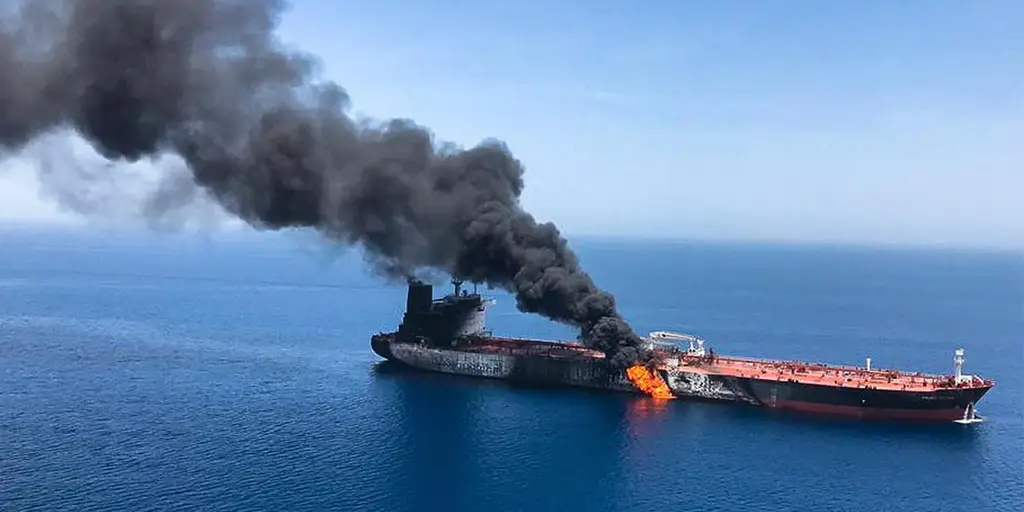
Then the strait itself was hit. On the night of August 31, the United Kingdom Maritime Trade Operations agency reported that a tanker completing an outbound transit was struck by three unknown projectiles roughly 17 nautical miles east of Khasab, Oman. Maritime security firm Vanguard Tech identified the vessel as the Liberian-flagged very large crude carrier Senegal Prosperity, struck on its port side, engine room and ballast tank. UKMTO said the crew was safe and reported no casualties and no environmental damage. Separately, the Revolutionary Guard claimed to have downed an American MQ-9 drone over the eastern Strait of Hormuz; Central Command had not addressed the claim.
Markets repriced immediately. Brent, which had settled at $88.29 on Friday, was quoted near $90.69 on August 31, up roughly 2.9 percent — reversing in one session more than half of the previous week's decline — and rose again on September 1 as the tanker strike registered.

The Video
Running alongside the actual exchange of fire was an information incident that has drawn scrutiny of its own. On August 30, President Donald Trump posted a one-line message on his social media platform stating that Kharg Island — Iran's principal oil export terminal, an eight-square-mile facility that has handled the bulk of Iranian crude for nearly seven decades — was being "blown to smithereens." The post was accompanied by video clips showing explosions engulfing an oil storage tank, a docked tanker and other structures.
No such attack occurred, or at least none was reported by any source. Forbes, U.S. News and World Report and The Times of Israel each reported that the footage was AI-generated and that no evidence existed of a strike on Kharg Island. Central Command's account of the day's operations was confined to the two launchers on Larak. No Iranian statement described damage at Kharg.
The post extends a rhetorical campaign the president has waged against the terminal since the war's early months. In March he said American forces had bombed every military target on the island and told NBC News the United States "may hit it a few more times just for fun." In July he suggested Washington "may take over" Kharg. In June he warned that the United States would hit Iran "VERY HARD" and seize the island. The Council on Foreign Relations, in an analysis published as the latest threat circulated, noted that he subsequently walked the threat back — Kharg is the lifeline of Iran's remaining crude exports, most of them bound for China, and destroying it would push prices sharply higher while stranding American personnel on an island the Revolutionary Guard heavily defends.
What makes the episode consequential is less the threat than the gap it opened inside the administration's own messaging. Central Command spent the same twenty-four hours describing a deliberately bounded action against two launchers, framed in the careful legal language of imminent threat and freedom of navigation. The commander in chief described, in fabricated imagery, the destruction of a facility nobody had touched. Two organs of the same government narrated two different wars on the same day — a problem that becomes acute as Congress returns to Washington needing to evaluate exactly what the executive has been doing.
Reactions
Trump, speaking on September 1, said he may continue strikes against Iran, adding that his awareness of serious troubles inside the country "doesn't mean we won't smack them." He ruled out any use of nuclear weapons, saying there is no reason for it; claimed that roughly thirty ships pass through the strait each night with American assistance and that prices have not risen as forecast; described China as "relatively inactive" on Hormuz while citing a good relationship with Xi Jinping; and argued the United States has expended fewer munitions against Iran than were supplied to Ukraine under his predecessor. Axios reported that Washington is weighing further limited strikes in the Hormuz region aimed at preventing Iran from reconstituting radar and missile capability against shipping. Treasury Secretary Scott Bessent signalled additional sanctions.
Iran's posture was two-track. President Masoud Pezeshkian, travelling to the Shanghai Cooperation Organisation summit in Bishkek hours after the retaliation, said Iran is "not looking for war, but we will give a decisive response to the aggressors," that Tehran "will never sit still in the face of any aggression," and — from Bishkek — that Iran seeks a peaceful settlement rather than a continuation of the war, blaming elements in the United States for seeking escalation. Iran's supreme leader issued no statement on the exchange. A Revolutionary Guard adviser said Iranian missile production had been relocated to safer sites and resumed at increased capacity.
Gulf capitals were conspicuously quiet. Jordan confined itself to an interception report; the Emirates issued a same-day denial. Neither Saudi Arabia, Kuwait, Bahrain, Qatar nor Oman had commented on the exchange. The Kremlin, asked whether Moscow might mediate, said it remains difficult to talk about mediation, while confirming Putin would discuss the Gulf situation with Pezeshkian.
Analysts noted what the retaliation was not. No Iranian fire was directed at shipping lanes, at Israel, or at Saudi Arabia, Kuwait or Bahrain; no proxy joined; Hezbollah, the Houthis and the Iraqi militias all held their fire. A salvo of eight or more missiles at hardened, defended bases producing no casualties sits at the low end of Iran's demonstrated capacity — an answer calibrated to satisfy domestic audiences without forcing Washington's hand. Both capitals, in other words, ran the escalation-management playbook they have refined across the war's earlier rounds.
What Comes Next
The immediate question is whether the mediation survives contact with resumed fire. Tehran's negotiating theory has been that time works in its favour and that the strait's closure is a non-wasting asset. If Central Command's account of attempted re-mining is accurate, at least one Iranian institution had concluded the opposite — that American demining was eroding the closure fast enough to justify the risk of a strike. Whether mediators treat the weekend as a rupture or as a clarifying demonstration of both sides' limits is the next fork.
The second question is domestic. Congress returns this week with a 60-day War Powers clock, opened by the administration's July 10 notification, running toward an early-September expiry. Senator Adam Schiff's resolution — co-sponsored by Senators Tim Kaine, Andy Kim, Jeff Merkley and Chris Van Hollen — awaits floor action, following six prior failed Democratic attempts, the most recent a 49-50 defeat on July 30. The administration will argue the Larak strike falls within existing blockade enforcement. Its critics now have an exhibit requiring no classified access to evaluate: a presidential post announcing an attack that did not occur. Separately, an unexplained increase of roughly sixty in the official wounded count remains outstanding, and reporting by The Intercept places independent tallies above 900 against an official 756.
The third is the market. Brent above $90 against roughly $66 before the war, American retail gasoline more than a dollar a gallon above last year, and a fresh attack on a laden VLCC in the strait's southern approaches together suggest that whatever confidence August's quiet had built has now been withdrawn. The USS George Washington strike group has taken station in the Arabian Sea, relieving the Abraham Lincoln, with the Theodore Roosevelt scheduled to follow — a rotation that describes a blockade requirement programmed well into 2027.
Indicators to watch in the coming days include whether any strike on Kharg Island actually materialises or the post stands as fabricated imagery alone; whether Central Command addresses the Jordan impact points and the Emirati drone engagement; whether Iran declares its response complete or continues; and whether the returning Senate moves the Schiff resolution before the clock runs out.
Published By | News Editor