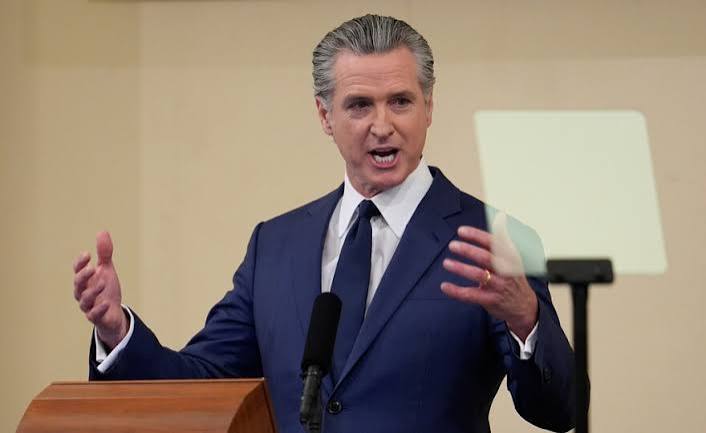
In a first-of-its-kind deal, Gavin Newsom is handing every state agency, city, and county in California a discounted AI assistant named Claude — the same week its maker quietly turned the technology loose on the entire planet for free. Here's what it means for your DMV line, your tax refund, and the global fight over who controls the smartest machines ever built.
SACRAMENTO, Calif.
The world's fourth-largest economy just hired a robot. Not a metal one with arms and wheels, but something arguably far more consequential: an artificial intelligence that reads, writes, reasons, and now has a seat inside the machinery of California's government — the sprawling apparatus that touches the lives of nearly 40 million people every single day.
In an announcement that landed with surprisingly little fanfare given its scale, Governor Gavin Newsom's office confirmed a sweeping partnership with San Francisco AI lab Anthropic that gives every California state agency — plus the state's cities and counties — access to Claude, one of the most capable AI systems on Earth, at a 50 percent discount. It is, by the state's own description, a first-of-its-kind arrangement in America. And it arrived in the same seven-day window that Anthropic pushed its newest model, Claude Sonnet 5, out to hundreds of millions of ordinary users worldwide — for free.
Taken together, the two moves mark a turning point that historians of technology may one day circle on the calendar. The most advanced AI on the market is no longer a curiosity locked behind a developer's paywall or a Silicon Valley demo stage. This week it became a public utility in the most populous state in the union, and a default setting on the phones and laptops of casual users across the globe. The genie isn't just out of the bottle. The genie has a government ID badge.
What California Actually Signed
The details of the deal are deceptively bureaucratic, which is exactly why they matter. Under the agreement announced by the Governor's office, Claude becomes the first AI productivity tool made available to all state agencies through the California Department of Technology's new Statewide Information Technology Shared Services portal — essentially a one-stop shop that lets any state office switch on the technology without negotiating its own contract.
The 50 percent discount is the headline number, but the fine print is where the ambition shows. State workers won't just get access to the software; they'll get free workforce training, technical assistance, and hands-on help redesigning their workflows, all provided by Anthropic itself. In plain English: the company isn't merely selling California a tool, it's embedding itself in how the state's employees do their jobs.
Newsom framed the whole enterprise in careful, almost defensive language — a sign of just how politically charged the word "AI" has become. "AI should not replace the human work of government," the Governor said in a statement. "It should help our workers move faster, solve problems more effectively, and deliver better results for Californians." In other words: nobody at the DMV is getting fired and replaced by a chatbot. At least, that's the promise.
The practical uses being floated are the unglamorous chores that eat up a public servant's day. Claude will help state employees draft documents, summarize dense reports, and analyze mountains of information that would otherwise require hours of human sifting. Think of the caseworker buried under a backlog of benefit applications, the analyst trying to make sense of thousands of public comments on a proposed regulation, or the clerk translating a byzantine policy into something a resident can actually understand. Those are the tasks in the crosshairs.
The Timing Is Not a Coincidence
To understand why this deal is more than a routine software procurement, you have to look at what Anthropic did just days before and after signing it.
On June 30, the company released Claude Sonnet 5, and on July 1 it made the model the default for every Free and Pro user on the planet. The significance isn't the version number — it's what Sonnet 5 can do. Anthropic bills it as the most "agentic" Sonnet model it has ever built, meaning it can do far more than answer questions. It can make multi-step plans, operate tools like web browsers and computer terminals, and run autonomously through tasks that, until recently, demanded far larger and more expensive systems.

Crucially, Anthropic priced it to move. Through the end of August, developers pay a promotional rate of just $2 per million words of input and $10 per million words of output; after that it settles at $3 and $15 — roughly half the cost of the company's flagship Opus 4.8 model. The strategy is transparent: make near-flagship intelligence cheap enough, and fast enough, that it becomes the water supply of the digital economy rather than a luxury good. A government that can suddenly afford to deploy that intelligence across every department at half price is exactly the kind of customer that thesis was built to win.
So the California deal and the Sonnet 5 launch are two halves of the same play. One puts the technology in the hands of the masses. The other puts it in the hands of the state that regulates, employs, and governs those masses. Both happened in the span of a week.
A Company at War With Washington — and Cozy With Sacramento
There is a deeper, more combustible subplot here, and it explains why Anthropic and California found each other in the first place.
While Anthropic was busy courting Sacramento, its relationship with the federal government had curdled into something close to open conflict. Earlier this year, the company clashed with the U.S. Department of Defense over a contract that would have let the Pentagon deploy Claude for, in the government's words, any lawful use. Anthropic pushed back hard, demanding explicit carve-outs that would bar the technology from being used to surveil Americans or to operate autonomous weapons without a human in the loop. Defense Secretary Pete Hegseth refused. The Pentagon walked, and signed with rival OpenAI instead.
That wasn't the only bruise. Just weeks earlier, in mid-June, the Commerce Department had taken the extraordinary step of ordering Anthropic's most powerful models offline worldwide after a national-security review — an unprecedented use of export-control authority against an American AI company — before reversing course and lifting the restrictions on July 1. For a company that markets itself as the safety-first conscience of the AI industry, it has spent 2026 getting repeatedly bloodied in Washington.
Against that backdrop, California looks less like a customer and more like a refuge. Sacramento gets to plant its flag as the government that harnesses AI responsibly — a politically useful contrast for a governor with national ambitions. And Anthropic gets a marquee public-sector partner willing to embrace exactly the guardrails the Pentagon rejected. It is a marriage of mutual convenience, and both sides know it.
The Expert Perspective
Technology analysts who watched the announcement land were quick to note that the deal's real weight lies in precedent, not price. Fifty percent off a software license is, in the grand scheme of a state budget, a rounding error. The precedent — that the most powerful AI on the market is now the sanctioned, default tool of an American state government — is anything but.
The optimistic reading, shared by many in the govtech world, is that this is precisely how AI should enter the public sector: through the front door, with training, oversight, and a human-in-charge philosophy baked in from day one, rather than seeping in through employees quietly pasting sensitive records into random chatbots. A structured, discounted, supported rollout is, in this view, the responsible path — and far preferable to the shadow-AI free-for-all already happening inside understaffed agencies whether leaders authorize it or not.
The skeptics counter with an equally sharp point. Handing a single private company deep, subsidized access to the inner workings of state government raises uncomfortable questions about dependency and lock-in. What happens when California's benefit systems, its document pipelines, and its analytical workflows are all quietly wired to one vendor's model? What happens to accountability when an algorithm helps decide how a resident's application is summarized, or which cases get flagged? Critics also warn that "AI won't replace workers" is the reassurance offered at the start of nearly every automation wave — and that the honest answer is usually more complicated than a governor's press release.
What This Means For You
If you live in California, the change may reach you first in the most mundane way imaginable: a slightly faster response to a permit request, a benefits letter that's actually readable, a call center that resolves your problem in one try instead of three. That's the promise, and for a state notorious for its bureaucratic molasses, it's not nothing.
But the ripple extends far beyond the Golden State. California has a long history as America's regulatory pace car — where it goes on emissions, on privacy, on labor, the rest of the country tends to follow. If a Claude-powered government proves it can cut wait times and stretch tight budgets without the horror stories, expect a stampede of other states cutting similar deals within a year. If it stumbles — a botched automated decision, a data-privacy scandal, a public backlash over jobs — that too will echo nationwide, and could set the cause of government AI back a decade.
And for the hundreds of millions of people who now have Sonnet 5 sitting in their pocket for free, the lesson is simpler still: the frontier is no longer somewhere else. The same class of intelligence that a governor is deploying across an entire state is the one answering your late-night questions, drafting your emails, and increasingly, doing the small tasks you used to do yourself. The gap between "cutting-edge AI" and "the thing everyone uses" has effectively collapsed to zero.
The Bottom Line
For years, the debate over artificial intelligence lived in the future tense — what it might do, whom it could replace, how it should be governed someday. This week, in the space of seven days, the future tense quietly expired. The most capable AI available became free for the masses and, simultaneously, an official instrument of the largest state government in the United States.
Whether that turns out to be a triumph of efficient, humane public service or a cautionary tale about ceding the machinery of government to a handful of private labs will depend on choices being made right now, in agency offices and legislative hearing rooms most Californians will never see. What's certain is that the experiment has begun, the test subjects number in the tens of millions, and there is no obvious off switch. California didn't just buy some software. It volunteered to find out what happens when a government and a superintelligence share a desk — and the rest of us are about to learn the answer alongside it.
Published By | Features Editor