Tunis, Tunisia
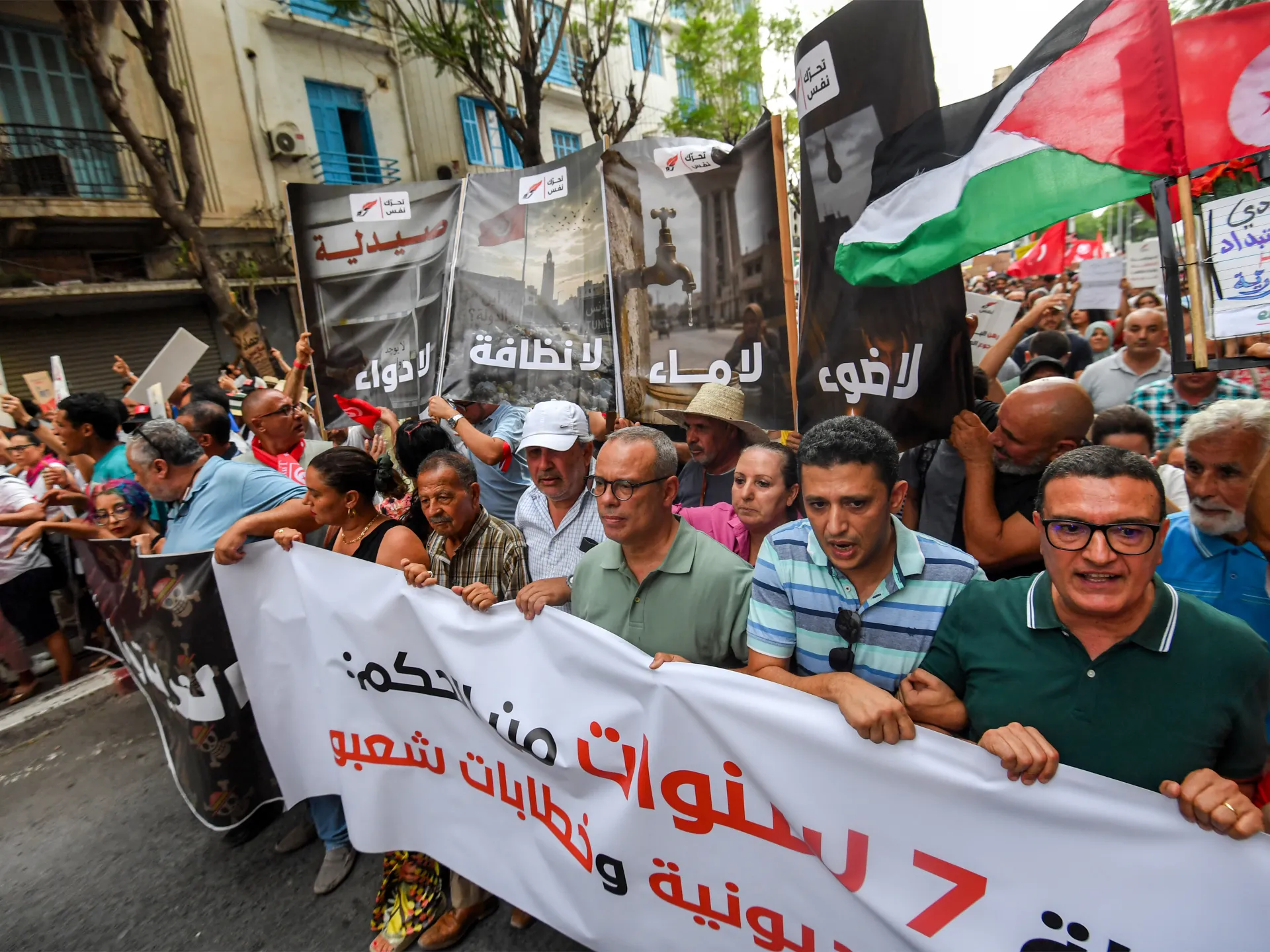
Five years to the week after President Kais Saied suspended parliament and began concentrating power in his own hands, Tunisia is marking the anniversary not with reflection but with renewed confrontation. Thousands of demonstrators filled Habib Bourguiba Avenue in the capital on July 25, chanting the 2011 revolution's old rallying cry — "The people want the fall of the regime" — while a sitting U.S. congressman publicly branded Saied's government a "one-man dictatorship" and pushed for sanctions. The convergence of economic stagnation, a jailed and ailing opposition leadership, and mounting international criticism has turned what was once framed as a temporary emergency measure into a defining crisis of Tunisian democracy.
The moment matters because Tunisia was, for a decade after its 2011 uprising, held up as the Arab Spring's lone democratic survivor. Saied's July 2021 intervention — when he dismissed Prime Minister Hichem Mechichi, suspended the elected parliament and began ruling largely by decree — was framed by his supporters as a necessary "correction" to a dysfunctional and corrupt post-revolutionary order. Five years on, that framing is increasingly difficult to sustain: the economy that Saied promised to fix has not recovered, and the political opposition he was supposed to be protecting the country from now sits largely in prison.

An economy that has not moved in a decade
The clearest evidence against Saied's economic stewardship comes from Tunisia's own statisticians. The National Institute of Statistics reported an unemployment rate of 15% in the first quarter of 2026, edging down only slightly to 14.9% in the second quarter — a marginal improvement that leaves joblessness roughly where it stood for much of the past decade, with youth and university-graduate unemployment running considerably higher than the headline figure.
Speaking on Al Jazeera's *Ma Waraa al-Khabar* program, Ridha Chkoundali, an economics professor at the University of Tunisia, offered a starker measure of the country's economic drift: the national investment rate, which averaged around 20% of GDP between 2015 and 2019, had collapsed to just 8% by 2023. Chkoundali attributed the decline to an investment climate poisoned by unpredictability and a rising tax burden, noting that tax rates have climbed roughly five percentage points since 2015 even as the state has used that revenue simply to cover its own obligations rather than to stimulate growth. The result, he said, is a taxation system that "is no longer used to stimulate investment but simply to collect revenues at the expense of economic growth."
Ordinary Tunisians are absorbing the consequences directly. Food inflation has run at nearly three times the general inflation rate, according to reporting from Al Jazeera's economics desk, eroding purchasing power for a population already contending with chronic water and electricity shortages. Saied himself has acknowledged the utility crisis, warning publicly that power and water cuts "must end immediately" and that "the state will act firmly against anyone who tries to aggravate the situation in the country" — rhetoric that opponents note has produced threats rather than fixes.
Mohamed Abbou, a former minister of state and former secretary-general of the opposition Democratic Current party, placed the blame squarely on Saied's governing style rather than on external conditions. "Tunisia has lost all credibility," Abbou said. "Everyone fears the situation in Tunisia because there is no rationality… there is no stability in laws, taxes, or anything else." Abbou also pointed to what he described as Saied's calculated posture toward international lenders: the president has publicly rejected a financing arrangement with the International Monetary Fund to preserve a populist image of independence, Abbou argued, while quietly implementing many of the same austerity measures the IMF would have demanded, including a freeze on public-sector hiring and reduced import volumes.
Not every voice lays the crisis entirely at Saied's feet. Political analyst Souhaib Mezrigui argued that the roots of Tunisia's economic malaise predate the 2021 power grab, tracing back to what he called an absence of coherent economic or social vision across the political class that has governed since the 2011 revolution. That argument has some purchase among Saied's remaining base, who continue to view his emergency measures as a necessary corrective to a paralyzed and self-dealing parliamentary system rather than as their cause.

A leadership decimated by prison
The economic argument, however, is only half of what brought protesters into the streets on July 25. The demonstration, organized by a coalition of opposition parties alongside the civil society initiative Nafas, centered as much on political prisoners as on empty wallets. Tunisia's jails have filled steadily with opposition figures since Saied's crackdown on dissent began, and the most prominent name among them is Rached Ghannouchi, the 85-year-old former speaker of parliament and longtime leader of the Ennahdha party, who was recently sentenced to life in prison.
Ghannouchi's health has become a flashpoint in its own right. He fainted inside Mornaguia prison after temperatures inside the facility reportedly reached 52 degrees Celsius, or 126 degrees Fahrenheit, according to Al Jazeera reporting drawing on accounts from detainees' families, including opposition politician Ahmed Nejib Chebbi. Imed al-Khamiri, a spokesman for Ennahdha, described the continued detention of Ghannouchi and other opposition figures as "a disgrace to the Tunisian state." Rights groups have separately warned that conditions inside Mornaguia are taking a severe toll on elderly inmates more broadly, not Ghannouchi alone.
Washington weighs in
The anniversary also drew a pointed response from across the Atlantic. U.S. Rep. Joe Wilson, R-S.C., marked the occasion with a statement accusing Saied of transforming what he called the Arab world's only constitutional democracy into a "one-man dictatorship." Wilson went further, charging that the Tunisian government's corruption has grown markedly worse under Saied, that opportunities for young Tunisians have been destroyed, and that Tunis has drifted toward closer alignment with Russian President Vladimir Putin, Iran and Hezbollah. Noting that Tunisian authorities have jailed American citizens, Wilson called on the U.S. State Department to issue a "Level 4: Do Not Travel" advisory for the country.
"I will also continue to work to pass the Tunisia Democracy Restoration Act imposing sanctions on Saied and his inner circle," Wilson wrote on the social media platform X, adding: "Democracy in Tunisia will win in the end. Madmen tyrants will not last." Whether that legislative push gains traction in Washington remains uncertain, but Wilson's statement signals that Tunisia's domestic crisis is increasingly being read in Washington through the lens of geopolitical alignment as much as democratic backsliding — a framing likely to sharpen U.S.-Tunisia tensions regardless of the bill's fate.
What the numbers conceal — and what to watch
Beneath the headline unemployment figures lies a debt picture that has worsened steadily on Saied's watch, with Tunisia's government debt burden as a share of GDP having climbed substantially since 2018, even as growth has failed to accelerate to a pace that might absorb it — a dynamic economists broadly agree leaves the country with less room to maneuver the next time global financing conditions tighten. That fragility is precisely what makes the government's continued refusal to formalize an IMF program consequential: it preserves Saied's populist positioning in the short term at the cost of a durable financing anchor in the long term.
Three threads are worth watching in the months ahead. The first is Ghannouchi's health and legal status; a death in custody or a further deterioration would almost certainly reignite the kind of mass mobilization Tunisia saw on July 25, and possibly at a larger scale. The second is the fate of Wilson's sanctions legislation in Congress, which would test how far Washington is willing to go in formally penalizing a government it once championed as a democratic model. The third is whether Tunisia's persistent water and electricity shortages — which Saied has now twice publicly promised to resolve without visible results — become the proximate trigger for a broader wave of unrest that moves beyond the organized opposition coalition and into the kind of spontaneous, nationwide protest that toppled Zine El Abidine Ben Ali in 2011. For a government whose central claim to legitimacy is that it rescued Tunisia from dysfunction, the accumulating evidence of five years of drift is becoming harder to explain away.
Published By | News Editor