World Politics
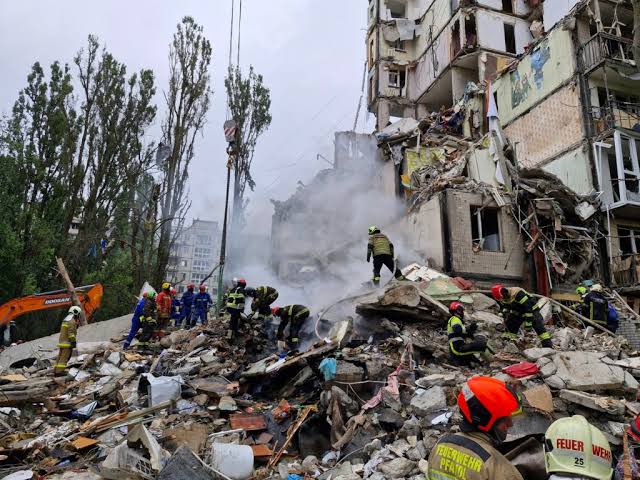
Russia this week carried out one of the deadliest attacks on Kyiv since the start of its full-scale invasion, unleashing a combined missile and drone barrage in the early hours of Thursday that killed dozens of civilians, wounded more than ninety, and damaged over a hundred residential buildings. The strike—which Moscow described as retaliation for Ukraine's increasingly effective campaign against Russian oil refineries—sent shock waves beyond Ukraine's borders: Poland scrambled fighter jets, Finland restricted its airspace, and the fragile American-brokered peace process was thrown into fresh doubt.
More than four years into the war, the attack is a reminder of how far the conflict remains from resolution, even as diplomats circulate a twenty-point American peace plan. It also crystallizes the war's current logic: Ukraine is bleeding Russia's energy economy with long-range drones, and Russia is answering with mass strikes on the Ukrainian capital's apartment blocks.
Background: The Long-Range War
The immediate backdrop is Ukraine's months-long campaign against Russia's oil industry. President Volodymyr Zelensky has authorized what Kyiv describes as a forty-day military and intelligence campaign intended to raise the cost of continuing the war. Ukrainian long-range drones have hit refinery after refinery deep inside Russia—including, in late June, the Slavyansk and Yaroslavl refineries.
The cumulative effect has been severe. Months of drone attacks have knocked out a significant share of Russian refining capacity, triggering gasoline shortages, rationing in more than half of the country's regions, and long queues at filling stations. The Carnegie Endowment assesses the oil sector as "battered but not broken"—yet the shortages have become a domestic embarrassment for President Vladimir Putin, and Russia's Defense Ministry explicitly framed the Kyiv attack as retaliation.
Key Developments: The Attack on Kyiv
The barrage began overnight into July 2, hours after Zelensky publicly warned that a "massive" Russian strike was imminent—a warning that sent thousands of residents into metro stations and likely saved lives. According to Ukrainian figures, Russia fired 74 missiles and 496 attack drones. Russia's Defense Ministry said it had conducted a "massive strike using long-range precision weapons."
Casualty figures vary by source and reporting time, but later counts put the toll at 30 or more dead, with 92 injured—CNN characterized it as the third-deadliest assault on the capital of the entire war. More than 130 residential buildings were damaged; in one ordinary nine-story block, a single missile destroyed 64 apartments.
Ukraine's air defenses performed strongly—the Defense Ministry said more than 90 percent of cruise missiles and Shahed-type drones were intercepted—but ballistic missiles remain the critical gap. Ukraine operates several Patriot batteries but faces a persistent shortage of interceptor missiles, a dependency that keeps Kyiv's security tethered directly to Washington.
The pattern fit a tactic analysts have described throughout the war: saturating defenses with hundreds of cheap Shahed drones to exhaust interceptors, then threading ballistic and cruise missiles through the gaps. Even a 90 percent interception rate leaves dozens of weapons striking a dense urban area when the salvo numbers in the hundreds.

Reactions: Jets Over Poland, Sanctions Talk in Brussels
The attack reverberated across NATO's eastern flank. Poland scrambled fighter jets as the barrage moved westward, while Finland restricted its airspace as a precaution. The episodes underscore how routinely Russia's air war now brushes against alliance territory.
In Brussels, EU foreign policy chief Kaja Kallas announced she would propose sanctions against additional entities supplying Russia's military-industrial complex. In Washington, Trump told reporters the strike could set back his efforts to end the war—a rare public acknowledgment that Russian escalation is complicating his diplomacy. The Kremlin responded that the peace process was merely "on pause" and that Moscow expects talks to resume. Zelensky defended Ukraine's deep strikes—including a weekend drone attack on the Moscow region—as "entirely justified."
What's Next
The diplomatic track is stalled but not dead. Three rounds of talks produced no breakthrough, and a further round was postponed amid the US-Israeli war with Iran. The Kremlin has declined to reject the American twenty-point plan outright, signaling instead that it wants amendments—keeping Trump engaged while conceding nothing.
Much hinges on capitals beyond Kyiv and Moscow: whether the EU's twenty-seven members can agree to tighten sanctions four years in, and whether Washington converts its sympathy for Kyiv's dead into expedited Patriot interceptor deliveries—the single decision most directly connected to how many people the next barrage kills.
On the battlefield, both sides have reasons to escalate. Ukraine will press its refinery campaign; Russia will likely continue mass strikes intended to exhaust Ukrainian air defenses and Western patience. The variables to watch are concrete: Patriot interceptor deliveries, the EU's next sanctions package, and whether this attack proves to be a spasm of retaliation or the opening of a harsher phase of the air war. For the residents of Kyiv digging out of 130 damaged buildings, the distinction is not academic.
Published By | News Editor