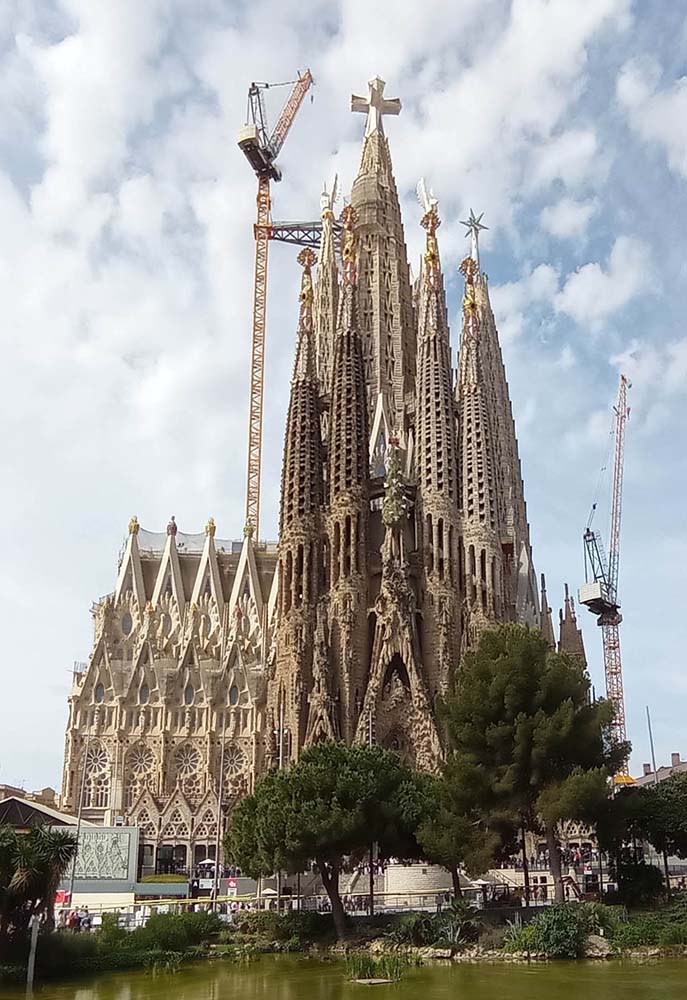
With the Tower of Jesus Christ now complete and the world's tallest church officially crowned, Barcelona's yearlong tribute to Antoni Gaudí is reaching its most public phase — including a citywide exhibition and a landmark music event this month.
BARCELONA
Some buildings take years to finish. The Sagrada Família took 144 — and the centenary year of the architect who dreamed it up is now unfolding exactly as he might have wanted: as spectacle, as pilgrimage, and as a citywide meditation on what it means to build something bigger than any single lifetime.
Antoni Gaudí died on June 10, 1926, struck by a Barcelona tram three days earlier, after devoting the final decades of his life almost entirely to the Sagrada Família's design. One hundred years later, almost to the day, the basilica reached a milestone Gaudí himself never lived to see: the completion of its central spire, the Tower of Jesus Christ, formally blessed in a ceremony led by Pope Leo XIV on June 10, 2026. The timing — a centenary of death meeting a coronation of stone and light — was not lost on anyone watching the celebrations unfold across the city this year.
A Tower 144 Years in the Making
The Tower of Jesus Christ now rises roughly 172.5 meters above Barcelona, with its monumental cross pushing the total structure to around 176 meters — enough to make the Sagrada Família officially the tallest church building in the world. The basilica claimed that title in stages: it first surpassed Germany's Ulm Minster, the previous record-holder at approximately 161.5 meters, when construction crossed that threshold in late 2025, before the spire's exterior was completed with the installation of its cross on February 20, 2026.
Even at that towering height, the design carries one of Gaudí's most quietly poetic decisions. The architect deliberately capped the tower below the height of Montjuïc, the hill overlooking Barcelona, which rises to 177.7 meters — a choice rooted in his belief that no human creation should surpass the work of God. It's a detail that captures Gaudí's entire design philosophy: audacious in ambition, disciplined by conviction, and never separated from the deeply held Catholic faith that shaped every curve and column of his masterwork.
A City-Wide Commemoration
Barcelona's Gaudí centenary hasn't confined itself to the basilica's scaffolding-free silhouette. Throughout 2026, the city has layered on public programming designed to bring the architect's legacy — and the century of craftsmanship behind it — to residents and visitors alike. At the Palau Robert Gardens, the exhibition "The Sagrada Família and Barcelona: 144 Years of a Shared Journey" has been running since April 27 and continues through July 26, tracing the entwined history between the basilica and the city that grew up around it, from Gaudí's earliest sketches to the modern construction techniques used to finally complete his vision.
Casa Batlló and Casa Vicens, two of Gaudí's other landmark residential works, have rolled out their own centenary programming across the year, offering guided tours and installations that place the architect's broader body of work in conversation with the Sagrada Família's completion. Together, the sites form an informal citywide trail for anyone hoping to trace Gaudí's evolution from ambitious young modernist to the singular architectural visionary whose unfinished cathedral became a UNESCO World Heritage Site and one of the most visited monuments on Earth.
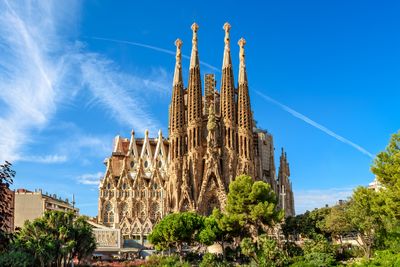
The celebrations reach a symbolic high point later this month, when Barcelona's Festival Grec arrives at the Sagrada Família on July 17 for "Arrels de Llum" ("Roots of Light"), a musical event marking three anniversaries at once: the completion of the Tower of Jesus Christ, the centenary of Gaudí's death, and the 50th anniversary of the Grec Festival itself. The free event is expected to draw large crowds eager to experience the newly completed basilica in a setting built around music and light rather than construction cranes.
Why the Completion Matters Beyond Barcelona
For more than a century, the Sagrada Família has functioned as a kind of open-ended argument about what architecture can be when it's untethered from a fixed deadline. Generations of architects, craftspeople, and engineers have worked from Gaudí's surviving models and drawings — some of them destroyed and painstakingly reconstructed after the Spanish Civil War — to interpret and complete a vision its original author could describe but never fully render in his own lifetime.
That the building is now, functionally, complete — with remaining work largely confined to decorative and surrounding elements — closes a chapter that has shaped architectural conversations about ambition, patience, and craftsmanship for generations. It also arrives at a moment when computational design and advanced fabrication techniques have made rapid, standardized construction the industry default, making the Sagrada Família's century-long, hand-guided completion feel almost radical by comparison.
What This Means for Visitors
For travelers, 2026 represents a rare, once-in-a-lifetime window to see the Sagrada Família in its most complete form yet, alongside a full slate of centenary programming that won't be repeated. Tickets to the basilica remain in high demand throughout the summer, and officials have encouraged visitors to book well in advance, particularly around the July 17 Festival Grec event and the final weeks of the Palau Robert exhibition.
Beyond the basilica itself, the centenary offers a broader occasion to explore Gaudí's citywide footprint — Park Güell, Casa Milà, Casa Batlló, and Casa Vicens — as a connected body of work rather than a collection of individual tourist stops, deepening appreciation for how singular his architectural language really was.
The Bottom Line
A century after his death, Antoni Gaudí's most ambitious work is, at last, essentially finished — and Barcelona is treating the moment with the reverence it deserves. Between the completed Tower of Jesus Christ, a citywide exhibition tracing 144 years of shared history, and a landmark musical celebration later this month, 2026 stands as the definitive year to witness both the culmination of Gaudí's vision and the city's enduring devotion to the architect who reshaped it.
Published By | Features Editor