A last-minute health absence for NBC's lead play-by-play voice puts Noah Eagle in the biggest chair in sports broadcasting, and reminds viewers how much a single voice shapes the biggest night of the NFL week.
NEW YORK
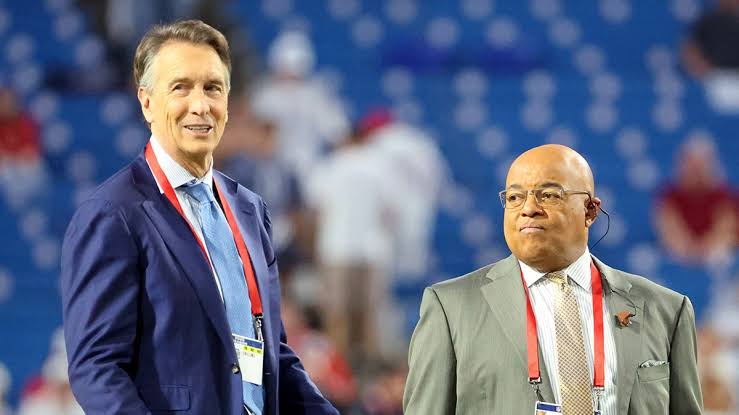
Sunday night's Buccaneers-Bears game on NBC arrived with an unfamiliar sound. Mike Tirico, the network's lead NFL play-by-play voice, was not in the booth. Hours before kickoff, Tirico released a statement saying an unspecified health issue would keep him away, and Noah Eagle, NBC's number-two NFL announcer, stepped in to call the game alongside analyst Cris Collinsworth and reporter Melissa Stark, according to Sports Media Watch.
It is a small piece of broadcasting news with an outsized feel. Sunday Night Football is the most-watched weekly program on American television, and Tirico has been its lead voice since 2022. According to Sports Media Watch, the absence is the first assignment he has missed since taking the job, and it is the first Sunday Night Football game not called by NBC's lead NFL voice in years. The report adds that Tirico had also never missed a Monday Night Football assignment during his earlier run at ESPN.
No further detail about Tirico's condition has been made public, and it would be wrong to speculate. What the network did disclose is the practical outlook: he expects to return to Sunday Night Football next week for Steelers-Bengals. Whether he can work Tuesday's Celtics-Sixers NBA game for NBC remains unclear.

A Busy Weekend for the Backup
Eagle did not exactly have a quiet weekend before getting the call. The day before, he had been on the call for NBC's Miami-Notre Dame college football broadcast, a game that carried major implications in the College Football Playoff picture. Going from a Saturday night college showdown to the NFL's marquee Sunday slot, on short notice, is the kind of turnaround that tests a broadcaster's preparation.
The 'next man up' principle is baked into network sports. Networks keep a designated understudy for exactly this reason, and Eagle held that role for February's Super Bowl. Sports Media Watch reports that Eagle has said he did not prepare to his normal standard for that assignment because he was working from Tirico's version of the spotting chart. His comment on the near-miss was candid: 'I would have been ready just in case; I'm glad it did not happen.'
That candor is revealing. A play-by-play announcer's preparation is deeply personal, built from handwritten boards, personnel notes and relationships with coaches and players, so stepping into another voice's game on a few hours' notice means leaning on instinct and a deep bench of experience.
Not the First Time a Voice Has Gone Missing
Broadcasting history is full of emergency substitutions, and Sports Media Watch's report collects several. Brian Anderson lost his voice before the NCAA men's basketball tournament and was replaced by Jason Benetti. Mike Breen missed the first two games of the 2022 NBA Finals because of COVID and was replaced by Mark Jones. Mike Emrick missed the first game of the 2014 Stanley Cup Final on NBC and Kenny Albert took over.
The report also recalls that Tirico himself has been on the other side of this equation, filling in occasionally for Al Michaels late in Michaels' Sunday Night Football tenure. And in 2024, Tirico left NBC's Kentucky Derby coverage midway through the broadcast after an allergic reaction, with Ahmed Fareed filling in.
The pattern is useful context: live television has a surprisingly deep culture of contingency planning, and most viewers never notice the seams. The remarkable thing about Tirico's streak is not that it ended, but how long it lasted.

Why the Voice Matters
For casual viewers, the play-by-play announcer is the connective tissue of a broadcast, setting the pace, introducing analysis and framing the moments that become highlights. On Sunday Night Football, where the audience skews toward the broadest possible mix of fans, that role carries extra weight. Collinsworth, who has worked beside Tirico, and Stark provide continuity in the booth, which helps explain why the network could make the switch with a lower risk of disruption.
The timing is also notable in a season that has been strong for NFL viewership. Sports Media Watch reported last week that the league is enjoying multiple viewership milestones at the eight-week mark, with the season described as the most-watched in recent years. A marquee primetime window is the league's best advertisement, so the production is built to be resilient to just this kind of change.
What This Means for You
For viewers, the practical takeaway is simple: nothing about the game itself changes. The coverage, camera work and analysis come from the same production team, and the network has indicated the regular lineup should return next week. If you are watching for the broadcast craft, though, a different voice is a chance to notice how much personality lives in the call, from rhythm and humor to how a announcer lets a big play breathe.
For anyone who follows sports media as a hobby, the episode also offers a window into how much invisible preparation sits behind every broadcast. Backups are named months in advance, charts are shared, and the best ones are ready to go at a moment's notice.
The Bottom Line
Tirico's absence is, by all available accounts, a short-term matter, and wishing him a speedy recovery is the right response. For Noah Eagle, it is a high-profile opportunity delivered the hard way. And for the rest of us, it is a reminder that the polished broadcast we take for granted on Sunday night is built by people, and that live television still runs on quick thinking when the plan changes.
Published By | Sports Editor