Written By | International News Agencies
On Saturday, November 14, Ukrainian President Volodymyr Zelensky said that American negotiators had, for the first time, linked those two questions directly.
World Politics
Overview
For almost five years, two questions have defined every discussion about how Russia's war in Ukraine might end: whether Kyiv would ever be allowed into NATO, and whether it would ever surrender the parts of the Donbas that Russian forces have failed to take by force. On Saturday, November 14, Ukrainian President Volodymyr Zelensky said that American negotiators had, for the first time, linked those two questions directly. According to remarks released by his office and reported by the BBC, Reuters, RTÉ and others, US envoys asked Kyiv a hypothetical that would have been unthinkable in Washington only months ago: "What if Ukraine joins Nato? Would Ukraine withdraw from Donbas?"
Zelensky described the question as a first. "This was the first time this had been raised," he told reporters, adding that he now believes "NATO is back on the agenda." He was equally clear, however, that Ukraine does not intend to give up its land, and that any decision of this magnitude could not be his alone. The revelation landed at the end of an extraordinarily busy week of diplomacy: the first trilateral US-Russia-Ukraine talks in nine months in Abu Dhabi, an overnight meeting between US envoys and Vladimir Putin in Moscow, a European Political Community summit in Dublin, and an informal EU leaders' meeting that produced, for the first time, an agreed European negotiating team.
Background: A War Frozen Around the Donbas
Russia today occupies roughly a fifth of Ukraine's internationally recognised territory, according to the BBC, including most of Donetsk and Luhansk, the two provinces that together make up the Donbas. Moscow claims to have annexed four Ukrainian regions in 2022, Donetsk, Luhansk, Zaporizhzhia and Kherson, following referendums that the United Nations and most of the world reject as illegitimate, and it annexed Crimea in 2014. The portion of the Donbas still held by Ukraine is small in proportional terms, but it contains heavily fortified towns that have absorbed years of Russian offensives. Surrendering it would carry enormous symbolic weight, amounting to an acceptance of the region as Russian, and would hand Moscow defensive lines that Ukrainian soldiers have paid dearly to hold.
NATO membership has been just as contentious. Kyiv has long sought membership as the only credible guarantee against a future invasion. Moscow regards another NATO member on its border as unacceptable and has repeatedly demanded Ukrainian neutrality, limits on the size of its army and territorial concessions, all of which Kyiv has rejected. US officials under the Trump administration had previously said Ukrainian membership was off the table, which is why Zelensky's account of the latest American question is so striking. It suggests that, at least as a negotiating probe, Washington is willing to test whether the promise of the Alliance's protection could unlock the territorial deadlock.
Key Developments: Abu Dhabi, Moscow and Dublin
The week began with two days of US-brokered talks in Abu Dhabi on November 10 and 11, the first such trilateral meeting since February. Ukraine's delegation was led by Rustem Umerov, Russia's by presidential aide Vladimir Medinsky, with US envoys Steve Witkoff and Jared Kushner mediating. According to the Kyiv Independent, the talks ended without a breakthrough on a broader ceasefire or peace deal, though they did yield an agreement on a potential new prisoner exchange. Umerov framed the outcome as only "the first step" toward ending the war and securing guarantees for Ukraine.
Witkoff and Kushner then flew to Moscow for a meeting with Putin on November 12, attended, according to TASS, by Kremlin aides Yuri Ushakov, Kirill Dmitriev and Medinsky. Putin used the meeting to propose a temporary "humanitarian mission" in Kostiantynivka, a contested town in Donetsk province that he claimed Russian forces now control. He offered to halt fighting so that the 400 to 500 civilians he said remain there could leave. Ukraine's General Staff rejects the claim that the town has fallen and says its forces are still fighting Russian infantry groups attempting to infiltrate it. Kyiv has also warned that a similar arrangement last month in Oleshky, in Kherson province, a temporary ceasefire that US First Lady Melania Trump helped broker for evacuations and aid, allowed Russian troops to reinforce their positions. Presidential adviser Dmytro Lytvyn said it was "understandable why they want this in Kostiantynivka."
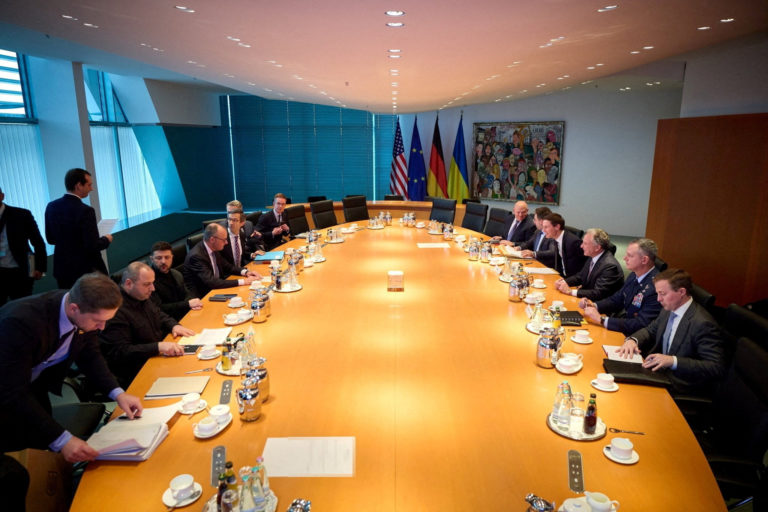
From Moscow, the US envoys travelled to Dublin, where Zelensky was attending the European Political Community summit, to brief him directly. It appears to have been in this sequence of conversations that the NATO-for-Donbas question was put to the Ukrainian side, although Zelensky's public account did not specify exactly when or by whom it was raised. According to Just Security's daily digest, citing the BBC, Zelensky also welcomed a pledge from Witkoff and Kushner to include EU delegates in the next round of talks with Russia.
Europe Gets a Seat, and a Team
That pledge matters because Europe has spent most of this year watching from the next room. Peace talks so far have involved only the United States, Russia and Ukraine, while European governments, which provide the bulk of Ukraine's financial support, were briefed separately. On November 13, at an informal meeting of EU leaders in Dublin, European Council President António Costa announced that Europe would be represented in future negotiations by the EU's institutions together with the "E5," the five largest military powers in the Coalition of the Willing: France, Germany, Italy, Poland and the United Kingdom.
"Europe must speak with one clear and united voice in all discussions" that shape Ukraine's future and Europe's security, Costa said, according to the Kyiv Independent. He insisted that "only Ukraine has the legitimacy to decide on matters concerning its territory and sovereignty," and that security guarantees should be discussed within the Coalition of the Willing in close coordination with NATO. "The weeks ahead will be a decisive test of Russia's readiness to bring this war to an end," he added. European Commission President Ursula von der Leyen said the "path to peace" would not be easy, and that "the best way to get Russia to the table is to keep up our support for Ukraine." She said the Commission would soon propose a 22nd package of sanctions against Russia and would put forward a plan to close Ukraine's 2027 financing gap before the next European Council, scheduled for November 26 and 27.
French President Emmanuel Macron, meanwhile, voiced frustration over what he described as a lack of US support for Ukraine and argued that Europe must step up, according to The Hill.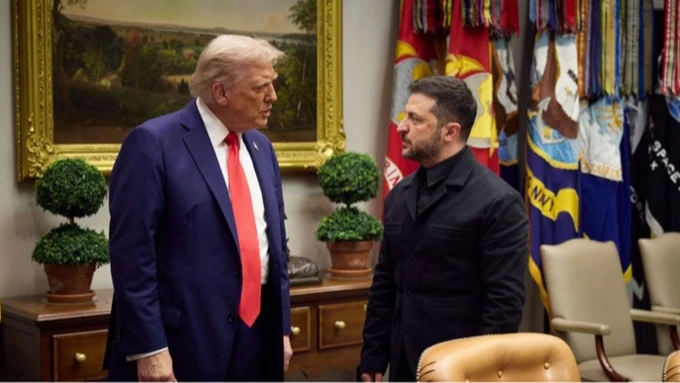
Zelensky's Conditions
Zelensky's response to the American question was carefully hedged. He said Kyiv is discussing "specific security guarantees from NATO and the EU," and that if Western partners confirm them, he would consult Ukrainian society. "I have no right to make that decision on my own," he said, according to RTÉ. Reuters, via Asharq Al-Awsat, reported that he would put a deal to a referendum only if Ukraine received a comprehensive package including security guarantees, a strong and well-funded army without imposed limits, and money for reconstruction. Outlets differed slightly in emphasis: some framed the US idea as a proposal, others as a question or suggestion, and the Kyiv Post alone highlighted Kyiv's continued refusal to legally recognise any occupied territory as Russian. These differences reflect the ambiguity of a diplomatic probe rather than a formal offer, and no American official had publicly confirmed or described the idea at the time of writing.
Zelensky also warned against any arrangement that would weaken the Western security architecture. "Real security in Europe means the EU and NATO. That's it. There is no other security in Europe," he said, cautioning that Kremlin attempts to reshape that architecture are "precisely things like this that lead to wars or escalations." He said Russia is "betting everything" on a winter campaign and urged Washington to pass a military package, including sanctions and weapons legislation from Congress, describing that as "the kind of motivation Putin needs."
Reactions from Moscow
There was no direct Kremlin comment on the NATO-for-Donbas idea in the reports available on Saturday. But Russian signals pointed firmly in the other direction. Foreign Ministry spokeswoman Maria Zakharova, as reported by Euronews, said the issue "was not discussed" during the talks with Witkoff and Kushner in Moscow. Since Zelensky's account concerns American questions put to Kyiv rather than to Moscow, the two statements do not necessarily contradict each other, but they suggest the idea has not yet been tested on the Russian side. Putin, according to reports aggregated from Arabic-language outlets, has continued to insist on control of all four annexed regions, has rejected foreign peacekeepers and buffer zones, and was quoted as saying that "there is only one dividing line, and it is the state border." Zelensky himself acknowledged the gulf, saying "you have also heard Putin's signals, and this is an extremely difficult conversation."
On the ground, the fighting continues. Russia's Defence Ministry claimed on Saturday to have captured the settlement of Tersianka in Zaporizhzhia province and to have struck Ukrainian energy and transport infrastructure; Reuters said it could not independently verify the claims. Ukraine, for its part, said it hit a Lukoil-owned refinery in Volgograd overnight.
Analysis: Why the Idea Matters, and Why It May Go Nowhere
The significance of the American question lies less in its likelihood of success than in what it reveals about Washington's thinking. For most of the past year, US envoys have pressed Kyiv to accept territorial realities in exchange for security guarantees of uncertain strength. Linking a withdrawal from the Donbas to NATO membership would reverse that logic, offering the strongest guarantee available, the Alliance's collective-defence commitment, in return for the most painful concession. It is the kind of trade that some Western analysts have floated for years, sometimes compared to West Germany's entry into NATO while Germany remained divided.
Yet the obstacles are formidable. Russia has made Ukraine's exclusion from NATO a core war aim, and nothing in Moscow's public statements suggests it would accept a deal that brings the Alliance to its border, even at the price of the entire Donbas. NATO membership also requires the unanimous approval of all 32 members, several of which have been sceptical of Ukrainian accession. And within Ukraine, any formal cession of territory would face deep resistance, which is precisely why Zelensky has tied it to a referendum and a package of guarantees he considers non-negotiable.
What's Next
The coming weeks will test whether this week's flurry of diplomacy produces anything durable. Europe's new negotiating team must now be integrated into talks that Washington has so far run on a three-way basis. The prisoner exchange agreed in Abu Dhabi will be an early indicator of whether the parties can deliver on even limited commitments. The European Council on November 26 and 27 will have to decide how to finance Ukraine through 2027, a question that will shape Kyiv's ability to keep fighting through a winter that Zelensky expects Russia to exploit. And in Washington, the outgoing Republican-controlled Congress has only weeks left before a Democratic majority arrives in January, a shift that could alter the politics of any military aid package. Whether the NATO question was a genuine opening or a trial balloon, Zelensky's decision to make it public has ensured that it will now be part of the conversation.