Written By | Health News Agencies
The FDA has approved AstraZeneca's Imfinzi together with the antibody-drug conjugate Padcev for people with muscle-invasive bladder cancer who cannot have, or refuse, cisplatin chemotherapy
WASHINGTON
For thousands of older bladder cancer patients, the options have long been grim: have the bladder cut out, hope for the best, and face a coin-flip chance that the cancer comes back within a year.
As of this week, that changes.
On Friday, November 13, the US Food and Drug Administration approved a new treatment plan that pairs two powerful drugs before surgery and keeps one going afterwards. The regimen combines durvalumab (sold as Imfinzi by AstraZeneca) with enfortumab vedotin (sold as Padcev). It is now approved for adults with muscle-invasive bladder cancer (MIBC) who are "ineligible for or who have refused cisplatin-based chemotherapy."
In the pivotal trial behind the approval, the combination cut the risk of the cancer returning, progressing or causing death by almost half, cut the risk of dying by 42%, and left 40% of patients with no detectable tumour at the time of surgery. Among patients who went straight to surgery, that figure was just 8%.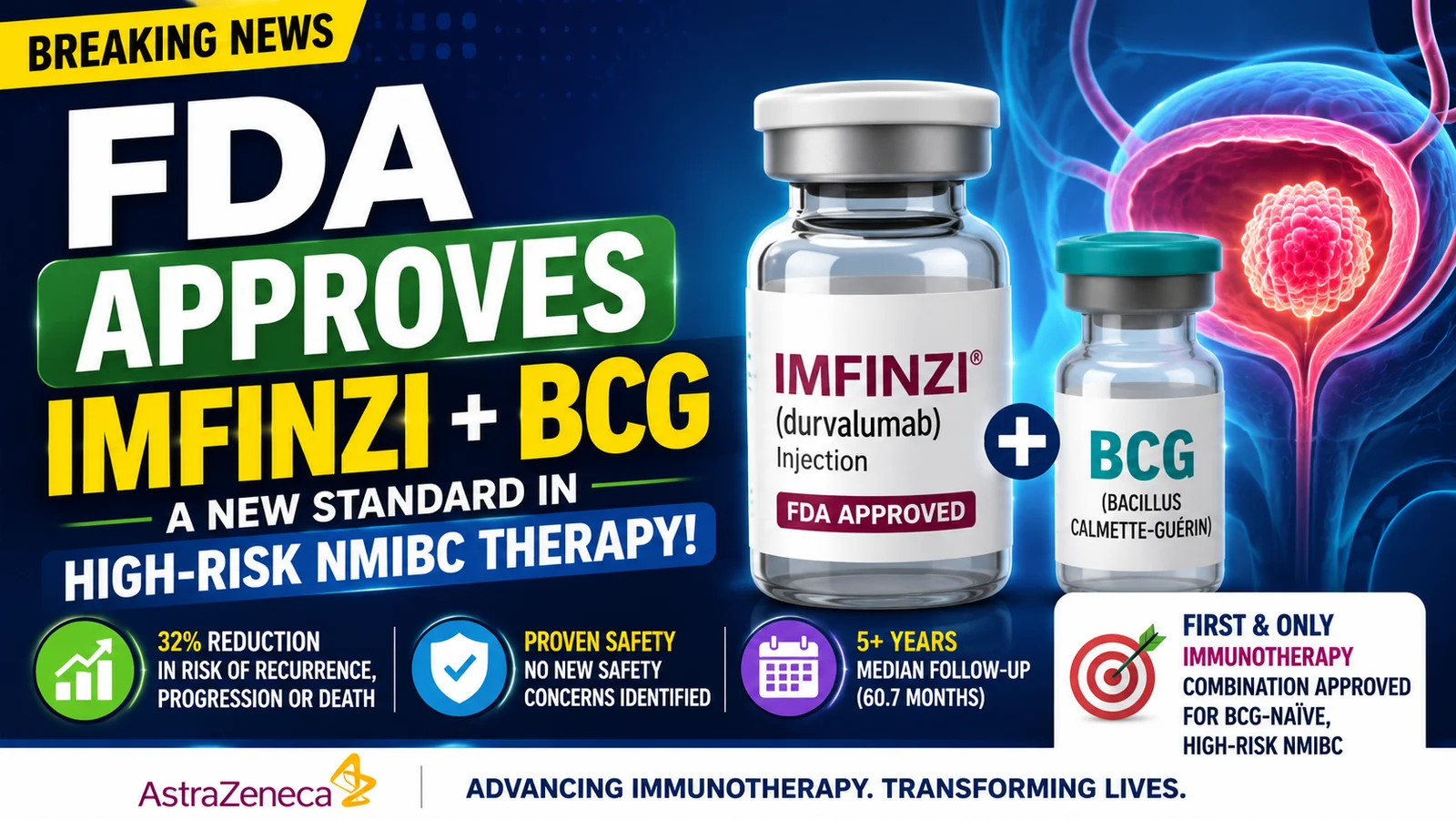
The forgotten patients of bladder cancer
Bladder cancer is often thought of as a "quiet" cancer, but it is anything but rare among older adults. About a quarter of bladder cancers are muscle-invasive, meaning the tumour has grown beyond the bladder's inner lining into the muscle wall. At that stage it is life-threatening, and doctors move fast.
For years, the gold-standard approach has been cisplatin-based chemotherapy before surgery to remove the bladder, a procedure called radical cystectomy. The chemo shrinks the tumour and kills stray cancer cells that may already have escaped.
But there is a catch. Cisplatin is hard on the kidneys and the body, and many bladder cancer patients are older, with weakened kidney function, heart problems or other conditions that make the drug too risky.
"Up to half of patients with muscle-invasive bladder cancer are not eligible for cisplatin," said Professor Thomas Powles, chair of Barts Cancer Centre at Queen Mary University of London and the international coordinating investigator of the trial.
For those patients, the default has largely been surgery alone, with or without approved treatment afterwards. And the cancer has a nasty habit of coming back. In the trial's control group, the median time before a recurrence, progression or death was just 12.1 months.
Meet the two drugs
The new regimen pairs two very different kinds of cancer-fighter. Durvalumab is an immunotherapy, a so-called checkpoint inhibitor. Cancer cells often hide from the immune system by flipping a molecular "off switch" called PD-L1. Durvalumab blocks that switch, taking the brakes off the body's own T-cells so they can recognise and attack the tumour.
Enfortumab vedotin is an antibody-drug conjugate, sometimes described as a "smart bomb." It is made of an antibody that homes in on a protein called Nectin-4, which is found in large amounts on most bladder cancer cells, chemically linked to a potent cell-killing payload. The antibody delivers the toxin directly into the cancer cell, sparing much of the healthy tissue that ordinary chemotherapy damages.
Together, the theory goes, the "smart bomb" breaks open cancer cells while the immunotherapy rallies the immune system to clean up what is left.
Inside the VOLGA trial
The approval rests on VOLGA, a large international, randomised, open-label phase 3 trial (NCT04960709). It enrolled 695 patients with muscle-invasive urothelial carcinoma who either could not have cisplatin or had chosen not to.
Patients were split into three equal groups. One group of 233 received durvalumab plus enfortumab vedotin before surgery, then durvalumab alone afterwards. A second group of 233 got the same treatment plus a third drug, the immunotherapy tremelimumab. A control group of 229 went straight to radical cystectomy, followed by observation or locally approved treatment.
These were not young, fit volunteers. The median age in both the investigational and control arms was 72, and 82% of patients were men, reflecting the real-world face of the disease.
The treatment schedule is precise. Before surgery, patients receive durvalumab 1,500 mg every three weeks plus enfortumab vedotin 1.25 mg/kg on days 1 and 8 of each cycle, for three cycles. After surgery, durvalumab 1,500 mg continues every four weeks for up to nine cycles. Patients weighing less than 30 kg receive durvalumab at 20 mg/kg on the same schedule.
The results that won the FDA over
The headline numbers, from a data cutoff of March 2, 2026, are striking.
Event-free survival (EFS), the trial's main measure, tracks how long patients live without the cancer coming back, getting worse or dying. In the surgery-only group, the median was 12.1 months. In the durvalumab-plus-enfortumab group, the median had not even been reached, because too few patients had suffered an event to calculate it. The hazard ratio was 0.51, a 49% reduction in risk.
Put another way: one year after starting, 73% of patients on the combination were alive and cancer-free, compared with 50% of those who had surgery alone. At two years, it was 64% versus 45%.
Crucially, patients also lived longer. The risk of death fell by 42% (hazard ratio 0.58). At a median follow-up of 26 months, 21% of patients in the combination group had died, compared with 32% in the control group. Two-year overall survival was 78% versus 69%.
Then came perhaps the most eye-catching figure of all. When surgeons removed the bladders, independent pathologists found no remaining invasive cancer, a pathologic complete response, in 40% of patients on the combination. In the surgery-only group, the rate was 8%. That is a nearly five-fold difference.
The benefit held up across the board. Patients whose tumours had high PD-L1 levels saw a benefit (hazard ratio 0.58), and so did those with low or negative PD-L1 (0.46). It worked in patients who were medically ineligible for cisplatin (0.53) and in those who simply refused it (0.49).
An exploratory blood test analysis added another hopeful signal: 60% of patients who had detectable circulating tumour DNA (cancer DNA floating in the blood) before treatment had cleared it by the time of surgery.
Why the triple combo didn't make the cut
The FDA's approval applies only to the two-drug regimen. The triplet arm, which added tremelimumab, did improve event-free survival (hazard ratio 0.61), but its overall survival advantage did not reach statistical significance at the interim analysis (hazard ratio 0.77). Follow-up of that group continues.
The side effects: real, but manageable
This is not a gentle treatment, and doctors are clear about that. Almost every patient on the combination, more than 99%, experienced some side effect, compared with 74% in the surgery-only group, which still experienced the after-effects of a major operation.
Serious grade 3 or 4 side effects hit 64% of the combination group versus 44% of controls. Side effects directly caused by the treatment at grade 3 or 4 occurred in 30% of patients. There was one treatment-related death (0.4%). Deaths from adverse events of any cause were similar, at 7% versus 6%.
The most common problems were itching (44%), urinary tract infections (36%), anaemia (32%), diarrhoea (26%), constipation (25%), loss of appetite (24%), rash (22%), nausea (21%), weakness (21%), hair loss (21%) and altered taste (20%). Treatment-related skin reactions occurred in 49% of patients, and peripheral neuropathy, nerve damage causing tingling or numbness, in 18%, almost all of it mild.
Immune-related side effects, a known risk with checkpoint inhibitors, affected a third of patients, with 11% at grade 3 or 4. There were no immune-related deaths.
Importantly for a curative-intent treatment, the drugs rarely got in the way of the operation itself. Surgery was delayed in 4% of patients on the combination, compared with 0.4% in the control group, and cancelled in just 0.9%. About one in five patients (21%) stopped at least one of the drugs because of side effects. Patients' overall quality of life was maintained after surgery.
Expert perspective
The approval caps a rapid run for the regimen. AstraZeneca announced the positive VOLGA results in May 2026, and in September the FDA granted the application priority review, a fast-track pathway for drugs that may offer a significant advance.
For AstraZeneca, the decision cements a big bet on bladder cancer. VOLGA is the third positive phase 3 trial for Imfinzi in the disease, following NIAGARA, which established the drug alongside platinum chemotherapy around surgery for muscle-invasive disease, and POTOMAC, in earlier-stage non-muscle-invasive cancer.
Susan Galbraith, AstraZeneca's head of oncology and haematology research and development, has said the bladder cancer trials set "a strong foundation for Imfinzi as the immunotherapy backbone in this early-stage, curative-intent setting."
The stakes are commercial as well as clinical. Imfinzi brought in more than $6 billion in sales last year, according to Pharmaphorum, a 37% jump, with bladder cancer a key growth driver.
The new approval also intensifies a crowded race. Padcev is already being paired with Merck's immunotherapy Keytruda for muscle-invasive bladder cancer before and after surgery, and Bristol Myers Squibb's Opdivo is approved as a post-surgery option for some patients. Specialists now have more tools than ever, and a growing need to work out which patient should get which combination.
What this means for you
If you or someone you love has been diagnosed with muscle-invasive bladder cancer, here is what this decision could mean.
Ask about cisplatin eligibility. Your oncologist will assess your kidney function, hearing, heart health and overall fitness. If cisplatin is not safe for you, or you do not want it, this new combination is now an FDA-approved option.
Ask about treatment before surgery. VOLGA showed that giving drugs before the bladder is removed can dramatically shrink or eliminate the tumour. Do not assume surgery alone is your only choice.
Understand the trade-offs. The combination carries a heavy side effect burden, including skin reactions, infections, nerve symptoms and immune-related problems. Ask your care team how they will monitor you and what to report immediately.
Seek a specialist centre. Muscle-invasive bladder cancer treatment involves urologists, medical oncologists and specialist nurses working together. A multidisciplinary team can help you weigh all the options, including clinical trials.
Know the warning signs. Blood in the urine, even once and even without pain, is the most common early sign of bladder cancer. Frequent or painful urination can also be a warning. See a doctor promptly.
The bottom line
For decades, the patients who could not tolerate cisplatin were left with the bluntest option: surgery, and then a long, anxious wait. The VOLGA results suggest that era is ending.
A treatment that can wipe out visible cancer before the operation in four out of ten patients, and that helps more of them live longer, is a genuine shift for a group that medicine has too often left behind. The side effects are real and the long-term data are still maturing. But for older patients facing one of the toughest diagnoses in urology, the FDA has just handed doctors a powerful new weapon.