LAGOS
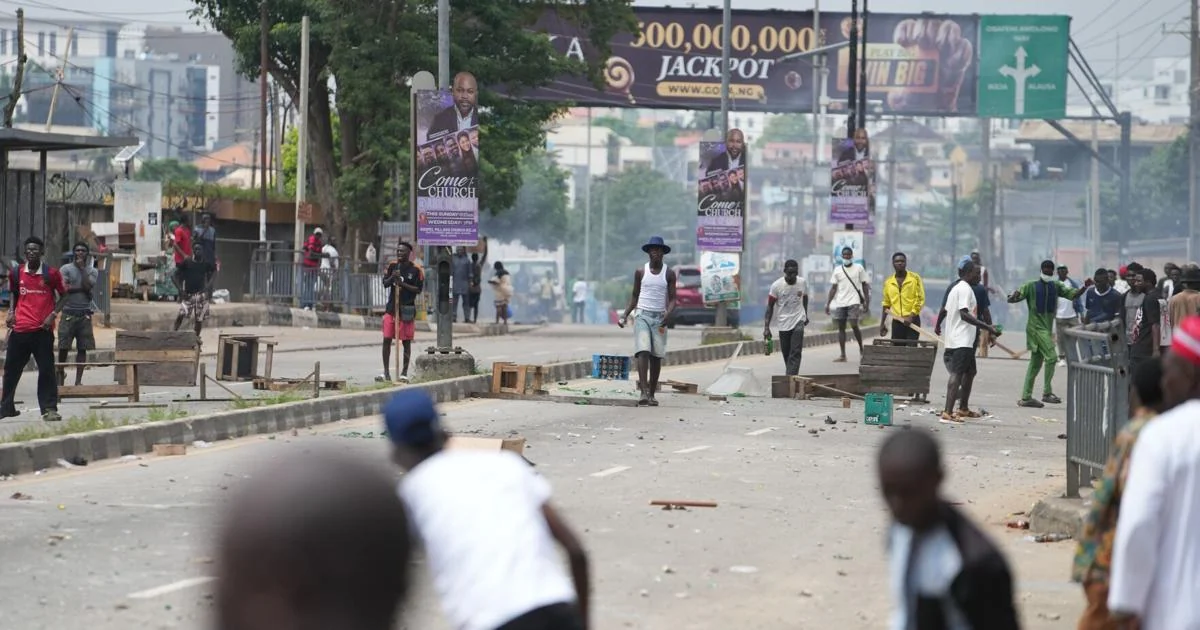
Armed men attacked a town hall organized by the opposition Nigeria Democratic Congress (NDC) in Lagos on Thursday, injuring supporters and assaulting journalists at an event for presidential candidate Peter Obi. The attack came a little over two months before Nigeria's presidential and National Assembly elections, scheduled for Jan. 16, 2027, and it landed on the same day the head of the country's electoral commission said he is dealing with more than 300 pending court cases, including one that could remove another leading opposition candidate from the ballot.
The two developments describe a campaign that is under strain from both ends. On the street, political violence is spreading across several states. In the courts, the question of who will actually appear on the ballot is still unresolved with the vote about nine weeks away.

What happened in Lagos
The NDC town hall was scheduled for the Classique Event Centre on Kudirat Abiola Way in the Oregun area of Ikeja, Daily Trust reported. Witnesses told the newspaper that attackers armed with guns, cutlasses, axes and other weapons invaded the venue and disrupted preparations ahead of the arrival of Obi and his running mate, Rabiu Kwankwaso. AFP, citing witnesses and video shared on social media, described men wielding sticks, machetes and axes rushing into a hall of supporters and dispersing the crowd. Police fired tear gas to disperse the confrontation, which spilled onto the road.
Mansur Ibrahim, a Nigerian photojournalist at the scene, told AFP that a large group of men barged in ahead of Obi's arrival. "They actually came into the hall, broke all the entrance doors and the glass walls," he said. "The NDC guys repelled them, chased them out of the hall into the road, and they started throwing stones at each other in the middle of the road."
Lagos police spokesperson SP Abimbola Adebisi confirmed that two people were injured and said the situation was under control, according to Daily Trust. Journalists were among the targets: AFP reported that a reporter from TheCable, Sam Adebanjo, was beaten and attacked with an axe, and had his equipment stolen, according to TheCable's own report. Despite the disruption, Obi later addressed supporters at the venue and said the party would not be deterred. "We will campaign in every part of Lagos State," he said, according to a report carried by Oman Ghana.
Who blamed whom
The NDC blamed the ruling All Progressives Congress (APC). NDC spokesman Osa Director told AFP: "Nobody is going to intimidate us, we will exercise our right to participate in this election." In a statement, the NDC National Campaign Council's spokesperson, Chiogo Constance Ikokwu, called the attack "an unacceptable assault on democracy" and said: "Nigeria is not a conquered territory, and political participation is not a crime." The party demanded arrests and prosecutions.
The APC rejected the accusation. Spokesman Felix Morka told AFP: "When a person makes an allegation, it is their duty to substantiate and provide evidence." The Lagos APC spokesman, Mogaji Seye Oladejo, said the party's leaders were attending its 2027 campaign flag-off in Epe, many kilometers away, when the incident occurred, according to Daily Trust. At the same time, the APC Presidential Campaign Council, through spokesperson Dele Alake, condemned the disruption and urged security agencies to arrest and prosecute those responsible, stating that both instigators and perpetrators "must face the full weight of the law."
The attribution therefore remains disputed. No arrests or findings of responsibility had been reported by the time of publication, though Daily Trust quoted one supporter as saying a suspect apprehended during the incident was taken away by police. AFP noted that the NDC had previously blamed a series of event cancellations on the government, which it accused of pressuring venue owners, claims the government denied.
A wider pattern of violence
The Lagos attack is not isolated. Daily Trust reported that in the preceding seven days there were cases of political violence in no fewer than seven states. On the previous Saturday, according to Daily Trust, NDC supporters were attacked at a rally in Delta State organized by the Obedient/OK Movement in support of Obi and Kwankwaso; one person was confirmed dead and five were injured. In Zamfara State, an APC rerun primary for a House of Representatives seat was marred by violence in which two people were reportedly killed, according to the same report. Incidents were also recorded in Edo, Gombe and Cross River states. The APC's own campaign council acknowledged attacks in Edo, Cross River and Gombe, saying they targeted political leaders and supporters across party lines.
Independent monitors have documented the trend. The National Peace Committee found 109 breaches of the National Peace Accord across 26 states and the Federal Capital Territory between Aug. 19 and Oct. 27, Daily Trust reported. Political violence and thuggery accounted for 33 of those, and misinformation and disinformation for 29. The committee named Kaduna, Edo and Enugu as serious flashpoints.
The National Assembly has taken notice. The House of Representatives set up a committee this week to investigate attacks on political gatherings and report in three weeks, according to the Nigeria Brief. Daily Trust reported that on Thursday the House adopted a motion by Minority Leader Fred Agbedi and 16 other lawmakers condemning violence, intimidation, assault and destruction of property at political events. The newspaper also quoted Murtala Muhammad, vice president of the Nigerian Political Science Association, who warned that Nigeria "may likely go into anarchy" if the violence is not urgently addressed.
The ballot-box question: Atiku's candidacy
While the street violence dominated Thursday's headlines, a second story was developing in the courts. On Nov. 5, a Federal High Court in Abuja voided the nomination of former Vice President Atiku Abubakar as the presidential candidate of the African Democratic Congress (ADC), Reuters reported. Atiku, who came second in the 2023 election with 29% of the vote, had won the ADC ticket in May. Nigerian media reported that the court overturned the ADC leadership led by David Mark, who has been fighting with Nafiu Bala Gombe over control of the party, and in doing so invalidated decisions the leadership took, including the primary that produced Atiku, according to AFP and Arise TV. The ADC rejected the ruling, called it politically motivated and said it would appeal. Atiku's campaign has blamed the government for being behind the lawsuit, which the ruling party denies.
On Thursday, Independent National Electoral Commission (INEC) chairman Joash Amupitan addressed the question at Chatham House in London. Asked whether Atiku would stay on the ballot if he fails to overturn the ruling, he said: "If he eventually fails, well, I'm obligated under Section 285 of the Constitution of Nigeria to obey every court order, especially if it is from the Supreme Court." Daily Trust reported that he said INEC has "over 300 cases hanging on the neck of INEC, and elections are just about 66 days away" and that the commission has already begun procuring sensitive election materials, which makes late reversals a logistical headache.
Amupitan argued for reform: all pre-election disputes should be concluded at least six months to a year before voting day. "The danger is that whenever there is such a decision, and it's up to you to now implement it, you become the problem," he said. The matter is now headed to the Court of Appeal, according to Daily Trust.

Background: a crowded and contested field
President Bola Tinubu is seeking a second term under the APC. He won in 2023 with 36.6% of the vote in a split opposition, AFP noted, and Obi finished third that year. Campaigning formally resumed after a ban was lifted on Aug. 19, 2026, and INEC has published a field of 18 presidential candidates, according to the Wikipedia entry on the election, which cites the commission. The governorship and state assembly elections are set for Feb. 6, 2027.
The opposition field has been shaped as much by courts as by voters. Earlier this year a Federal High Court ordered INEC to deregister the ADC and four other parties, a ruling the Court of Appeal later nullified in July. Atiku hailed that judgment at the time. The pattern has left opposition parties arguing that legal tactics are being used to narrow the ballot, which the government denies.
Analysis: two threats to credibility
Taken together, the two developments point to different threats to the election's credibility. The violence threatens participation: if candidates and voters believe that attending a rally can lead to a beating, turnout and campaign activity will suffer, and the parties that are most often targeted lose out most. The litigation threatens legitimacy: if a major candidate is struck from the ballot weeks before the vote, and especially if it happens after INEC has begun procuring sensitive election materials, supporters may conclude that the contest was decided in court rather than at the polls.
What to watch next
Several markers will show whether the campaign stabilizes. The first is whether Lagos police announce arrests or charges in the Oregun attack, and whether the House committee investigating rally violence reports within its three-week deadline. The second is the Court of Appeal's handling of the ADC leadership case, and whether it rules in time for INEC to finalize the ballot. The third is whether the NDC and other opposition parties are able to hold events in Lagos and elsewhere without further disruption.
Nigeria has roughly nine weeks to settle both questions. If it cannot, the January vote will be fought not only over policy and personality but over whether the process itself can be trusted.
Published By | News Editor