Economic & Social Transformation
For most of the past decade, African stock exchanges were described with a familiar list of adjectives: thin, illiquid, dominated by a handful of telecoms and banks, and shunned by companies that preferred private equity, bank loans or listings in London and New York. In 2026 that story has been interrupted. Across West, East, North and Southern Africa, equity indices have posted some of the strongest returns in the world, long-awaited initial public offerings (IPOs) have finally reached the market, and regulators are rewriting listing rules to lure issuers back. The question for policymakers is whether this is a cyclical rally riding on easing inflation and stabilising currencies, or the start of a structural shift in which domestic capital markets begin to finance African growth at scale.
This article looks at the evidence exchange by exchange, then asks what would have to happen for the rally to translate into deeper markets that serve households, pension funds and companies, rather than a brief windfall for a narrow set of investors.
A continent-wide rally, measured in dollars
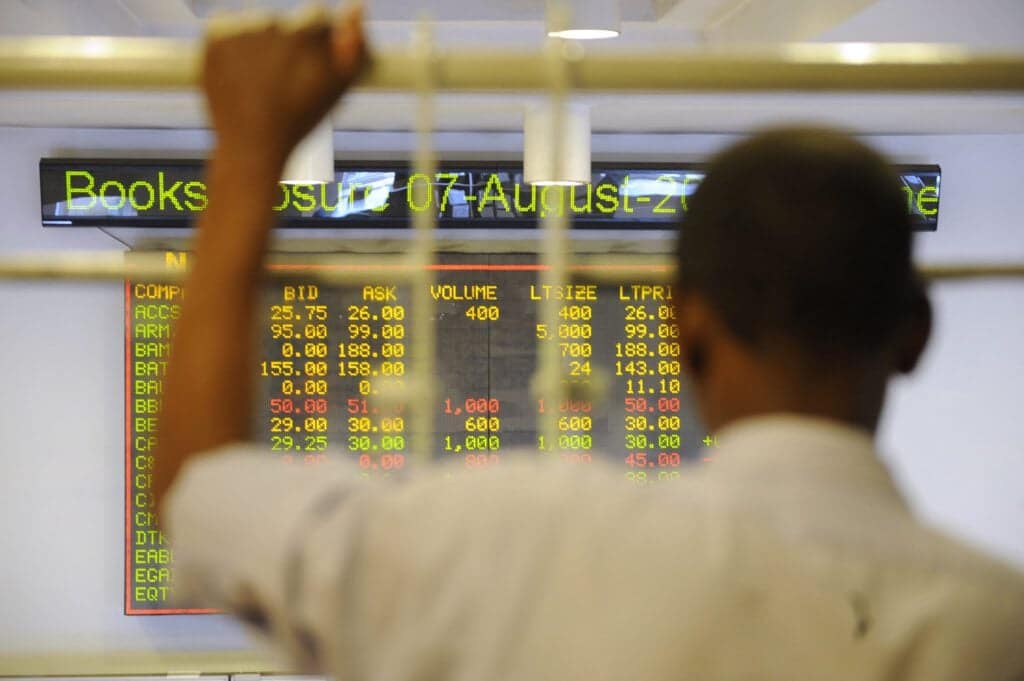
The headline numbers are striking. By late May 2026 the Nigerian Exchange (NGX) All-Share Index had gained about 69 percent in US-dollar terms, the highest return among the 17 African exchanges tracked by the data provider African Markets, according to BusinessDay. The BRVM, the regional exchange in Abidjan that serves the eight countries of the West African Economic and Monetary Union (WAEMU), saw its Composite Index set repeated records, closing at 555.48 points in the week to 11 September, up roughly 60 percent for the year, according to market reports compiled by Daba Finance; the exchange's own bulletin had shown the index up 26.4 percent by 11 June. Ghana's GSE Composite Index was up about 63 percent year-to-date at the end of October, even after pulling back from a March peak above 15,500 points. In Nairobi, the Nairobi Securities Exchange (NSE) crossed KSh4 trillion in market capitalisation for the first time in August, reaching a record of around KSh4.17 trillion as Safaricom rallied.
Aggregators estimate that combined African market capitalisation has passed US$2 trillion, up from about US$1.6 trillion in 2024, though that figure mixes data from different dates and should be read as indicative. The Johannesburg Stock Exchange (JSE), at roughly US$1.4-1.5 trillion, still accounts for around three-quarters of the continent's listed value. The rest of the continent remains small by global standards: Nigeria's market, now Africa's second largest at roughly US$117-119 billion, is comparable to a single large-cap company in the United States.
Nigeria: reform, recapitalisation and the Dangote test
Nigeria's rally is the clearest example of how macroeconomic reform can reprice a market. After the 2023-24 currency unification and removal of the petrol subsidy, the naira's steadier path and falling inflation brought foreign and domestic investors back to equities. ThisDay data show that total market capitalisation of all listed securities (equities and bonds) closed August 2026 at N215.09 trillion, up N65.4 trillion, or 43.7 percent, from N149.7 trillion at the end of December 2025. Equity capitalisation alone stood near N160 trillion in early November.
A second driver has been the Central Bank of Nigeria's bank recapitalisation programme, which raised about N4.65 trillion of fresh capital across 33 institutions between March 2024 and April 2026, much of it through rights issues and public offers on the exchange. By 17 April 2026, 26 listed companies were each worth at least N1 trillion, a cohort that barely existed three years earlier, according to Proshare.
The next test is the planned listing of the Dangote Petroleum Refinery. Analysts quoted by BusinessDay and others project that a successful listing could lift NGX capitalisation to N200-225 trillion and that the refinery could account for roughly a quarter of the exchange's value. That would deepen the market but also concentrate it, and the listing has been repeatedly delayed, with some analysts questioning the reported pricing. With elections approaching in early 2027, the NGX's own N230 trillion year-end target is an aspiration, not a forecast.
Kenya: the end of an IPO drought
Kenya's story is about supply finally meeting demand. The listing of Kenya Pipeline Company (KPC) in early 2026, after an IPO that was reported as about 105.7 percent subscribed and raised roughly KSh112 billion, ended an 11-year drought of IPOs on the NSE. Market capitalisation reached a record KSh3.76 trillion at the end of June, a 27.8 percent gain in shilling terms for the first half, and then pushed past KSh4 trillion in August. NSE chief executive Frank Mwiti has said the market could reach KSh5 trillion by the end of 2026 if gains continue.
Yet concentration remains a structural weakness. Safaricom alone accounts for roughly a third or more of the market's value, so the index often moves with a single stock. Turnover outside the largest banks and Safaricom is thin, and the volatility of smaller counters (Car & General, the year's runaway leader, fell 37 percent in one stretch in August) shows how little liquidity it takes to move prices.
Francophone West Africa and Ghana: regional scale and recovery
The BRVM is the continent's most interesting experiment in pooled capital markets: one exchange, one currency (the CFA franc) and one regulator serving Côte d'Ivoire, Senegal, Benin, Burkina Faso, Mali, Niger, Togo and Guinea-Bissau. Its market capitalisation topped XOF 20 trillion during an August surge driven by heavyweights such as Sonatel, according to Daba Finance. The regional model shows how small economies can pool listings and investors to reach a scale no single member could achieve alone, though trading is still dominated by a few large telecoms and banks.
Ghana's gains reflect recovery more than expansion. After the 2022-23 debt crisis and domestic debt exchange hit banks and pension funds hard, the completion of the IMF programme, the cedi's recovery and sharply lower inflation have revalued listed banks and MTN Ghana. The challenge now is to turn that repricing into new listings, which have been scarce.
South Africa and Egypt: fixing supply
The two largest and most sophisticated markets face a different problem: companies leaving. The JSE has lost hundreds of listings over two decades through take-privates and delistings. Its answer is a simplified rulebook, which took effect for new applicants on 13 January 2026 and for existing issuers on 16 February 2026. The reforms cut the listings requirements roughly in half, created Main Board Prime and Main Board General segments alongside AltX, and allowed dual-class shares for Main Board applicants. Thirty-one Main Board companies have migrated to the General segment. Commentators remain divided on whether take-privates at large premiums signal a loss of confidence or a healthy recycling of capital.
Egypt is using the exchange as a tool of state reform. Under its IMF-backed programme, the government is listing state-owned enterprises on the Egyptian Exchange (EGX). Reports differ on the count, but by mid-2026 a government update cited 12 state companies listed with more in preparation, and three petroleum firms (ENPPI, ELAB and Petroleum Marine Services) were admitted in June to launch the petroleum-sector programme. The first public offerings from the provisionally listed pipeline are reportedly targeted for December. Turning temporary listings into genuine free floats is the real test.
Smaller markets illustrate the limits. Zambia's Lusaka Securities Exchange saw a direct listing by Klapton Reinsurance in March 2026, but its All Share Index was down about 3.8 percent year-to-date in early November, showing that debt restructuring alone does not automatically revive equity issuance.
Integration: the African Exchanges Linkage Project
Fragmentation is the continent's deepest structural barrier. Most exchanges are too small to attract global index investors on their own. The African Exchanges Linkage Project (AELP), led by the African Securities Exchanges Association (ASEA) with African Development Bank support, launched in December 2022 linking seven exchanges (Nigeria, Mauritius, Morocco, South Africa, Kenya, Egypt and the BRVM) through an order-routing platform built by DirectFN. Its reported Phase II, announced at the 2026 Building African Financial Markets forum, adds Botswana, Ghana, Eswatini and Uganda, with the ambition of giving investors access to over 2,000 securities on up to 15 markets and contributing to an integrated continental capital market by 2030. Uptake depends on broker participation, harmonised settlement and capital-account rules; so far cross-border trading volumes remain modest.
Why it matters for development
Deep equity markets matter for more than investors' returns. They give growing firms an alternative to expensive bank credit, allow governments to privatise or part-privatise state enterprises transparently, and give pension funds and insurers long-term local assets that match their liabilities. Nigeria's capital market is now reported at about 33 percent of GDP, according to the Association of Securities Dealing Houses of Nigeria, far below the ratios seen in emerging Asian economies. Wider retail participation also has social significance: when millions of Kenyans subscribed to the KPC offer, or when Nigerian retail investors join rights issues, ownership of national assets broadens.
There are also risks. Rallies driven by currency stabilisation can reverse quickly if inflation or politics turn. Concentration in a few stocks means index gains can overstate broad corporate health. And when retail investors arrive late to a rally, as happened in several markets in earlier cycles, losses can damage trust for years.
What would make the rally last
- More and better supply: credible IPO pipelines from privatisations (Egypt, Kenya, Ethiopia), large private champions (Dangote) and mid-sized firms using simplified boards such as the JSE's General segment.
- Domestic institutional demand: pension reforms that allow and encourage funds to hold listed equities, rather than mainly government bonds.
- Market plumbing: faster settlement, lower trading costs, digital retail platforms and securities lending to improve liquidity.
- Regional scale: making AELP routing and the BRVM model the norm rather than the exception, so investors can buy a portfolio of African firms through one account.
- Macroeconomic credibility: the gains of 2026 rest on falling inflation and steadier currencies. Losing either would undo them faster than any listing rule can help.
Conclusion
2026 may be remembered as the year African exchanges stopped being an afterthought. Nigeria, Kenya, Ghana and the BRVM have shown that investors will return when macroeconomic policy becomes credible and attractive assets come to market. But a rally is not the same as depth. The real measure of transformation will be whether, in five years, more African companies raise growth capital at home, more households own a piece of them, and more of the continent's savings are invested in its own firms rather than parked offshore or in short-term government paper.
Published By | Features Editor