Written By | International News Agencies
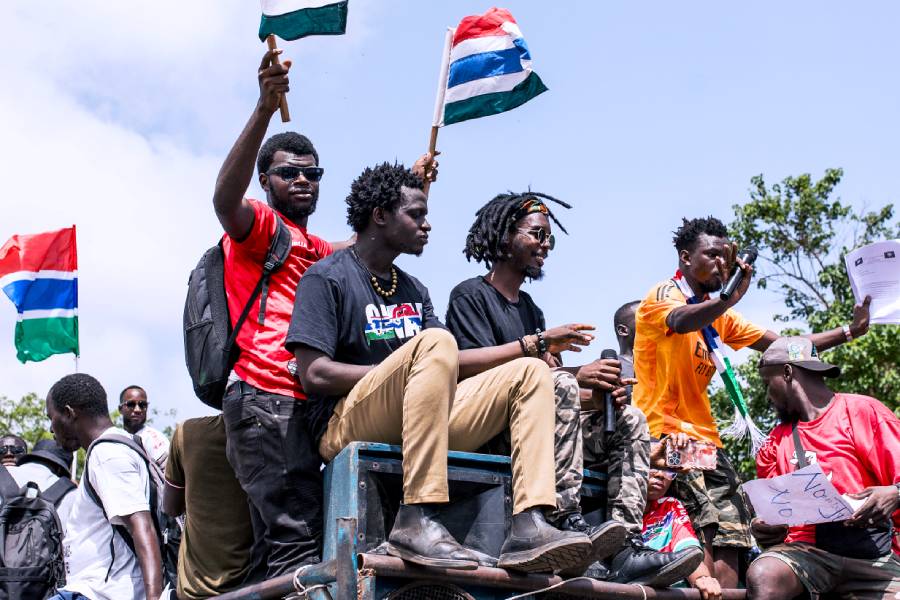
The commission, chaired by Joseph Colley, will issue formal acceptance of nominations to qualified candidates at 3 p.m. Thursday, according to The Point, a Banjul daily.
BANJUL, The Gambia
The Gambia's Independent Electoral Commission is scheduled to announce this afternoon which presidential aspirants have qualified for the Dec. 5 election, a decision that will settle the shape of a race in which President Adama Barrow is seeking a third term against two major challengers. The most consequential question hanging over the announcement is whether Talib Ahmed Bensouda, the former mayor of Kanifing and the flagbearer of an opposition coalition, will be cleared to run despite a government-accepted commission of inquiry finding against him.
The ruling matters well beyond the list of names on the ballot. It will be the third presidential election since the 2016 vote that ended Yahya Jammeh's 22-year rule, counting that vote, and the first in which Barrow, who once pledged to serve a short transitional term, seeks a third mandate. A contested disqualification of a leading opposition candidate, weeks before polling day, would test the credibility of an electoral system that has become one of West Africa's more closely watched democratic recoveries.
Today's announcement
The commission, chaired by Joseph Colley, will issue formal acceptance of nominations to qualified candidates at 3 p.m. Thursday, according to The Point, a Banjul daily. The nomination period, which opened on Nov. 3, closes on Nov. 14, The Point and The Rio Times reported.
Three candidates had completed all nomination requirements as of today, The Point reported: Bensouda of the Unite Movement for Change, known as UNITE; Ousainou Darboe, leader of the United Democratic Party; and Barrow of the National People's Party.
Several others still faced outstanding requirements. The Point reported that Kebba Bojang of the National Democratic Party needed 1,914 additional registered voters' signatures and was awaiting verification of his secondary school certificate; independent candidate Bakary K. Badjie, a National Assembly member, needed 2,310 additional national signatures plus outstanding signatures from several administrative areas; Ibrahima Tabora Manneh of the People's Alliance Party needed 1,507 more national signatures; and the Alliance of Progressive Citizens' candidate was 1,040 signatures short. The submission of the Gambia Labour Party candidate, identified by The Rio Times as Bakusa Dukureh, was not processed after he publicly acknowledged holding dual nationality.
The field has also narrowed through withdrawals. The Point reported that the Democratic Party formally pulled out of the race, along with several independent aspirants. On Nov. 9, Colley said the commission had received 12 nomination submissions out of 18 expected and that six aspirants had withdrawn, according to The Rio Times.
The Bensouda question
Bensouda's candidacy is the central legal dispute of the campaign. Section 62(3)(c) of the 1997 Constitution bars a person from contesting the presidency if, while holding public office, a commission or committee of inquiry established by law has found that person liable for misconduct, negligence, corruption or improper behavior, The Gambia Journal (Gambiaj.com) reported.
The Local Government Commission of Inquiry, which examined the administration and financial management of local councils, made adverse findings against Bensouda related to expenditure authorizations, recruitment and procurement at the Kanifing Municipal Council, according to The Gambia Journal. The commission submitted its report to the president on May 11, 2026, and Bensouda received an adverse-finding notice the next day, the Foroyaa newspaper reported. The government accepted the findings in a White Paper and endorsed further investigations and a forensic audit.
Bensouda's camp disputes that the findings meet the constitutional threshold. At a Nov. 4 news conference, UNITE's secretary for legal and constitutional affairs, Abdul Aziz Bensouda, who is also the candidate's brother and lawyer, argued that the commission did not find the former mayor personally liable for corruption, negligence, misconduct or improper behavior. He quoted the report's conclusion that the evidence "does not establish primary accounting officer liability" but supports "oversight level exposure," according to Foroyaa. "A white paper is a reaction to a report. It is not a new finding, it is not a new conclusion," he said.
UNITE has also made allegations that have not been independently verified, including that metadata on a copy of the report from the Ministry of Justice showed it "was altered after the 11th of May," Foroyaa reported.
Bensouda filed an appeal against the adverse finding at the Court of Appeal on June 24, 2026, and that case remains pending, The Gambia Journal reported. He resigned as mayor effective Nov. 6 — ending eight years and five months in office — to meet constitutional requirements for running, and he submitted his nomination papers on Nov. 7 with all 16 required credentials. "We are comfortable and we are more than hopeful. The law is very clear," Abdul Aziz Bensouda said after the filing, according to The Gambia Journal.
Barrow, for his part, has said in a Nov. 5 letter that the White Paper is neither a court judgment nor a ruling on anyone's eligibility, that the validity of the finding is before the Court of Appeal and that the electoral commission determines qualification, subject to the courts, according to The Gambia Journal's paraphrase.
The dispute has raised the temperature of the campaign. Bensouda alleged at a rally earlier this month that Attorney General and Justice Minister Dawda Jallow had approached the electoral commission and the president about his possible disqualification, The Gambia Journal reported. Jallow denied the claim, saying he had not visited the commission since becoming attorney general more than six years ago and had not advised Barrow to direct it. At the same time, UNITE national president Ebrima Dibba told supporters the party was prepared to "put our lives to the line" if Bensouda were blocked, prompting the Gambia Press Union to warn against hate speech and intimidation. "Elections should be a contest of ideas, not hostility; of vision, and not division," union president Isatou Keita said.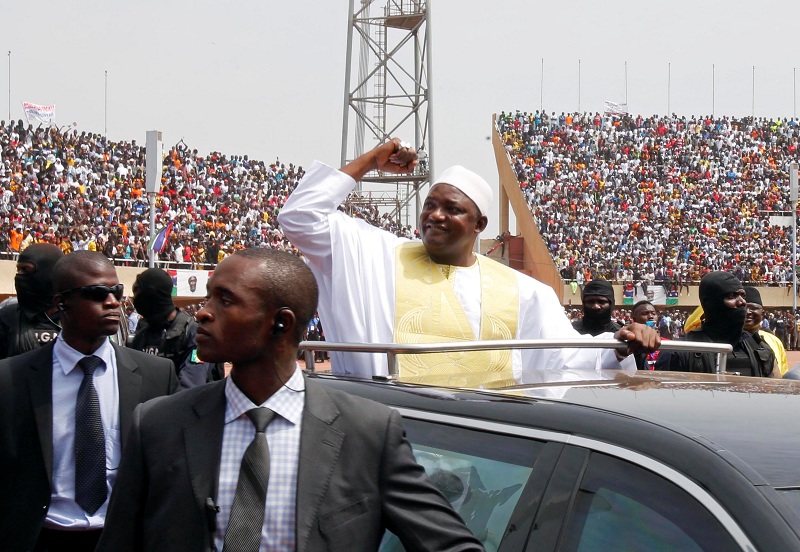
Barrow's third-term case
Barrow filed his nomination papers on Tuesday, Nov. 10. The current constitution imposes no presidential term limits, so he is eligible to run again. A draft constitution that would have introduced a two-term limit — with a provision counting Barrow's first term — failed in the National Assembly in September 2020, when it received 31 votes in favor and 23 against, short of the three-quarters supermajority required, according to the election's Wikipedia entry.
Speaking at his filing, Barrow said Gambians decide how long a president serves, The Rio Times reported in a paraphrase. He said he supports term limits but argued they are not necessarily the best system, citing Britain and Germany, where heads of government face no term limits. He promised a new constitution with term limits if his party wins a sufficient majority in the National Assembly, and he listed roads, electricity, agriculture, health care and education as his priorities.
Darboe, 78, a former vice president and Barrow's runner-up in 2021, has accused the president of obstructing constitutional reform to extend his hold on power, a charge Barrow's supporters reject. In the 2021 election, Barrow won 53.23 percent of the vote to Darboe's 27.72 percent.
Analysis: a three-way race on a narrow stage
The Gambia elects its president in a single round by plurality, meaning a candidate does not need a majority to win. That rule makes opposition fragmentation decisive. Polling is sparse and should be treated with caution. A Gambia Participates survey published in August put Barrow at 32 percent, Darboe at 25 percent and Bensouda at 19 percent, with 17 percent undecided; the UDP disputed that survey, The Rio Times reported.
If those figures are even roughly indicative, the combined opposition vote could rival or exceed Barrow's, but a divided opposition would still favor the incumbent under a first-past-the-post system. Bensouda's exclusion would remove the third-placed candidate in that survey and could push some of his supporters toward Darboe — or toward abstention and protest. His inclusion would keep the opposition vote split between two major challengers.
Either outcome carries risks for the commission. A decision to disqualify Bensouda while his Court of Appeal case is pending could invite accusations of political interference, given the allegations against the attorney general. A decision to clear him could prompt a legal challenge from rivals invoking Section 62(3)(c). Either way, the courts are likely to be drawn in during a compressed campaign window.
The relative significance of today's development should be kept in proportion. The Gambia's crisis is procedural rather than violent, and its institutions have so far handled the nomination process openly, with the commission publishing detailed lists of missing signatures and pending checks. But in a region where several states are now governed by military juntas and where incumbents have stretched or rewritten term limits, a clean, competitive vote in the Gambia would carry symbolic weight well beyond its size.
What to watch
The immediate markers are this afternoon's list of accepted candidates and the commission's handling of Bensouda's eligibility and the dual-nationality case; whether any rejected candidate goes to court before nominations close on Nov. 14; whether the Court of Appeal moves to hear Bensouda's case before polling day; and whether the parties and their supporters heed the press union's call for restraint once official campaigning begins. Voters go to the polls on Saturday, Dec. 5, dropping marbles into color-coded drums under the Gambia's distinctive voting system, with results typically known the following day.