Written By | Fashion and Design Desk
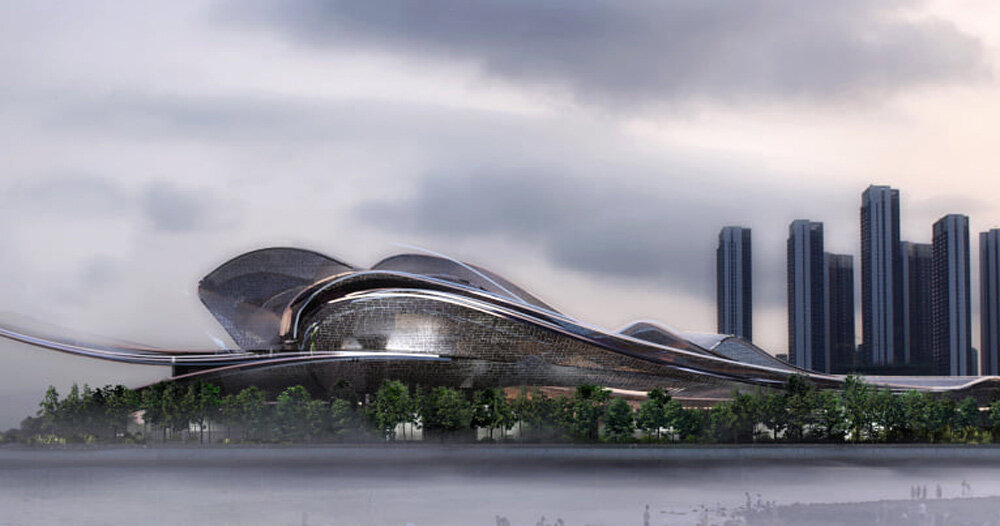
New construction images show the wave-roofed cultural complex taking shape on Shenzhen Bay, with completion targeted for December 2028
DESIGN
On a spit of reclaimed land in Shenzhen's Shekou district, surrounded by water on three sides, one of the most ambitious cultural buildings in Asia is starting to look like its renderings. Newly released construction images of Ateliers Jean Nouvel's Shenzhen Opera House, published by designboom on November 11, show the vast complex rising on the waterfront, with its signature sweeping roof scheduled to be structurally complete next year and full delivery targeted for December 2028.
For a city that has grown from fishing villages into a megacity of more than 17 million people in little more than four decades, it is a statement building in every sense: a cultural landmark intended to sit alongside the skyscrapers and tech campuses that define Shenzhen's global image.
A Building Shaped Like a Wave
The project, titled "Light of the Sea," was selected through an international competition in 2021. Its site, in the Dongjiaotou area of Shekou in Nanshan District, overlooks Shenzhen Bay, and Nouvel's Paris-based studio has responded directly to that setting. The defining feature is a sweeping, curved roof inspired by ocean waves, conceived as a "flowing ribbon" that wraps the complex in a single continuous profile.
The marine theme carries indoors. According to designboom, the interiors use mother-of-pearl finishes on the curves of the balconies and on acoustic walls, an effect intended to evoke light shimmering across water. It is a characteristically Nouvel move. The Pritzker Prize-winning French architect has long been fascinated by light and its filtering, from the mashrabiya-like apertures of the Institut du Monde Arabe in Paris to the perforated dome of the Louvre Abu Dhabi.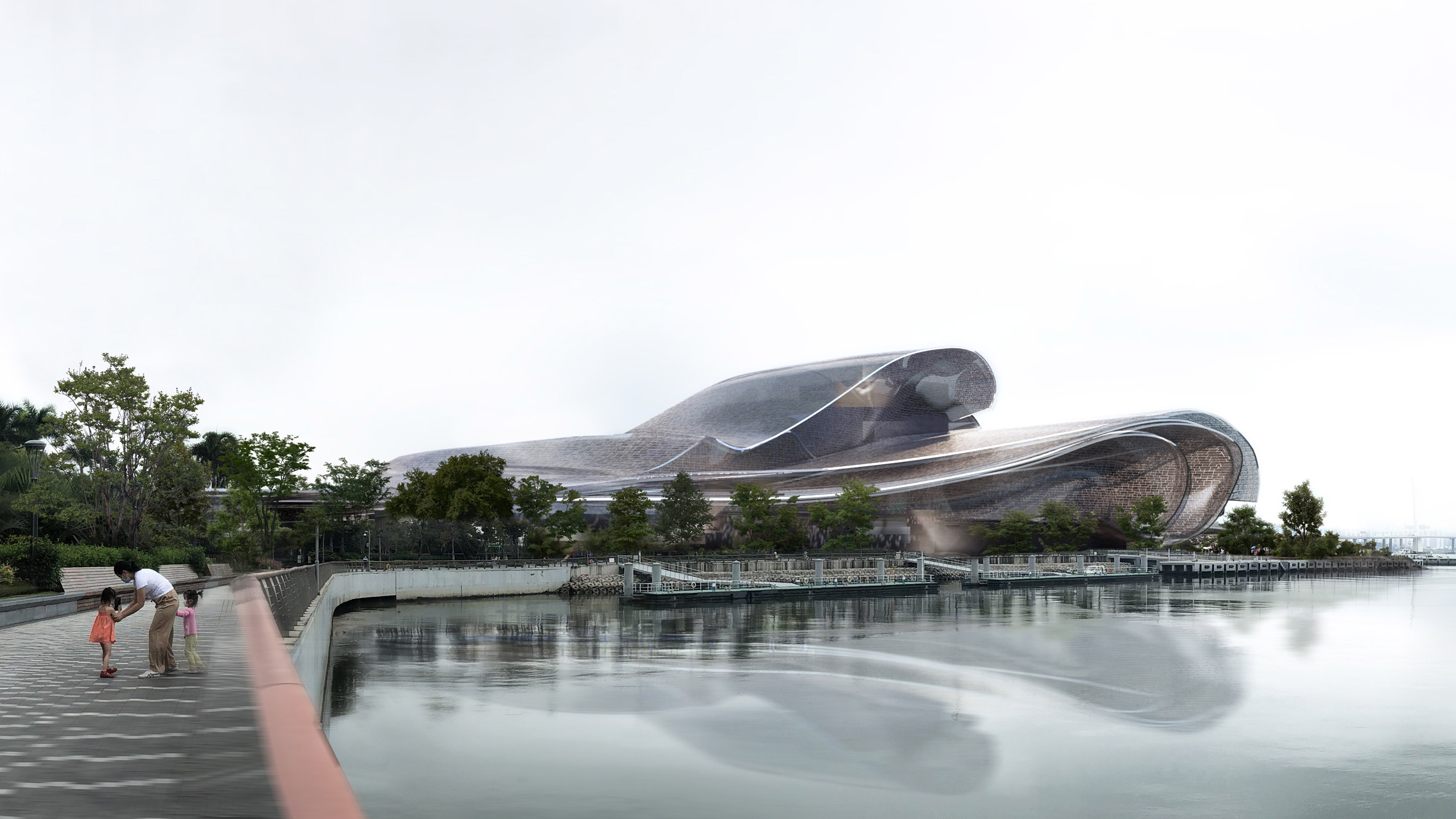
Four Venues Under One Roof
The scale is remarkable. The complex covers 220,000 square meters and contains four separate performance spaces: a 2,100-seat opera hall, an 1,800-seat concert hall, a 1,000-seat small opera hall and a 500-seat multifunctional theater. Together, that is capacity for more than 5,000 audience members at once.
Beyond the stages, the program includes public facilities, cultural and creative spaces, a stage design and production center, accommodation for performers, offices, outdoor terraces and a generous foyer. In other words, it is designed not just as a place to watch performances but as a working cultural campus where productions can be built, rehearsed and staged on site.
Acoustics are a central ambition. The project targets a background noise rating below NR 15, an extremely quiet standard that matters enormously in concert halls, where the hum of ventilation or traffic can undermine a pianissimo passage. Achieving it on a waterfront site in a busy port district is a significant engineering challenge.
There is a public dimension, too. The outdoor terraces and large foyer suggest a building meant to be used by residents even when no curtain is rising, a waterfront gathering place in a district better known for its port and container traffic than for its civic life.
Built With Robots
The construction itself reflects Shenzhen's identity as a technology hub. Designboom reports that the build is using welding and surveying robots along with digital design and construction technologies, tools that are increasingly common on complex Chinese megaprojects, where geometry like a continuously curving roof would be extraordinarily difficult to execute by traditional methods alone. The main roof structure is scheduled for completion in 2027, after which the building's iconic silhouette should be fully legible from across the bay. The project budget has not been disclosed in the coverage.
Part of a Wider Opera-House Boom
The Shenzhen project arrives amid a striking wave of large performing-arts buildings in China. Snøhetta's Shanghai Grand Opera House was completed earlier this autumn, and cities across the country have commissioned major international architects to deliver cultural venues as symbols of civic ambition. These buildings serve a double purpose: they provide genuine infrastructure for orchestras, opera and dance companies, and they act as architectural calling cards, much as the Sydney Opera House did for Australia half a century ago.
The question that always follows such projects is programming. A spectacular building needs a full calendar of performances and an audience to sustain it. Shenzhen's young, affluent and fast-growing population gives the opera house a strong potential base, and the inclusion of production facilities suggests an intention to create original work rather than simply host touring shows.
What This Means for You
For travelers, the Shenzhen Opera House is shaping up to be a destination in its own right, worth planning around once it opens. Shenzhen is easily reached from Hong Kong, and the bayfront location means the building will be as compelling from the outside, particularly at dusk, as it is inside. For design lovers, it is a chance to watch one of the world's most celebrated architects work at enormous scale in real time; the construction milestones over the next two years, especially the roof's completion in 2027, will be worth following. And for anyone interested in how cities brand themselves, it is a case study in how culture has become a central part of urban identity.
The Bottom Line
Jean Nouvel has spent his career sculpting light, and in Shenzhen he is attempting to capture the light of an entire bay under one rippling roof. With its four venues, quiet-as-a-library acoustic ambitions and robot-assisted construction, the "Light of the Sea" is a portrait of 21st-century Shenzhen: technologically confident, culturally ambitious and looking outward to the water. If it delivers on schedule in December 2028, it may well become the city's defining image.