Written By | Business Experts
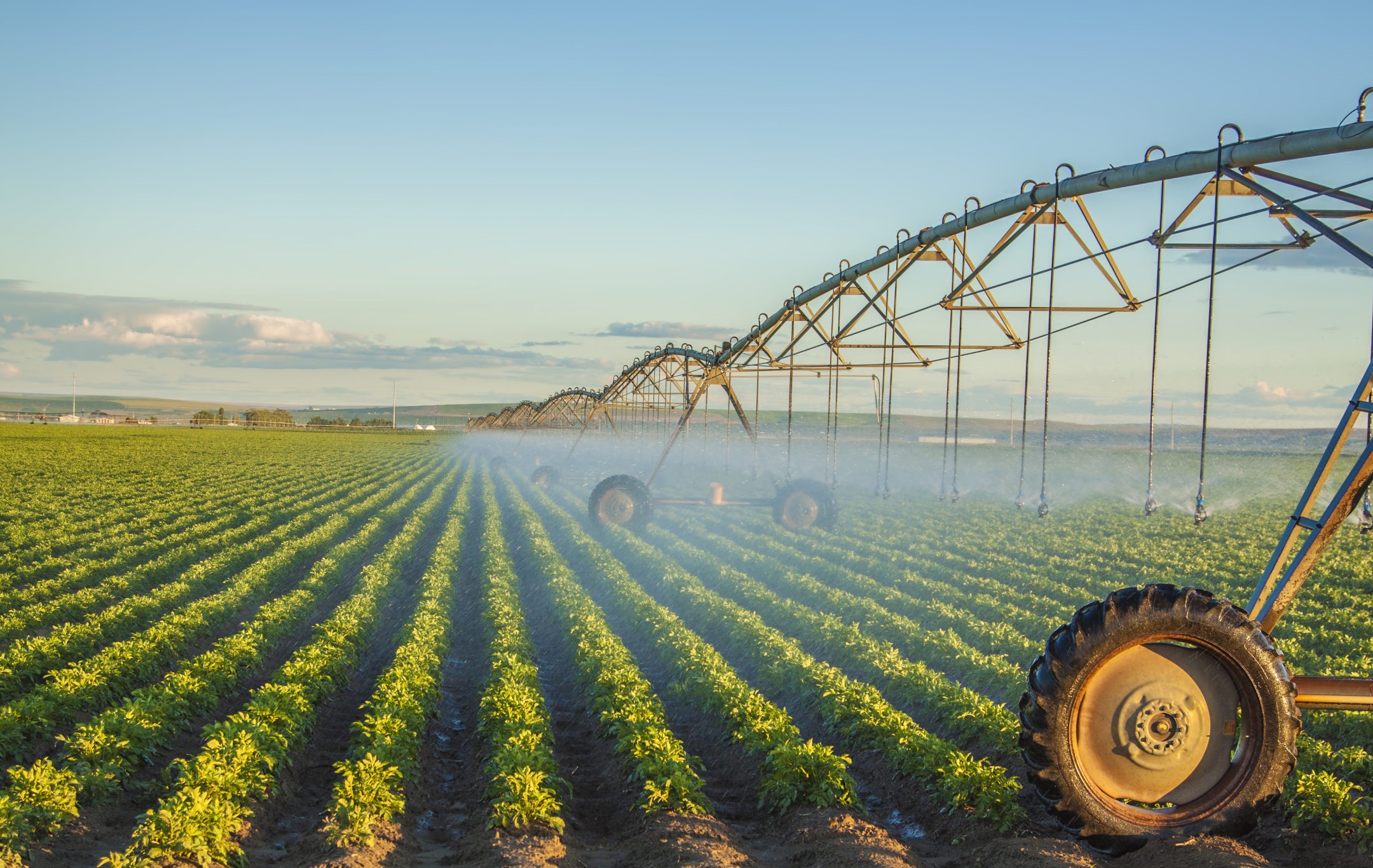
The Food and Agriculture Organization (FAO) estimates that only about 6% of cultivated land in Africa was equipped for irrigation in 2023, against a global average of 23%.
Economic & Social Transformation
Africa farms the way much of the world farmed a century ago: it waits for the rain. The Food and Agriculture Organization (FAO) estimates that only about 6% of cultivated land in Africa was equipped for irrigation in 2023, against a global average of 23%. That one number explains a lot about the continent's economy. It helps explain why yields stay low, why rural incomes collapse in the dry season, why food-import bills track every drought, and why each El Niño or La Niña forecast turns into a macroeconomic risk.
In 2026 the topic moved from the margins of development policy toward the centre. A World Bank flagship report published in March, Nourish and Flourish: Water Solutions to Feed 10 Billion People on a Livable Planet, put a jobs number on the opportunity. It estimates that converting all viable rainfed land to irrigation could create about 245 million jobs worldwide, and that nearly 90% of them, roughly 218 million, would be in sub-Saharan Africa. Governments from Bamako to Nairobi have launched irrigation programmes this year. This article looks at what those programmes promise, how they are financed, and why the main constraint is money and institutions rather than water.
The productivity case: why water control matters
The economics are simple. FAO estimates that irrigated land produces about 3.2 times more value than rainfed land, with average yields about 76% higher. Irrigation allows two or even three cropping cycles a year. It reduces exposure to erratic rainfall, and it creates work in the dry months when rural labour demand normally disappears. The World Bank report also stresses a less visible effect: a service economy of small and medium-sized firms that supply, install and maintain pumps, drip lines and canals, plus agronomic and water-management consultancy.
This matters because agriculture still employs about 60% of Africa's workforce. Even modest increases in output per hectare and in days worked per year therefore have large effects on poverty and on household consumption. Irrigation is also one of the few climate-adaptation investments that pays a commercial return in normal years, not only during disasters.
The money is going elsewhere, however. The World Bank found that total agricultural support across 90 countries reached US$663 billion in 2023. Of the roughly US$490 billion in public spending, only US$27 billion went to irrigation. The report urges governments to redirect agricultural spending, especially input subsidies, toward water infrastructure. For African finance ministries that spend heavily on fertiliser programmes, this is a difficult political request.
The Sahel: large potential, mostly unused
The gap between potential and reality is widest in the Sahel. The World Bank estimates that water resources in Burkina Faso, Mali, Mauritania, Niger, Senegal and Chad could support between 3.18 million and 4.36 million hectares of irrigation. Currently irrigated land in these six countries totals about 845,000 hectares, less than 30% of the lower-bound estimate. These countries face recurring food crises and import large amounts of rice and wheat, yet the Niger and Senegal rivers flow through them largely unused for farming.
Earlier efforts give reasons for caution. The World Bank's regional Sahel Irrigation Initiative Support Project, which covered all six countries and allocated about US$151.6 million (after restructuring) to irrigation investment, received a development-outcome rating of only 'Modest' from the Bank's Independent Evaluation Group. The project did improve water-user association governance and fee collection in Niger, Senegal and Mauritania. Those gains matter, because irrigation schemes in the region have repeatedly failed when canals silt up and pumps break down for lack of maintenance funds.
Mali shows both the opportunity and the risk. The 2026-2027 agricultural campaign was launched on 25 June in Ségou, inside the Office du Niger zone, under the theme 'Renewal of the Office du Niger, from irrigated perimeter to industrial agropole'. The Office du Niger is one of Africa's oldest large irrigation schemes, gravity-fed from the Markala dam on the Niger River. Its developed area is put at roughly 100,000 to 127,000 hectares, depending on the source, and is used mainly for rice and sugarcane. This season's plan covers 143,000 hectares across the main and off-seasons. Nationally, Bamako is targeting 11.92 million tonnes of cereals. Officials say results will depend on input access, water distribution, transport and security in producing areas. That list shows how far Mali's agricultural ambitions remain tied to its wider security and fiscal problems.
Niger has made irrigation a presidential priority. On 22 December 2025, the Minister of Agriculture and Livestock, Colonel Mahaman Elhadji Ousmane, presented the Programme de la Grande Irrigation (PGI) for 2024-2027 to the Conseil consultatif de la refondation. Its stated goal is to halve imports of rice, maize and wheat by 2027. The programme plans to cultivate 39,700 hectares over two campaigns a year and to produce at least 481,500 tonnes of paddy rice annually, about 313,000 tonnes of milled rice. The national budget and the patriotic solidarity fund (FSSP) are financing the development or rehabilitation of 11,700 hectares (8,000 new, 3,700 rehabilitated) through a performance contract with ONAHA, the national hydro-agricultural agency. Ongoing donor projects cover another 17,131 hectares, and renewed cooperation with Germany has allowed procurement to start for three dams and 343 hectares of schemes in Agadez and Tahoua. The minister also asked for help securing land access and protecting infrastructure from vandalism. That request points to the social side of irrigation: tenure, local ownership and maintenance usually decide whether a scheme survives its first decade.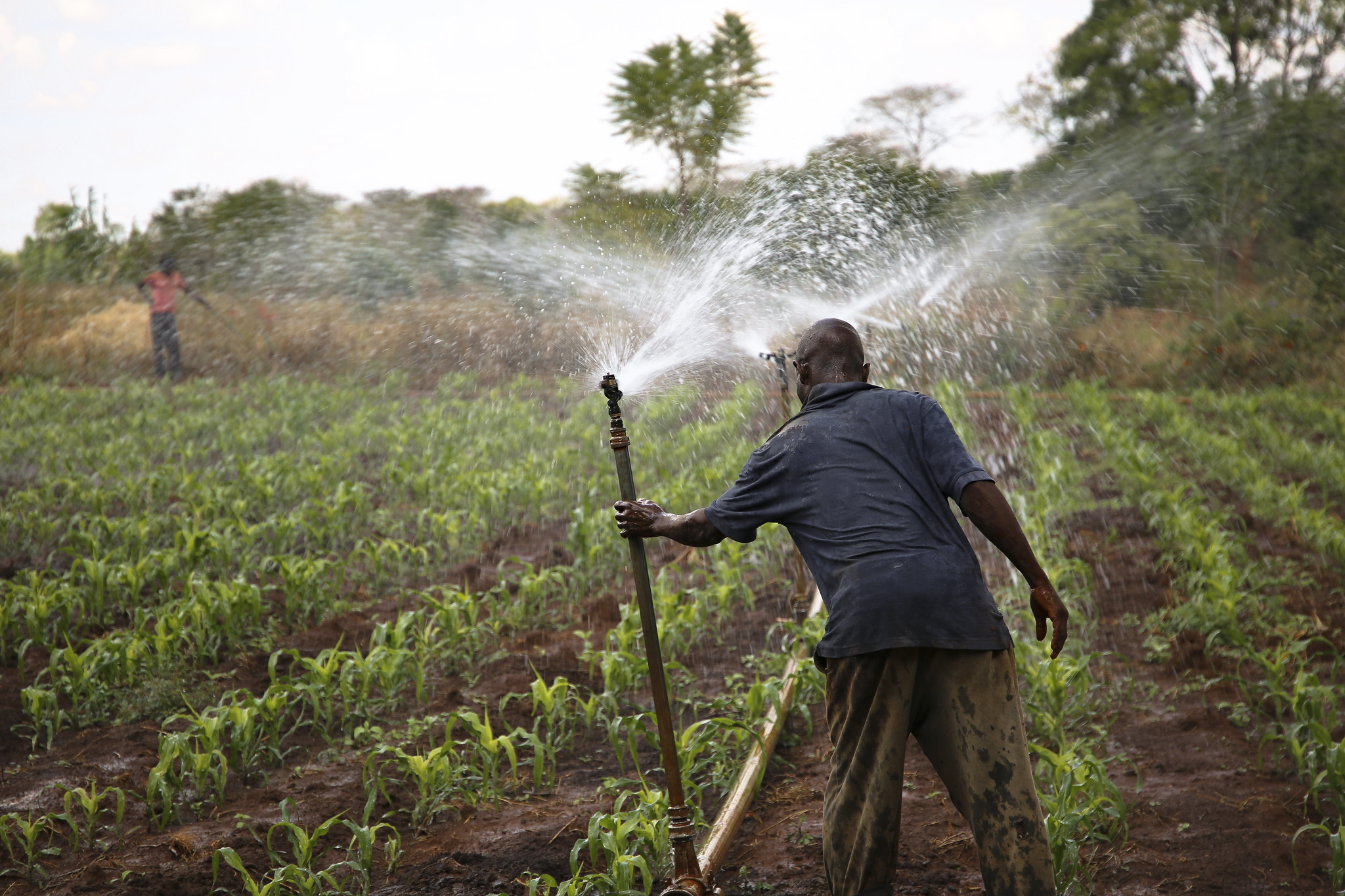
East Africa: Kenya tries a farmer-led model
Kenya is testing a different model. Instead of large state-built canal schemes, which Kenya has tried with mixed results, the government is betting on farmer-led irrigation development (FLID). Under the National Irrigation Sector Investment Plan (NISIP), a ten-year blueprint for 2025-2035, the state moves from building schemes to enabling markets. Irrigation Principal Secretary Ephantus Kimotho said in February 2026 that the FLID component targets more than five million farmers and about 350,000 acres. It aims at individual farmers and small groups cultivating between half a hectare and two hectares.
The overall plan is to add one million irrigated acres and optimise 319,000 existing acres at an estimated cost of KSh598 billion (about US$4.6 billion). About 60% is expected to come from private investors and farmers and 40% from government. Only about 4% of Kenya's agricultural land is irrigated, and about 75% of smallholders depend on rain. The government's main tool is results-based financing: equipment suppliers receive rebates only after an independent check confirms that working systems have been installed. The aim is to lower prices for farmers while protecting them from poor-quality installations.
The private market is adjusting its financing structures. On 24 September 2026, solar-pump company SunCulture announced a US$10 million transaction, structured with fintech Kaleidofin, that moves eligible customer receivables into a dedicated vehicle so that capital can be recycled into new pay-as-you-go loans. SunCulture's chief executive, Samir Ibrahim, said the constraint on irrigation in Kenya has been 'less about farmer demand than the availability, cost and duration of financing'. CGIAR research workshops in Kenya reached the same conclusion: financing is the largest single barrier to scaling farmer-led irrigation.
Nigeria: groundwater is available, credit is not
Northern Nigeria has some of West Africa's best conditions for small-scale irrigation, with shallow groundwater across much of the savannah belt. A CGIAR assessment published on 5 November 2026 found strong farmer interest in solar-powered irrigation, which avoids the fuel costs that make petrol pumps uneconomic. Expensive diesel and petrol since Nigeria's subsidy removal have strengthened the case for solar. The same assessment identified weak market links and the lack of loans whose repayment schedules match harvest cycles as the main obstacles. A farmer who can sell tomatoes or onions only twice a year cannot service a monthly loan designed for salaried borrowers. Lenders, suppliers and buyers have to be coordinated, not just introduced.
Continental initiatives are trying to address this. The Solar Agri Pumps Financing Initiative under the International Solar Alliance's Global Subsidy Facility aims to deploy one million solar agricultural pumps across Africa by 2030, working through cooperatives and local financial institutions. If it delivers, it would be among the largest coordinated irrigation-equipment programmes the continent has seen. The record of donor-led targets suggests watching disbursements rather than announcements.
North Africa: Morocco shows irrigation's limits
Morocco's experience is a warning that irrigation depends on water supply. The kingdom built one of Africa's most extensive irrigated agricultural sectors, but seven consecutive years of drought emptied its reservoirs and forced cuts in water allocations to farmers. Heavy winter rains in early 2026 allowed the water minister to declare the drought over in January, with the national dam filling rate at 46%. Reserves peaked at about 76% in mid-May. By 18 August they had fallen to 68.6%, still roughly double the 34.49% recorded on the same date in 2025. Basin gaps remain large: in late July, the Tensift basin was 86.3% full and Draa-Oued Noun only 35.7%.
Rabat's response is to diversify supply beyond rainfall. It is linking basins, reusing treated wastewater and building large-scale seawater desalination, with a target of more than 1.7 billion cubic metres of desalinated water a year, part of which will go to farming. Officials still warn that structural imbalances persist. For the Sahel and East Africa, the lesson is that irrigation expansion without basin-level water accounting can move the shortage elsewhere rather than solve it, especially where groundwater is drawn down faster than it recharges.
What it will take
Several policy priorities follow from this year's evidence:
Africa's rural economy has long depended on rainfall. The World Bank's estimate of 218 million potential jobs is a theoretical ceiling, not a forecast. Still, the distance between 6% and 23% irrigated land is one of the largest unexploited productivity gaps on the continent. Whether this year's plans close part of that gap will depend less on dams and canals than on financing, maintenance and governance.