POLITICS
A closed-door party meeting, a reported paper on what makes a good national leader and a change of tactics by the movement backing Gen Muhoozi Kainerugaba have pushed the question of who follows President Museveni into the open.
What happened
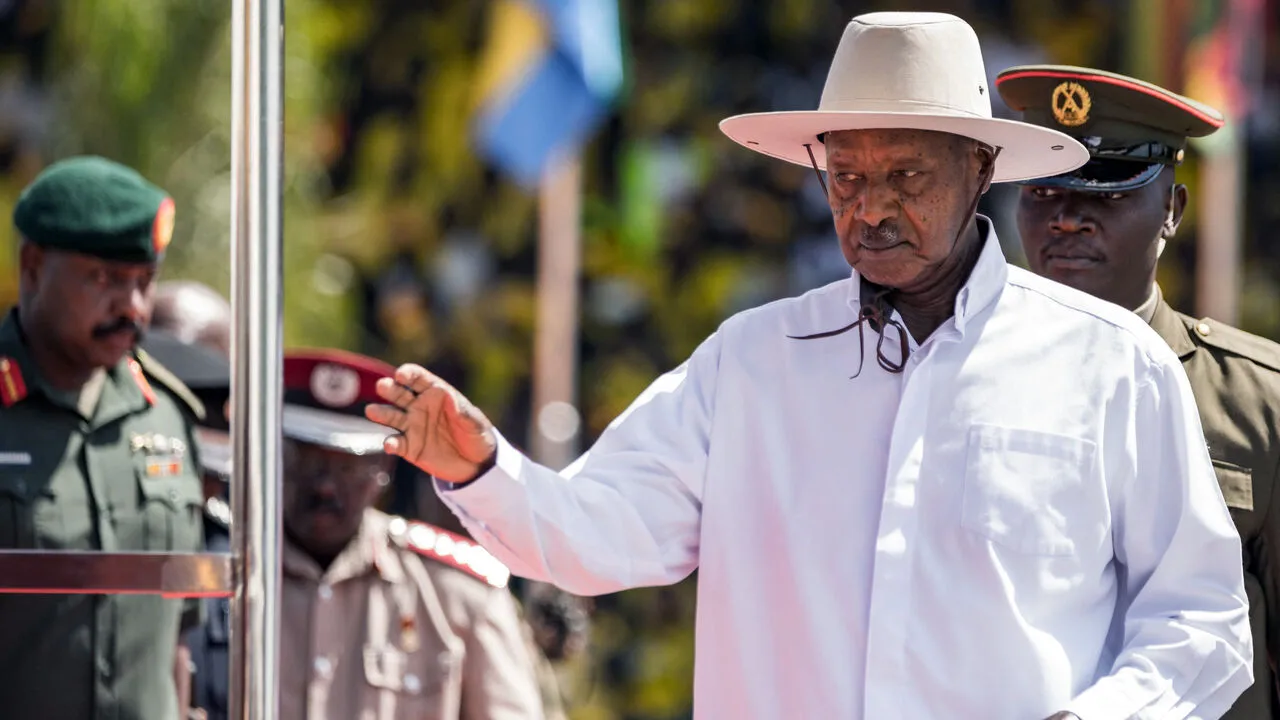
Uganda’s succession question moved from whispered speculation to open party debate in the last days of October. President Yoweri Museveni presented a paper on the qualities of a good national leader to the ruling National Resistance Movement’s (NRM) Central Executive Committee (CEC), and, according to sources cited by the Daily Monitor, spoke about the record of his son, Gen Muhoozi Kainerugaba, the Chief of Defence Forces. Days later, the Patriotic League of Uganda (PLU), the movement that campaigns for Muhoozi, overhauled how it collects endorsements for him. The NRM has since rejected at least one published account of the succession discussion.
The CEC, the party’s top decision-making organ and a body Museveni chairs, met behind closed doors at State House, Entebbe, on Tuesday 27 October. NRM deputy Secretary General Rosemary Namayanja told the Daily Monitor the meeting discussed construction of the party’s NRM House headquarters, the party’s performance in the presidential, village and women council elections, and strategies for implementing its manifesto. Beyond that official summary, accounts diverge sharply, and almost everything about the leadership discussion comes from unnamed sources.
According to those sources, Museveni tabled a paper outlining attributes he considers essential in a future national leader, including pan-Africanism, military discipline and ideological clarity. The Monitor reported that he told members many countries had failed the succession question because they did not test leaders against the qualities of a good leader before handing them power, and that he indicated the majority would have the final say. AFP, citing several party sources, reported on 28 October that it was the first time Museveni had addressed succession openly with NRM leaders.
The most quoted passage, attributed by the Monitor to sources in the room, has Museveni saying that as the father of Muhoozi, a resistance fighter and the person who encouraged him to join the army, he knew his son to excel on most of those considerations. He reportedly told members to discuss “frankly, in the right forum” Muhoozi’s suitability against them, adding that if they were satisfied with the “what” and “why”, they should then look at the “how”. The Monitor also reported that Museveni welcomed a discussion on the economy and said Bank of Uganda officials and other technocrats would be invited to State House the following week.

Two readings of the same meeting
Party figures drew opposite conclusions. Daudi Kabanda, the Kasambya County MP, publicly read the president’s remarks as a direct endorsement of Muhoozi for the presidency. Dr Tanga Odoi, chairman of the NRM Electoral Commission, who said he attended the meeting to the end, told the Monitor that succession “wasn’t discussed” at all. In his account, Museveni presented a paper seeking clarification on the status of the PLU and explaining that it is not a political party.
Both versions can be partly true: a paper on leadership attributes and a discussion of the PLU’s standing could easily overlap with the question of who might lead the country next. Analysts quoted by the Monitor said that by presenting a paper on preferred leadership qualities, Museveni may be trying to give structure to a succession question that has long threatened to expose fault lines in the ruling establishment. The paper itself has not been published, so outside observers cannot test either reading against its text.
The latest turn came in the past few days, when the Monitor carried a report headlined “NRM debunks presidential succession claim”, in which Mr Todwong described a report as false. The detail of the claim being denied was not available to this briefing, so it is noted here only as a sign that the party is actively contesting how the CEC meeting is portrayed.
The PLU changes tactics
On Saturday 31 October, PLU General Secretary Twalla Fadil announced that paper-based signature drives for Muhoozi would stop with immediate effect and that all endorsements of “General Muhoozi Kainerugaba Museveni as the next President of Uganda” would henceforth be collected online through the movement’s website. Fadil said the change came directly from Muhoozi and was meant to streamline supporter tracking and professionalise cadre identification. Field coordinators holding physical endorsement books have until 30 November to return them to the PLU secretariat in Kampala for audit and compilation. For supporters without smartphones or reliable internet, the PLU plans regional and district offices that will help with online registration and issue Patriotic Cadre numbers.
Muhoozi, writing on X, said PLU branch offices would open countrywide from 1 December and that the PLU would approve all new Resident District Commissioners. He described the PLU as “a sect, faction or pressure group within the NRM religion”, a “denomination” with zero tolerance for corruption, and compared it with the MAGA movement inside the US Republican Party. He also ordered PLU members to stop discussing his father’s paper to the CEC: “Leave these matters to me and Mzee. Focus on the endorsements from the people.”
The legal and political questions
The Monitor notes that Section 16 of the Political Parties and Organisations Act, together with Articles 208 and 209 of the 1995 Constitution, bars serving military officers from taking part in partisan politics. Muhoozi remains Chief of Defence Forces. Alice Alaso, national coordinator of the opposition Alliance for National Transformation (ANT), said it was “dangerous to keep the country guessing” and urged Museveni to say plainly whether a veiled transition is under way. Civil society activist Sarah Bireete argued that if Muhoozi has presidential ambitions, Museveni must formally retire him from the army.
The legal tension is not new. A South African-based analysis by the Institute for Security Studies (ISS) describes Muhoozi as the apparent front-runner in the succession debate, noting that his growing political prominence runs against Ugandan law and that his command of the military is central to any succession arrangement. Africa Confidential reported that his intention to succeed his father, long an open secret, was confirmed on 26 August, and AFP described a “palace intrigue” around the succession in late August. Not everyone accepts the dynastic premise. Former presidential candidate Joseph Kabuleta has called a direct father-to-son handover a “fantasy”, arguing that a post-Museveni transition is more likely to involve negotiation among several political and military actors.

Why it matters
Museveni, 81, has ruled since 1986. He won the 15 January 2026 election, which the Electoral Commission declared on 17 January, and was sworn in for a seventh term on 12 May. The NRM holds 372 of 529 seats in Parliament, according to the Rio Times, so the ruling party’s internal decisions effectively shape the national outcome. A succession settled inside the NRM, rather than at the ballot box, would carry consequences for the opposition, the army’s role in politics and investor perceptions of stability.
The way the matter is being handled also matters. Information is flowing through sources, social media posts and partial denials rather than through a published party position. That ambiguity lets different camps claim presidential backing while the president himself keeps his options open, a pattern long observed in NRM politics. For citizens, it leaves open when, how and by whom the next leader will be chosen.
What to watch next
Several dates and questions will indicate where this is heading. The PLU’s 30 November deadline for returning paper endorsement books and its 1 December branch-office rollout will show how large and organised the movement is, and whether the NRM tolerates a parallel structure inside the party. Any CEC clarification of the PLU’s status, the NRM’s next statements on the Todwong-related report, and whether the paper to the CEC is made public would sharpen the picture. Finally, watch for any legal challenge to Muhoozi’s dual role, or any move by Museveni to retire him from the military, either of which would signal that the political track has become formal.
Published By | News Editor