Written By | Torch Media Africa
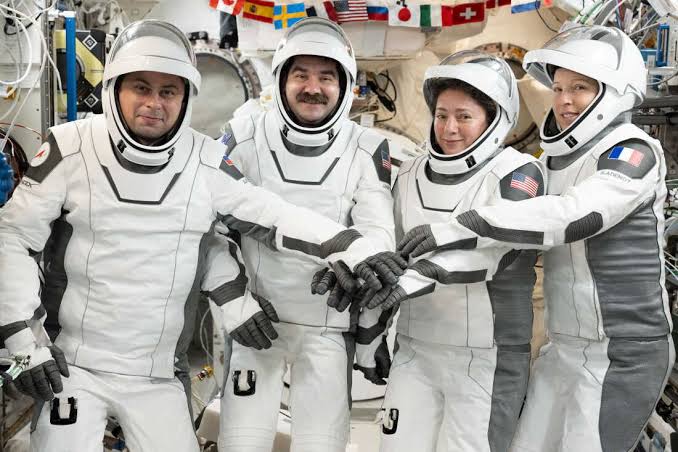
NASA's Crew-12 astronauts return after nearly eight months in orbit, with a first for France, a European endurance record and a spacewalking milestone for Jessica Meir
PACIFIC OCEAN, OFF LOS ANGELES — 10 October 2026
At 11:34 a.m. Eastern on Thursday 8 October, a gumdrop-shaped SpaceX capsule named Freedom hit the Pacific Ocean off the coast of Los Angeles, its parachutes billowing above the waves. Inside were four humans who had not felt a sunrise on solid ground since the middle of winter.
NASA's Crew-12 astronauts, Jessica Meir, Jack Hathaway, Sophie Adenot and Andrey Fedyaev, were home after 237 days in space, 235 of them aboard the International Space Station. Recovery teams hoisted the capsule onto a ship, and NASA's Bill Spetch summed it up with relief: "It's great to have them back after 237 days in space, 235 of those on the space station. The crew is doing well. They were all smiles exiting the capsule."
It was the end of a mission packed with records, firsts, scientific experiments and more than a little drama.
By the Numbers
According to NASA, the crew travelled more than 100 million miles and completed more than 3,792 orbits of Earth. They launched on a Falcon 9 from Cape Canaveral at 5:15 a.m. Eastern on 13 February 2026 and docked with the station the following day. Dragon Freedom undocked at 8:05 a.m. Eastern on Wednesday 7 October, then spent just over a day lowering its orbit ahead of the fiery plunge through the atmosphere.
Now comes the hard part: readjusting to gravity. The astronauts face routine medical exams and a 45-day postflight conditioning programme, according to Space.com. After checks aboard the recovery ship they will head ashore and on to NASA's Johnson Space Center in Houston.
Meir's Milestone
Commander Jessica Meir had a busy tour. She performed four spacewalks on this flight, taking her career total to seven. NASA says that puts her third among American women for spacewalks, behind only Peggy Whitson and Suni Williams. Her 440 cumulative days in space land her in NASA's top 10 for time off the planet.
Meir was open about what she missed. On a call in September she said: "I'm so looking forward to seeing nature again." After 237 days of metal corridors and artificial light, a breeze might feel like a luxury.
France's Spacewalk Star
For France and Europe, the headline belongs to Sophie Adenot of the European Space Agency. On 18 August she became the first French woman to walk in space, and she added two more spacewalks over the following two weeks, three in total. One of them was with Meir, and Space.com notes it was the sixth all-female spacewalk in the history of the station.
Adenot also set a record: her 237 continuous days in space are the longest for any ESA astronaut, topping the 201 days Luca Parmitano racked up in 2019 and 2020. She was on her first spaceflight. So was NASA pilot Jack Hathaway. Meir and Russian cosmonaut Andrey Fedyaev were each on their second.
Adenot's mission, which ESA named Epsilon, also had a sartorial side. She tested the EuroSuit, a European intravehicular spacesuit prototype delivered in May aboard SpaceX's CRS-34 cargo flight, checking ergonomics, how easy it is to get in and out of, and mobility, across several sessions between late May and the summer. She was expected to take part in almost 200 science and technology experiments, including French-led health-monitoring work such as autonomous ultrasound and bone and blood-flow measurements.
A Mission That Almost Wasn't Normal
This flight began under unusual circumstances. In January, the previous crew, Crew-11, returned early in the station's first medical evacuation after one crew member had a health issue. NASA stressed it was not an emergency, and the affected astronaut, Mike Fincke, has since retired with 549 days in space. The early return left the ISS running on a three-person crew from 15 January until Crew-12 arrived, and the launch of Crew-12 was moved up as a result.
There was cosmonaut shuffling too. Fedyaev replaced Oleg Artemyev, who was removed from the crew in December 2025. Roscosmos cited a "transition to other work," though The Insider reported he had been expelled from the United States over alleged export-control violations, a claim as reported by the outlet.
Then there was the delay at the end. Crew-13 had been scheduled to launch on 12 September, but a propulsion problem on its Dragon capsule, named Grace, pushed it back, extending Crew-12's stay by weeks.
The Relief Crew Arrives — Fast
Crew-13 did eventually fly. It lifted off on 1 October and reached the station in under eight hours, according to Space.com, which describes it as the fastest US crewed trip to the ISS. The all-time record belongs to a Russian Soyuz flight at just over three hours. Faster trips matter. For future crews they mean fewer hours cramped inside a capsule before the station's roomier living quarters.
The handover let Crew-12 pass on station knowledge face to face, a vital tradition of human spaceflight that no checklist can fully replace.
Science From Orbit
What did four people do with eight months in a microgravity laboratory? NASA lists a range of research. The crew tested production of stem cells for cell-based therapies, demonstrated on-demand intravenous fluid generation for future missions, and studied how pneumonia-causing bacteria can lead to long-term heart damage. Other work covered nutrition and how physical characteristics affect blood flow in space. Reports also mention quantum science work and metal 3D printing in orbit.
Why does that matter on Earth? Making IV fluids on demand is crucial for any crew too far from home to be resupplied, and could help remote clinics on Earth. Heart and infection research in microgravity can reveal disease mechanisms that gravity masks. NASA has not yet said when results from Crew-12's experiments will be released.
Why Dragons Now Land Off California
One quiet detail of this homecoming: the splashdown happened in the Pacific rather than off Florida. SpaceX moved Dragon recoveries to the West Coast after pieces of capsule trunk survived reentry and hit the ground. Dragon now fires its deorbit burn before releasing the trunk, so any leftover debris falls harmlessly into the ocean. Crew-10 was the first NASA crew to splash down off California, in 2025.
Life Aboard a Crowded Laboratory
When Crew-12 docked on 14 February, the hatch opened that evening and the station returned to its normal complement of seven people after weeks of running lean. Seven people sharing a space about the size of a six-bedroom house means constant juggling of experiments, exercise sessions, repairs and downtime. Astronauts typically exercise around two hours a day to fight muscle and bone loss, a routine that becomes even more important over a stay as long as 237 days.
Spacewalks add another layer. Each one takes months of training in giant pools on Earth and hours of painstaking work in the vacuum outside, where a dropped tool is gone forever. Four walks for Meir and three for Adenot represent a heavy outdoor workload for one crew, and underline how much maintenance an ageing orbital outpost demands.
What the Bosses Said
NASA Administrator Jared Isaacman praised the crew and the thousands of people at NASA, SpaceX and partner agencies behind the mission. He said: "Building the capability, experience, and confidence to do this repeatedly is exactly what will allow us to go farther."
Dana Weigel, manager of NASA's Low Earth Orbit Program, said the agency's station work provides the science, engineering and risk reduction needed for future missions across the solar system, adding: "We're grateful for the dedication across the human spaceflight team that makes this possible." That programme relies on private US companies, including SpaceX, to carry astronauts to and from the station, a model that would have sounded radical two decades ago and now feels routine.
What Happens Next
The station is not going quiet. SpaceX's robotic CRS-35 cargo mission is planned for launch on 13 October, and NASA says it will carry the last set of Roll-Out Solar Arrays for the station. NASA has booked three more crew flights through Crew-17.
Meir, Hathaway and Fedyaev will face reporters at a news conference at Johnson Space Center on 15 October. Adenot will not attend, as she is returning to Europe. Expect plenty of stories about the first shower, the first cup of real coffee and what it is like to have your legs remember their job.
What This Means For You
It is easy to treat a splashdown as a spectacle and move on, but this mission touches ordinary life in several ways. The medical research on stem cells, infection and heart damage could feed into treatments on Earth. The on-demand IV fluid tests point towards healthcare that works far from hospitals. The EuroSuit trials are part of the long road to better spacesuits for the next generation of explorers.
There is a human lesson, too. Eight months is longer than most people spend away from home for anything. Crews on the way to Mars will need years. Every long-duration flight, like Adenot's record 237 days, adds data about how bodies cope with bone loss, fluid shifts and isolation. That is the evidence that will decide whether we can safely go farther.
For those who love space but not the launch-day anxiety, here is the comforting part: this one went to plan at the end. Capsule, parachutes, ship, smiles.
The Bottom Line
Crew-12's flight will be remembered for a handful of firsts and records: Adenot's walk into the history books as France's first woman to spacewalk, her European endurance record, Meir's climb up NASA's spacewalking rankings, and an unusually rapid handover to Crew-13. It will also be remembered as a mission that began in a medical scramble and ended with a quiet splash off Los Angeles.
The four astronauts now begin the slow, wobbly work of becoming Earthlings again. The rest of us get to watch the next crew take their place above our heads, circling the planet 16 times a day, and consider that the longest journeys begin with very human limits. As Meir put it, they are looking forward to seeing nature again. They have earned it.



