NAMUGONGO, UGANDA
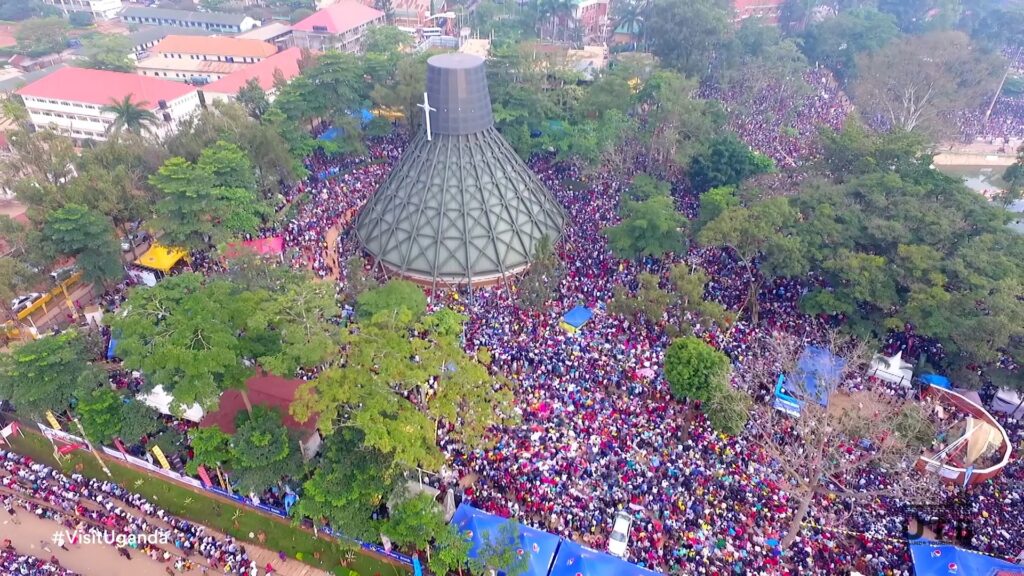
The road into Namugongo does not announce itself as holy ground. Boda-bodas weave between market stalls, roadside vendors fan charcoal fires, and the ordinary clatter of a Kampala suburb fills the air — until, quite suddenly, the crowd noise falls away and two shrines rise out of the trees, one crowned with a great cone of copper-toned tiles said to evoke a traditional reed hut, the other a plain brick chapel standing exactly where, on a June morning in 1886, a young page named Charles Lwanga and twelve companions were bound, wrapped in reed mats, and burned alive on the orders of a teenage king. Nearly a century and a half later, this quiet patch of earth on the northeastern edge of Uganda's capital has become one of the largest annual pilgrimage sites on the African continent, drawing more visitors in a single day each June than most national parks welcome in a year.

A Kingdom, a King, and a Test of Faith
The story that makes Namugongo sacred begins not with tourism but with terror. In the 1880s, the Kingdom of Buganda sat at the political and cultural center of what would become Uganda, ruled by the young Kabaka Mwanga II. Christianity, carried in by Catholic White Fathers and Anglican missionaries only a decade earlier, had taken root fastest among the pages and attendants of the royal court — young men and boys who served in Mwanga's household and found in the new faith a moral language that increasingly put them at odds with the king's demands. Between 1885 and 1887, Mwanga ordered the killing of dozens of these converts, Catholic and Anglican alike, culminating in the mass execution at Namugongo on June 3, 1886, when twenty-two Catholics and a roughly equal number of Anglican converts were marched to the site, wrapped in mats, and set alight. Among them was Charles Lwanga, the head page, whose composure at the moment of execution became the central image of the martyrdom story told and retold ever since.
The Vatican canonized twenty-two of the Catholic martyrs in 1964, and the Anglican Communion commemorates its own martyrs on the same date. What might have remained a somber historical footnote instead became a living devotional practice: within a generation, Ugandan Christians began walking to Namugongo every June 3 to mark the anniversary, and the pilgrimage has only grown since. The Catholic shrine, a strikingly modern basilica completed in 1967 and consecrated by a papal envoy that same year, was elevated to the status of minor basilica by Pope John Paul II during his 1993 visit to Uganda — one of the clearest signals of how far the site's significance had traveled beyond Uganda's borders. A short walk away, the Anglican shrine sits directly atop the execution ground itself, a plainer structure whose power lies precisely in its proximity to the actual site of the burning.

What a Visitor Finds Today
Visitors arriving on an ordinary weekday find a site that functions as equal parts church, museum, and memorial park. Guided tours move between the Catholic basilica's soaring interior — its circular design meant to recall a traditional grass-thatched meeting house — and the more intimate Anglican shrine, pausing along the way at Martyrs' Lake, where some of the condemned were held before their final march, and at the site of the Ndazabazadde tree, one of the surviving fragments of the sacred grove that once covered the execution ground. A site museum displays artifacts, photographs, and interpretive material tracing the historical and religious background of the martyrdom, giving context that the physical grounds alone can only gesture toward. Because the compound sits inside Kiira Municipality in Wakiso District, roughly fifteen kilometers northeast of central Kampala, it is easily reached as a half-day trip from the capital, and many tour operators pair it with other cultural sites such as the Kasubi Tombs to build a fuller picture of Buganda's religious and royal history.
The site transforms entirely each June 3, the Feast Day of the Uganda Martyrs, when the ordinary trickle of visitors becomes a flood — organizers and church officials have described crowds exceeding a million people converging on the grounds, many having walked for days from villages across Uganda and neighboring countries as an act of devotion in itself. Access on that day begins before dawn, with pilgrims queuing behind security checkpoints as early as 5:30 in the morning, and the atmosphere shifts from contemplative to genuinely overwhelming: processions, all-night vigils, open-air Masses, and a sea of people that turns a quiet suburb into one of the largest single-day religious gatherings anywhere on the continent. For travelers who want the emotional weight of the martyrdom story without the scale of Martyrs' Day itself, tour guides generally recommend visiting in May or in the early days of June, when the shrine's preparations are visible and the crowds are still manageable, or simply choosing a quiet weekday outside the pilgrimage season altogether.
That balance between reverence and accessibility has been reinforced by a wave of infrastructure upgrades at the Anglican site completed ahead of this year's commemorations. Renovation work inspected in May 2026 included repaired and reconstructed perimeter walls, improved drainage, new walkways, and strengthened security coordination with the Uganda Police Force, alongside landscaping, tree trimming, and road-access improvements intended to make the grounds more welcoming to the crowds that gather there. A solar-powered borehole was installed to guarantee water supply during peak pilgrimage days, and sanitation facilities — including a new shower block for overnight pilgrims — were modernized, addressing what had long been one of the most practical challenges of hosting such enormous crowds on a single day each year. Architect Jonathan Edward Nsubuga, known for shaping several of Kampala's landmark structures, has been credited with a significant role in the shrine's ongoing physical evolution.
There is no formal entry fee to walk the grounds of either shrine, though donations are welcomed and guided tours arranged through the shrine's own staff or through local tour operators typically carry a modest charge that supports the site's upkeep. Modest dress is expected, as at any active place of worship, and visitors should plan to remove hats and speak quietly within the basilica and shrine interiors. Combined with the relatively short drive from Entebbe International Airport or central Kampala, Namugongo remains one of the most logistically simple additions any traveler can make to a broader Uganda itinerary — a half-day detour that, unlike the gorilla treks and savanna drives the country is more famous for, asks visitors to sit with the darker chapters of the nation's founding story rather than its wildlife.

This Week in Ugandan Tourism
Uganda's tourism sector is having a busy, headline-heavy stretch. On July 2, the Uganda Tourism Board welcomed a high-level delegation from Roc Nation, led by Michael R. Yormark, president of Roc Nation Sports International, for a site inspection running through July 5 — an early move in positioning the country ahead of the co-hosted AFCON 2027 football tournament. Just before that, from June 27 to July 1, UTB Board Chairperson Pearl Hoareau Kakooza represented Uganda at the AESATA Travel Agents' Conference in Livingstone, Zambia, presenting on strengthening partnerships across the regional travel ecosystem. On the conservation and pricing front, the Uganda Wildlife Authority's fee changes took effect July 1: the standard gorilla trekking permit for foreign non-residents holds at $800 (with a $600 low-season rate in April, May, and November), while the premium four-hour gorilla habituation permit rose from $1,500 to $1,800 — revenue UWA says continues to fund the anti-poaching patrols and veterinary care behind the mountain gorilla population's recovery from roughly 620 individuals in 2008 to more than 1,000 today. Freshly released government figures also show the broader sector's momentum: the Tourism Statistical Abstract 2025 recorded more than 1.6 million international visitor arrivals last year and tourism earnings of roughly UGX 5.8 trillion, about $1.62 billion. And on the ground, the Uganda Cultural and Tourism Festival opened June 26 with diaspora businesses, cultural performers, and diplomats in attendance, part of a broader push — including a planned Munich cultural festival and roadshow — to court European travelers to the Pearl of Africa.
Whatever draws a traveler to Uganda first — the gorillas of Bwindi, the thunder of the Nile at Murchison Falls, the terraced hills around Fort Portal — Namugongo offers something the wilder corners of the country cannot: a direct, walkable link to the moment modern Uganda's religious and national identity began to take its current shape, still tended, still visited, and still, every June, still full.
Published By | News Editor