Written By | Torch Media Africa
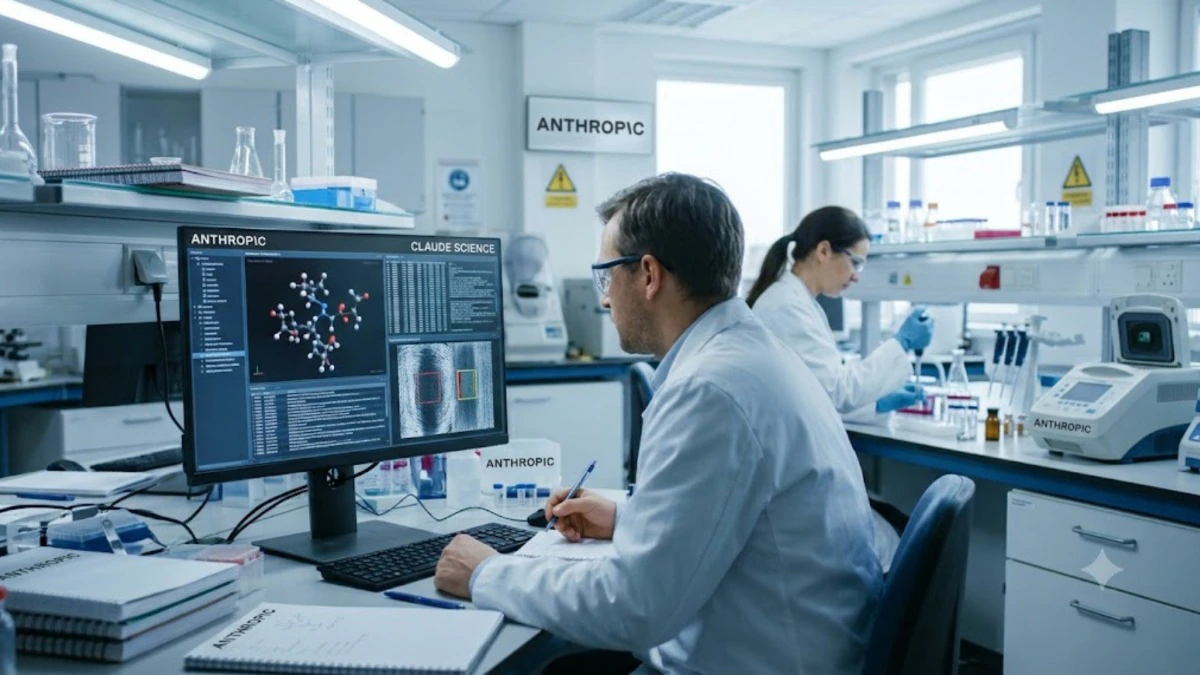
Claude helped take a rare muscular dystrophy treatment from idea to promising mouse results in under 18 months. Now the AI company wants to make medicines of its own.
SCIENCE & TECH
It sounds like the pitch for a science-fiction film: a lone entrepreneur with no lab of his own sets out to cure two rare forms of muscular dystrophy, and gets from idea to promising results in mice in under 18 months — by using an AI assistant to run the whole show.
It is, according to Anthropic, real. On 27 October 2026 the AI company announced that it had acquired Mithril Medicine, a one-person biotech founded by Cody Tranbarger, and that it is now running drug-discovery programmes of its own. In the same breath it released early results from work with six drug developers, claiming dramatic time savings on tasks that normally eat up months.
A caveat before the excitement: everything here is early, almost entirely preclinical, and reported by the company itself. Anthropic describes the work as early progress, and no drug is anywhere near a pharmacy shelf. But the numbers are striking, and they show how fast AI is pushing into the most expensive, slowest industry on Earth.
The One-Person Biotech
Mithril Medicine is developing treatments for two rare forms of muscular dystrophy. Its founder, Tranbarger, used Claude to coordinate contracts, logistics and experiments with 11 external laboratories and to handle much of the company's operations, according to Anthropic. The company says a possible treatment reached mouse testing, with promising results, in under 18 months.
That is the kind of timeline that makes drug-industry veterans sit up. Traditionally, getting from a target to animal data involves a team of scientists, project managers, lawyers and contract specialists. Here, the claim is that a single founder, backed by an AI system, orchestrated outsourced labs like a conductor leading an orchestra.
Anthropic has now acquired the company, and Tranbarger has joined to continue the work. If the results hold up, the company says a drug candidate could begin human clinical trials as soon as late 2028. Financial terms of the Mithril deal were not disclosed in the coverage we reviewed.
Rare diseases are a natural proving ground. Patient populations are small, commercial incentives are thin, and large pharmaceutical firms often pass. If AI can cut the cost and headcount needed to pursue a rare-disease drug, projects that never made business sense might suddenly become viable.
The Six Partners and Their Numbers
The acquisition came wrapped in a broader progress report. Anthropic's life sciences team says it has worked with six organisations: BigHat Biosciences, Bristol Myers Squibb, Divergence Labs, Enveda, Generate Biomedicines and The Column Group. Here is what each reportedly achieved.
Generate Biomedicines: six scientists used Claude Code to design components for CAR T-cell therapy, a treatment in which a patient's immune cells are engineered to hunt cancer. One design was about 70% shorter than the standard version and, in lab tests, let immune cells make roughly 10 times as many receptors. It also killed tumour cells more efficiently and stayed active for longer.
Divergence Labs: Claude turned the team's goals into a design plan and generated roughly 35,000 antibody designs in about a month. Early tests found three binders and 20 designs that could dislodge IgE, the antibody involved in allergic reactions. Three of those 20 worked better than the standard medication.
BigHat Biosciences: Claude proposed changes to two antibody-fragment leads, and the lab tested about 1,010 variants over roughly 10 weeks. The best versions bound more than 10 times more tightly. One lead stayed in solution at a temperature 18°C higher, while the other clumped more than 100 times more slowly. Claude and an Anthropic researcher also reanalysed the raw data and proposed better metrics, which the team then validated.
Enveda: Claude reviewed 1,061 pages of manufacturing documentation. It caught all 11 issues that human reviewers had found and seven they had missed. Human review time fell by 89%, from over 25 hours to under three. Claude also drafted a regulatory document in four hours, compared with about three months by hand.
The Column Group: the venture firm is creating a company called Pleiades that will use Claude to run more, and more complex, drug programmes with a small team. Its first Claude skill, for assessing drug targets, was tested on 45 target-disease pairs.
Bristol Myers Squibb: the pharma giant is using Claude to assess early-stage clinical trial plans and estimate their chance of success, with plans to expand the work in 2027. A BMS executive said Claude produced a useful initial analysis from a single prompt, work that would otherwise take days.
Why Paperwork Might Be the Real Breakthrough
It is tempting to focus on the glamorous results — shorter CAR T constructs, tighter-binding antibodies. But the Enveda numbers may hint at where AI's nearest impact lies: the grinding administrative and regulatory work that surrounds every drug.
Cutting a 25-hour document review to under three hours, and a three-month regulatory draft to four hours, will not make headlines the way a cancer cure would. Yet drug development is notoriously slow and expensive, and a significant share of that time disappears into documentation, compliance and coordination. Saving weeks here can mean patients get access sooner, and cheaper.
Claude Science and the Safeguards Question
Alongside the results, Anthropic announced a package of tools and programmes for researchers. Claude Science is an AI workbench for scientists. Anthropic is offering Claude credits to life scientists, and has opened a call for guest investigators — research groups invited to propose projects using Claude.
Perhaps the most notable item is the Life Sciences Verification Program. Frontier AI models carry safeguards that block some biology-related requests, because the same knowledge that designs a medicine could in principle help someone build a pathogen. Those guardrails can also frustrate legitimate researchers. Under the new programme, trusted organisations will be allowed to use more capable models with more permissive safeguards.
That is a delicate balancing act. Too restrictive and AI is useless for the very scientists who could benefit most; too loose and the risk of misuse grows. Anthropic's answer is verification — knowing who is on the other end — but how well that works in practice will be scrutinised by biosecurity experts.
The Money and the Competition
Anthropic is not alone. Earlier this year, according to The Next Web, it paid a reported $400 million in stock for Coefficient Bio, a stealth biotech AI start-up with fewer than 10 employees, many of them former Genentech computational biologists. That report said the team joined Anthropic's Health Care and Life Sciences group, led by Eric Kauderer-Abrams, who stated an ambition that "a meaningful percentage of all of the life science work in the world" should run on Claude.
Rivals are circling the same prize. The Next Web lists Google DeepMind's spin-off Isomorphic Labs, Nvidia's $1 billion, five-year partnership with Eli Lilly, and OpenAI's work with Moderna on personalised cancer vaccines. Drug discovery has become one of the most hotly contested battlegrounds for AI companies hunting for applications that justify their enormous valuations.
Reality Check: What Experts Will Be Asking
Sceptics will point out several things. First, mice are not people: the great majority of drug candidates that look promising in animal studies fail in human trials. Anthropic's own timeline puts any first-in-human study in late 2028 at the earliest, and that is if everything holds.
Second, the evidence comes from the company and its partners rather than from peer-reviewed papers. Third, speed is not the same as success. Generating 35,000 antibody designs in a month is impressive, but the test is how many become real medicines. As The Next Web observed of the earlier Coefficient Bio deal, whether such bets pay off depends on whether frontier AI can produce real scientific breakthroughs rather than merely faster paperwork.
There is also the question of how much of the Mithril result belongs to the AI and how much to the founder. Tranbarger still had to choose the target, decide which experiments mattered and judge the data; Claude handled coordination and execution at a speed no individual could match. That division of labour — human judgment, machine throughput — is how Anthropic frames the work, and it is probably the right way to read the early results: as a force multiplier for scientists, not a replacement for them.
Supporters counter that even modest improvements — fewer wasted experiments, quicker documentation, better choices about which trials to run — compound across a pipeline that costs billions per approved drug.
What This Means For You
For patients with rare diseases, the most hopeful message is that AI may lower the barrier to starting a drug programme at all. A single motivated founder coordinating 11 labs is a very different model from a 500-person pharma division.
For everyone else, the near-term effect will be quiet: faster internal reviews, better-planned trials and shorter regulatory drafting at the companies that make your medicines. Over time that could shave months off development timelines and, perhaps, costs.
For anyone worried about the dark side of AI and biology, the Life Sciences Verification Program is worth watching. How the industry balances open scientific access against biosecurity will shape the rules for every powerful model that follows.
The Bottom Line
Anthropic's announcement is both a progress report and a statement of intent. The company that built an AI assistant now owns a biotech start-up, runs its own drug programmes and is courting the world's pharmaceutical firms. The early numbers — tenfold gains here, 89% time savings there — are eye-catching, but they are preclinical, company-reported and unproven where it counts: in human patients.
The real verdict will arrive years from now, if and when a Claude-assisted molecule enters a clinic. Until then, the story of one founder, 11 labs and an AI collaborator stands as a glimpse of a possible future in which the smallest teams chase the hardest diseases.



