Agriculture
While meteorologists in northern Uganda spend this week telling farmers to hold off on planting because the rains have failed again, a very different kind of agricultural story is playing out in Kampala, Jinja and the Busoga sub-region. Today, July 24, marks the application deadline for the fifth season of the AYuTe Africa Challenge Uganda, a national innovation competition run by Heifer International Uganda that is trying to answer a harder, longer-term version of the same underlying problem: how does Ugandan agriculture become resilient enough — and profitable enough — to hold onto the young people who are supposed to inherit it.
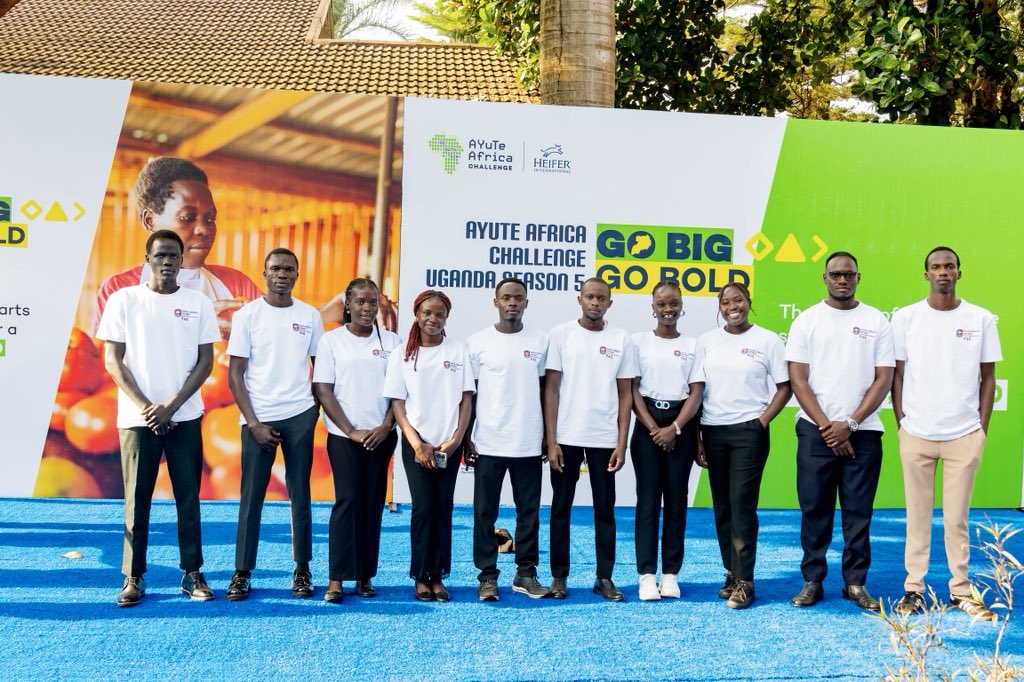
Launched under the theme "Go Big. Go Bold." at an event that brought together government officials, development partners, academics and private investors, this year's AYuTe Uganda features two distinct tracks. The National Agritech Innovation Track is open to young entrepreneurs anywhere in the country building technology-driven solutions — in precision and climate-smart production, livestock and aquaculture technology, post-harvest handling, farm mechanisation and energy, or digital market and finance tools. The new Busoga Agribusiness Entrepreneurship Track is narrower and more commercially focused: it is reserved for entrepreneurs based in the Busoga sub-region who are already running operational agribusinesses — turning raw farm produce into higher-value goods — with at least six months of trading history behind them.
Both tracks share the same basic proposition. Successful applicants, who must be Ugandan youth aged 18 to 35, will compete for a share of Shs205 million in catalytic financing, alongside mentorship, incubation support, business development training and access to investor and government networks. The organisers say they are deliberately encouraging applications from women, people with disabilities, and innovators from underserved rural areas — including, pointedly, rural Busoga itself.

Why Heifer is betting on youth, again
Representing the Ministry of Agriculture, Animal Industry and Fisheries at the launch, Commissioner for Agricultural Extension and Skills Management Consolate Acayo framed the programme as central to the ministry's own transformation agenda. "Innovation is key to the future of Uganda's agriculture. Through initiatives like AYuTe, we are giving young people the opportunity to develop practical solutions that improve farming, create jobs and strengthen food security," she said.
William Matovu, Country Director of Heifer International Uganda, has made a similar argument in each of the programme's five seasons since its 2022 launch — but the numbers behind the pitch have grown. By the fourth edition in 2025, Matovu said AYuTe had attracted more than 600 young applicants, funded 12 winning ventures, and reported impact on more than 8,000 smallholder farmers through improved crop yields and better livestock survival rates. "AYuTe is about unlocking the potential of young entrepreneurs to build businesses that improve the lives of smallholder farmers while transforming agriculture through innovation," Matovu said at this year's launch.
The programme's ambitions extend beyond Uganda's borders. National winners earn a shot at the AYuTe NextGen Grand Challenge, a continental competition Heifer International hosted in Kampala in mid-2025, where more than 100 applications from ten African countries were narrowed to 11 finalists pitching before investors and policy leaders. The 2025 continental winners came from Kenya, Ghana and Nigeria — Carolyn Mwangi of Kimplanter Seedlings and Nurseries took the Climate-Smart Agriculture category with a data-driven climate-resilient seedling business, while Nana Opoku of Ghana's Grow for Me won the Access to Finance and Markets category with a platform letting investors fund crops managed by professional farmers. No Ugandan innovator has yet topped the continental stage, which is part of what gives this year's national deadline its edge: Season 5 is, among other things, a search for Uganda's first NextGen champion.
The economics behind the pitch
The urgency behind AYuTe is rooted in a labour-market problem that Uganda's government has struggled to solve. According to the Uganda Bureau of Statistics' Labour Market Survey 2025, national unemployment stands at 12.2 percent, but youth unemployment among 18-to-30-year-olds is markedly higher at 16.2 percent, with young women (18.7 percent) affected more than young men (13.4 percent). An estimated 700,000 people enter Uganda's labour market every year, a wave of job-seekers the formal economy has consistently failed to absorb at scale.
Agriculture already employs roughly a third of Uganda's working youth — second only to services — but much of that employment is low-productivity subsistence farming rather than the kind of scalable, technology-enabled enterprise that generates real income growth. Uganda's National Development Plan IV sets a target of cutting youth unemployment to 12.9 percent by the 2029/30 financial year, and government officials increasingly point to agro-industrialisation and agritech as the likeliest route to get there, given that roughly 70 percent of Uganda's population is under 30.
Kenneth Bagarukayo, Commissioner for Research and Development at the Ministry of ICT and National Guidance, has tied the programme explicitly to that national digital strategy. "Agriculture, which employs over 70 percent of our population, must evolve. As a ministry, we are supporting this evolution through the National ICT Policy, the National Fourth Industrial Revolution Strategy, and the Digital Uganda Vision, all of which emphasise the integration of technology into every sector, including agriculture," he said at an earlier edition of the challenge.
AYuTe Uganda is organised in partnership with the Ministry of Agriculture, Animal Industry and Fisheries, the Ministry of ICT and National Guidance, the Mastercard Foundation, and CURAD (the Consortium for Enhancing University Responsiveness to Agribusiness Development), giving winning entrepreneurs a route into an existing incubation and market-linkage ecosystem rather than leaving them to scale alone after the prize money is spent.

A test of whether innovation can outrun the weather
There is an unavoidable contrast between this week's two biggest agricultural storylines. In Acholi and Karamoja, drought and a severe El Niño event are actively destroying harvests and, in the most severe cases, taking lives — a reminder of how exposed Ugandan farming remains to a single failed rainy season. AYuTe's pitch is that some of the very tools being developed by this year's applicants — climate-smart production technology, drought and pest early-warning tools, post-harvest loss reduction, digital market access — are exactly the kind of innovation that could, over time, blunt the damage from exactly the sort of shock now unfolding in the north.
Whether a Shs205 million pool of catalytic financing, spread across a still-undetermined number of winners, can meaningfully shift outcomes for Uganda's roughly 70 percent youth population working in a sector this exposed to climate shocks is a fair question, and one Heifer International's own data only partially answers: 8,000 farmers reached in four years is a rounding error against the millions of smallholders in Uganda's agricultural workforce. But as a model for building a pipeline of agri-entrepreneurs, rather than solving the sector's problems outright, the programme has attracted government backing, continental recognition and — as of today's deadline — a fresh cohort of applicants betting that the next scalable idea in Ugandan agriculture might come from someone under 35 with a prototype and a business plan, rather than from a ministry programme alone.
Shortlisted finalists are expected to be announced in the weeks following today's deadline, ahead of pitch events later in the year that will determine which ventures receive funding — and which, if any, will go on to represent Uganda at the next AYuTe NextGen Grand Challenge.
Published By | Features Editor