SCIENCE & TECH
A RED DOT THAT REFUSED TO MAKE SENSE
For four years, the James Webb Space Telescope has been sending home snapshots of the deepest, oldest corner of the universe humans have ever seen — and buried among the glittering galaxies, it kept flagging something astronomers couldn't explain. Tiny, impossibly bright, blood-red smudges. Hundreds of them. Scattered through images of the cosmos as it looked within the first billion years after the Big Bang.
Astronomers nicknamed them "little red dots," which sounds almost cute for something that broke half the models of how the universe is supposed to work. JWST's resolution is good enough that if these objects were large galaxies, the telescope should have been able to make out their shape — spiral arms, a bulge, something. Instead, the dots stayed dots: compact, unresolved, and stubbornly red, blazing with more light than they had any right to produce for objects that small, that early, that fast after the universe's birth.
Now a team led by Rohan Naidu, a NASA Hubble Fellow and Pappalardo Fellow at MIT's Kavli Institute for Astrophysics and Space Research, says they've found the answer hiding inside one of them — and it isn't a galaxy or a star at all. It's something science has never formally classified before: a "black hole star."
MEET MoM-BH*-1
The object at the center of the discovery has been given the catalog name MoM-BH*-1 — MoM for "Mirage or Miracle," the JWST survey program that found it. It sits in the constellation Cetus, and its light has been traveling toward us for roughly 13.1 billion years, meaning we are seeing it as it existed just 660 million years after the Big Bang — making it the earliest, most distant example of its kind ever observed.
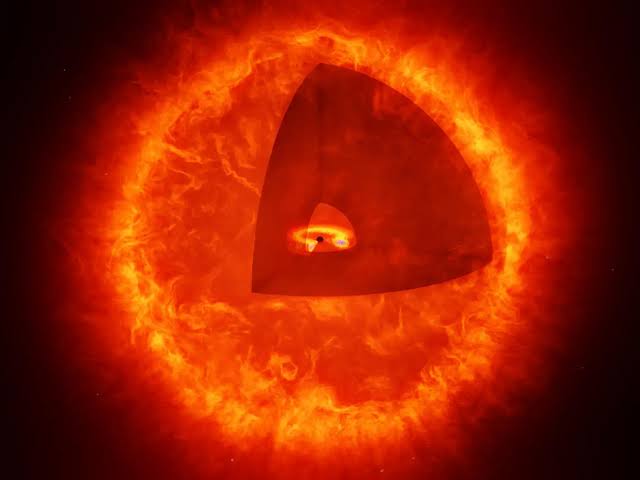
Here's the part that sounds like science fiction: MoM-BH*-1 isn't powered the way stars are powered. A normal star shines because nuclear fusion is happening in its core, hydrogen crushing into helium and releasing light as a byproduct. MoM-BH*-1 has no fusion at its heart at all. Instead, researchers calculate there's a black hole roughly 100,000 times the mass of our sun sitting at the center, and it is devouring surrounding gas and dust so violently, and generating so much radiation in the process, that it lights up the enormous cocoon of gas trapped around it — a shroud so large it would swallow our entire solar system, Neptune's orbit and all.
"We think there is a central black hole that is 100,000 times as massive as the sun," Naidu said, describing the find. "And around this black hole, there would be this very extended envelope of gas that looks like a star the size of the solar system. It's huge."
Do the arithmetic on the brightness and it gets stranger still: astronomers estimate the object is radiating roughly 100 billion times more energy than a single star like our sun — not because the black hole itself is unusually massive as black holes go, but because it's stuffed inside a gas envelope so thick and reflective that it behaves almost like a stellar photosphere, the visible "surface" layer of a star. It isn't a star. It just plays one, brilliantly, at cosmic distances.
WHY THIS SOLVES A FOUR-YEAR MYSTERY
The little red dots have been one of JWST's most stubborn puzzles since the telescope launched in December 2021 and began science operations in 2022. Astronomers floated competing theories almost immediately — maybe they were unusually dusty young galaxies, maybe they were an odd population of ancient massive stars, maybe the color was some kind of instrumental fluke. None of the explanations quite fit the data.
The black hole star model does something the earlier theories couldn't: it explains both the color and the compactness at once. A black hole gorging on gas inside a dense cocoon would glow intensely red because the surrounding material absorbs and re-radiates much of the black hole's high-energy light at longer, redder wavelengths — the same basic physics that makes a sunset red, just turned up to cosmological extremes. And because the whole structure, black hole plus gas envelope, is no bigger than a solar system, it would appear as an unresolved point of light even to JWST's sharp eye, exactly like the mystery dots.
Researchers now believe black hole stars like MoM-BH*-1 could account for a meaningful share of the little red dot population discovered since 2022. Some may already be growing directly into the cores of young galaxies — in fact, astronomers studying MoM-BH*-1 think it sits close enough to a forming galaxy that the two are likely to merge within about 100 million years, potentially producing exactly the kind of object that shows up elsewhere in JWST's images as a red dot embedded in early galactic structure.
THE BIGGER PUZZLE THIS COULD CRACK
There's a reason astrophysicists have been chasing this particular mystery so hard, and it isn't just tidiness. It connects to one of the most persistent open questions in cosmology: how do supermassive black holes — the kind that anchor the centers of galaxies, including our own Milky Way — get so big, so fast?
Standard black hole growth is supposed to be slow. A black hole formed from a collapsing star starts small, and it can only feed on infalling matter at a certain maximum rate before the radiation pressure from all that superheated material blows the rest away, called the Eddington limit. Under normal assumptions, growing a black hole from stellar remnants to a billion solar masses should take longer than the amount of time that had elapsed when astronomers were already finding billion-solar-mass black holes in the early universe. The math didn't work. Something had to be feeding these black holes faster, or hiding an early head start that observers weren't seeing.
Black hole stars may be exactly that missing evolutionary stage: a dense, gas-shrouded incubator where an infant black hole can pack on enormous amounts of mass at a blistering pace, largely hidden from view because the thick gas cocoon obscures the most direct evidence of runaway feeding. If that's right, little red dots and black hole stars aren't a curiosity on the margins of astronomy — they're a missing chapter in the story of how essentially every large galaxy, ours included, ended up with a monster at its center.
NOT EVERYONE IS FULLY SOLD YET
To be clear, "black hole star" is a new proposed classification, not yet universally settled science. It's the leading and best-fitting explanation on the table right now, published alongside supporting modeling work, but astronomy has a habit of demanding a pile of independent confirmations before a genuinely new category of object gets locked into the textbooks. Researchers want more examples, better spectroscopic fingerprints, and ideally a direct detection of the black hole's gravitational signature rather than just the glow it produces, before declaring the case fully closed.
Even skeptics agree, though, that MoM-BH*-1 is a serious contender precisely because the model reproduces so many odd features of the little red dots simultaneously — the color, the compactness, the extreme brightness for the apparent size, and the demographic clustering in the very early universe — rather than requiring a separate patch for each anomaly.
EXPERT PERSPECTIVE
Naidu's team frames the discovery as a turning point less because of one object and more because of what it might represent statistically. If black hole stars really do explain a substantial fraction of the hundreds of little red dots already catalogued by JWST, astronomers suddenly have a much larger sample of "black hole incubators" to study than anyone expected — essentially a fossil record of supermassive black hole formation, hiding in plain sight in JWST's deep-field images all along.
Outside researchers working on the "little red dot" problem, including groups affiliated with the Max Planck Institute for Astronomy and other JWST survey teams, have separately converged on similar gas-cocoon models over the past year, lending independent weight to the interpretation even before this particular object's data was published. The convergence across multiple research groups — rather than one lab's pet theory — is part of why the black hole star idea is being taken seriously as the front-runner explanation rather than just one more entry on a long list of guesses.
WHAT THIS MEANS FOR YOU
None of this changes anything about your Tuesday. But it's a genuine reminder of how young and unfinished our picture of the universe still is — a four-year-old space telescope just forced astronomers to invent a brand-new category of object because nothing in the existing textbooks fit what it was seeing. If you've ever looked up at the night sky and assumed astronomers basically have the universe figured out, the little red dots are a good corrective: there were hundreds of unexplained objects sitting in plain sight in publicly released data for years before anyone worked out what they were.
There's also a practical thread for anyone who follows space funding debates: discoveries like this are the return on investment for expensive, patient science infrastructure. JWST cost roughly $10 billion and took decades to build and launch. A result like the black hole star classification — a genuinely new addition to the astronomical field guide, with implications for how every large galaxy in the universe, including the Milky Way, built its central black hole — is the kind of payoff that's hard to predict in advance and nearly impossible to get any other way.
THE BOTTOM LINE
Four years ago, JWST handed astronomers a stack of blood-red dots they couldn't explain. Today, thanks to Rohan Naidu's team and the newly classified MoM-BH*-1, there's a real answer on the table: hidden black holes, wrapped in gas cocoons the size of solar systems, blazing so bright they briefly masquerade as stars. It's a strange new entry in the universe's field guide — and possibly the missing link in explaining how the supermassive black holes anchoring galaxies like our own got so big, so fast, so early. Expect more of these objects to turn up as astronomers go back through JWST's archives with fresh eyes, now that they finally know what they're looking for.
Published By | Tech Wiz