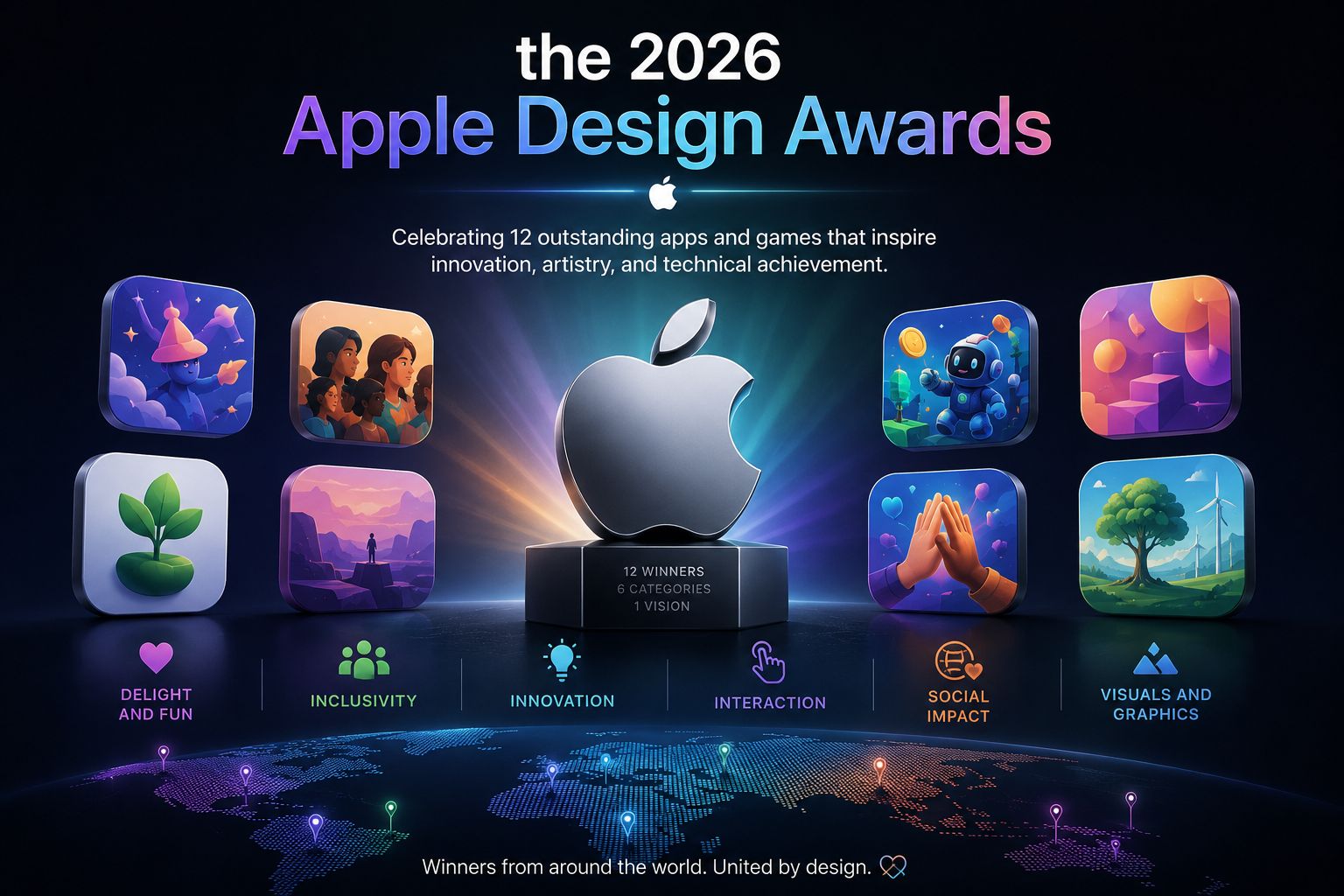
From an otherworldly mansion mystery to a Vision Pro sports revolution, this year’s winners showcase a new standard for what software can look, feel, and mean.
DESIGN
Every year, in the days before Apple’s Worldwide Developers Conference descends on Cupertino—with its customary blend of controlled excitement and genuine surprise—the company does something quietly remarkable: it names the twelve apps and games that best exemplify what digital design can be. The Apple Design Awards ceremony is less a red-carpet moment than a philosophical statement—Apple’s considered answer to what software should aspire to in an era of limitless possibility and dangerously short attention spans.
The 2026 winners, announced on June 2, are twelve extraordinary pieces of software selected from 36 global finalists, representing teams from the Netherlands, Spain, India, the United Kingdom, the United States, Italy, Canada, and Poland. Spanning categories from Delight and Fun to Social Impact, Inclusivity, and Visuals & Graphics, they collectively form a design manifesto for the mid-decade moment: software that is technically brilliant, emotionally intelligent, and unmistakably human.
The Innovation Winners: A Mansion Mystery and an Immersive Arena
Of the six award categories, Innovation is perhaps the most scrutinized—and the 2026 winners are as contrasting as they are compelling. Blue Prince, the game winner from Dogubomb, is a genre-defying adventure that has attracted near‑universal critical praise. Describing Blue Prince is a challenge, which is itself part of its achievement. Depending on your angle, it is a puzzle game, a mystery, an architectural exploration, and a slow‑burn narrative with a second game’s worth of secrets hidden within its walls.
The conceit: players explore a vast, procedurally arranged mansion room by room, discovering fragments of story in hanging pictures, hand‑scribbled notes, and the precise geometry of the spaces themselves. There is no combat and no conventional objectives. Instead, there is an overwhelming sense of depth—a world that rewards patience, curiosity, and a willingness to sit with uncertainty. Apple’s judges cited Blue Prince’s “extraordinary depth, secrets, and an entire second game’s worth of story to bring the mysterious world to life” as the basis for its Innovation award.
On the app side, the Innovation award went to NBA: Live Games and Scores—specifically its version built for Apple Vision Pro. This is software that rethinks what it means to watch sports in the spatial computing era. Users can watch up to five live NBA games simultaneously (a feat that sounds chaotic but is seamless in execution) while floating real‑time player statistics hang in the air before them. A 3D court in tabletop mode provides a god’s‑eye perspective previously available only to coaches and analysts. Spatial Audio wraps every game in the genuine sonic environment of the arena.
Most remarkably, a feature called Spectrum Front Row—available for Lakers games—offers what Apple calls “the future of sports broadcasting”: an immersive format that places the viewer effectively courtside. It is a vision of sports consumption that feels genuinely futuristic, raising intriguing questions about what attending a live game will mean as spatial computing matures.
Designing for Everyone: Inclusivity and Social Impact
Two of the most emotionally resonant award categories in 2026 are Inclusivity and Social Impact, and their winners speak to a growing conviction within the design community that the best software reaches the widest possible human audience.
Guitar Wiz, the Inclusivity winner in the app category, has been praised for making music learning accessible in ways that previous products never managed. Its adaptive interface responds to a user’s specific physical capabilities, offering genuine flexibility for players with limited mobility, visual impairments, or cognitive differences that traditional music instruction can exclude.
Pine Hearts, the Inclusivity winner in games, is a gentle exploration game set in a caravan park, centered on a child processing grief through memory and small acts of tenderness. Its accessible design—comprehensive visual, audio, and cognitive options—is matched by a narrative sensitivity that has made it one of the most talked‑about independent games of the year. “Pine Hearts proves that accessibility and artistry are not competing values,” one critic noted. “They are, in the right hands, the same thing.”
In the Social Impact category, Primary: News in Depth won for its journalism platform, which takes a different approach to the fractured information landscape by providing multi‑perspective, context‑rich news coverage designed to build understanding rather than simply confirm existing beliefs. Consume Me, the Social Impact game winner, takes a more provocative route: a satirical exploration of consumer culture and social media addiction that turns the mechanics of the very platforms it critiques into tools of self‑examination.
The Visual and Interactive Triumphs
Tide Guide: Charts and Tables, the Visuals and Graphics winner in the app category, is a masterclass in what data visualization can become when treated as an artistic discipline. A tidal prediction app that presents its information through fluid, elegantly animated charts and typographically sophisticated tables, it demonstrates that utility and beauty are not merely compatible—they are mutually reinforcing. Cyberpunk 2077: Ultimate Edition, its game counterpart, needs little introduction: CD Projekt Red’s landmark open‑world game, now fully optimized for Apple platforms, delivers a visual experience that remains, years after its original release, genuinely stunning.
The Interaction winners—Moonlitt: Moon Phase Tracker and Sago Mini Jinja’s Garden—represent opposite ends of the age spectrum but share a commitment to making digital interaction feel tactile, intuitive, and delightful. Moonlitt’s interface, which renders lunar phases with a painterly, almost meditative quality, has been described as the most beautiful way to look at the sky on a small screen. Sago Mini Jinja’s Garden, designed for the youngest of users, demonstrates that thoughtful interaction design for children is one of the most demanding—and underappreciated—challenges in the field.
Finally, Grug and Is This Seat Taken? took the Delight and Fun awards—a reminder that among all the loftier ambitions of the Apple Design Awards, the most fundamental criterion remains the simplest: does this make you smile?
What the 2026 Awards Tell Us About Design’s Future
Taken together, the 2026 Apple Design Award winners articulate a coherent vision of where digital design is heading. Software is becoming more spatially aware, more emotionally intelligent, more attuned to the full diversity of human experience—and more willing to take genuine aesthetic risks in pursuit of beauty as well as function. The NBA app’s Vision Pro experience points toward a world where the boundaries between physical and digital spectatorship dissolve. Blue Prince’s success suggests an appetite for software that is patient and deep, rewarding genuine engagement rather than compulsive micro‑interaction.
The diversity of the winning teams is equally telling. From Poland to India, from the Netherlands to Canada, the 2026 awards confirm that design excellence has no geographic center of gravity. WWDC 2026, which begins on June 8 in Cupertino, will provide the wider context for these individual achievements—new operating system features, new hardware capabilities, new creative tools—but the Design Awards are, in many ways, the more honest signal about the state of the craft. They ask not what Apple is building, but what the best human minds are doing with the tools they have.
The answer, in 2026, is remarkable: software that makes you cry, software that makes you see sports differently, software that helps you grieve and software that helps you learn, software that treats the moon as a work of art and data as a form of poetry. The awards are fifteen minutes of recognition for work that took years. But what they celebrate is something that cannot be manufactured: the specifically human desire to make things that matter.
Published By | Tech Edictor