Written By |
Uganda's deepest, quietest water hides twenty-nine islands, a hard history, and a road that cannot come soon enough
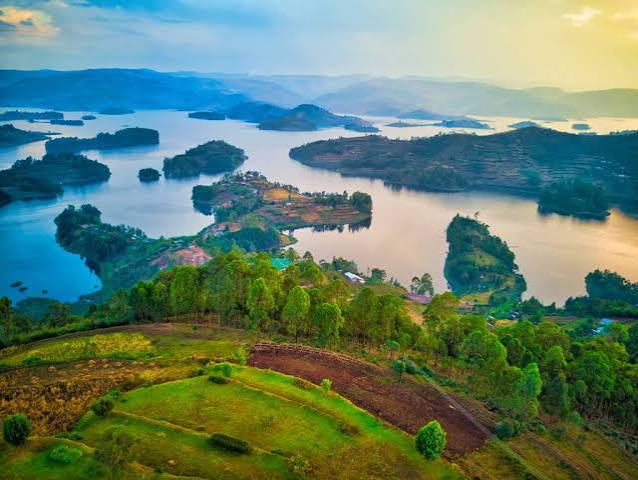
The mist comes off Lake Bunyonyi before the sun does. It settles into the folds between the hills, so that for an hour after dawn the islands appear to float free of the water entirely — dark humps suspended in white, with the terraced slopes of Kigezi rising behind them in steps so precise they look drawn. Then a dugout canoe slides out of the haze, a boy standing in the stern, and the whole picture resolves into something ordinary and inhabited. This is the moment most visitors remember. It is also the moment they stop taking photographs and simply sit.
Lake Bunyonyi sits in Uganda's far south-west, in Kabale District, a short run from the Rwandan border and within reach of Kisoro. Its name comes from the Rukiga word for the small birds that crowd its reed beds and shoreline scrub — bunyonyi, the place of many little birds. At roughly 1,962 metres above sea level, it is cool enough that lodges lay out blankets at night and travellers arriving from the heat of Kampala find themselves unexpectedly grateful for a fire. The lake runs about 25 kilometres long and only some seven kilometres at its widest, a long-fingered body of water pressed into a valley that lava flows are thought to have dammed more than ten thousand years ago.
Its depth is the subject of Uganda's most cheerfully unresolved tourism argument. Published figures range from a sober 44 metres to a headline-friendly 900, and the larger number is repeated often enough that Bunyonyi is routinely billed as the second-deepest lake in Africa, after Tanganyika. No widely accepted modern bathymetric survey supports the upper end of that range. Travellers should treat the claim as local lore rather than settled science — which does nothing to diminish the lake, and arguably improves the story.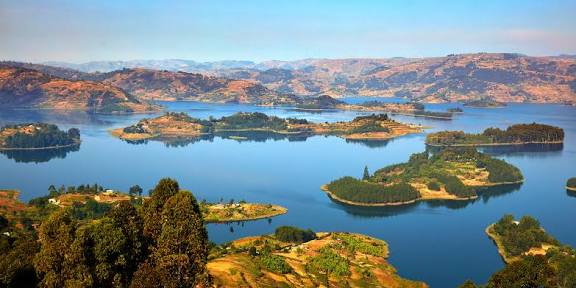
Twenty-nine islands, and one that hurts
What is not in dispute is the islands: twenty-nine of them, clustered mostly through the lake's midsection, each with its own shape and its own use. Some carry lodges and campsites. Some are farmed. Bushara, wooded and gently managed, is a favourite for birders. Bwama held a leprosy treatment centre founded by an English missionary doctor in the interwar years, and the buildings still stand, now a school. And then there is Akampene.
Akampene is a scrap of land barely larger than a bedroom, crowned by a single tree. Its English name is Punishment Island, and the name is literal. Within living memory of some families around the lake, girls who became pregnant before marriage were rowed out and abandoned there — a sanction that had less to do with morality than with economics, in a society where bride price underwrote a household's survival and an unmarried pregnancy erased it. Most of the girls could not swim. Some were retrieved by men too poor to afford bride price, who took a wife this way. The practice persisted into the early twentieth century despite missionary and colonial pressure against it. Guides raised on these shores tell the story plainly and without theatre, and the five minutes you spend on that island will reorder how you look at the rest of the view.
What lives here
The birds justify the name. More than two hundred species have been recorded around the lake and its wetlands — grey crowned cranes, Uganda's national bird, stepping through the marsh margins; herons stationed in the shallows; weavers working the papyrus into knots. Early morning on the water, or a slow walk along the shoreline swamps, will do more for a birder than any hide.
Below the surface, the ecology is a human story. Crayfish, introduced decades ago, took to Bunyonyi with such enthusiasm that they now dominate the lake and have spread through connected waters. Every lodge and every roadside restaurant serves them, usually grilled with garlic, and the local crayfish plate has quietly become one of the region's defining dishes. Otters work the reed edges. What Bunyonyi conspicuously lacks is hippos, crocodiles, and — by long-standing local reputation — bilharzia, which is why this is one of the very few large lakes in the region where Ugandans and visitors alike swim without hesitation. It is a reputation rather than a guarantee, and cautious swimmers stick to the deeper open water off lodge jetties.
Practical notes for the traveller
Bunyonyi is not a national park, so there is no Uganda Wildlife Authority gate fee and no permit to secure in advance. Costs are what you arrange on the ground: a bed, a boat, and a community guide. Dugout canoe hire, motorised island-hopping circuits, village and Batwa cultural visits, and guided hill walks are all booked through lodges or the community associations that operate at the main landing sites, and rates are negotiated rather than posted. Accommodation spans genuine backpacker dormitories, mid-range island lodges reached only by boat, and a handful of higher-end properties on the eastern shore.
Getting there is the honest inconvenience. Kampala to Kabale is roughly 466 kilometres via Mbarara and Ntungamo — about eight hours by coach in good conditions — and the lake lies some 15 kilometres beyond the town, a twenty to twenty-five minute transfer over the escarpment. Most international visitors arrive sideways rather than directly, folding Bunyonyi into a Bwindi gorilla itinerary as the decompression stop afterwards, which is exactly what it is best at.
The dry months — June to August, and December to February — bring the clearest water, the most reliable hill walking, and the peak birding windows. The rains are not a reason to stay away; they are the reason the hills are that colour. Bring warm layers regardless. At almost two thousand metres, Bunyonyi nights are cold in a way the equator does not lead you to expect.
This Week in Ugandan Tourism
Free national park entry, 25–27 September. The Uganda Wildlife Authority has confirmed Open Park Days from 25 to 27 September, waiving entry at Murchison Falls, Queen Elizabeth, Lake Mburo and Kidepo Valley national parks, along with the Pian Upe, Toro-Semliki, Katonga and Ajai wildlife reserves. The State Minister for Tourism, Susan Nsambu Nakawuki, announced the window, which is open to Ugandans and foreign visitors alike. UWA's acting commissioner for tourism and business development, Dorcus Rukundo, framed it simply: before we celebrate World Tourism Day, let us first explore Uganda.
Mbale hosts World Tourism Day on 27 September. The national commemoration lands at Mbale Secondary School grounds in Mbale City, a deliberate push to draw attention toward Mount Elgon and the eastern circuit. The global theme this year is the digital agenda and artificial intelligence in redesigning tourism, and the Ministry of Tourism has signalled it intends to lean into that — destination marketing and visitor management are both on the agenda.
The Kabale–Lake Bunyonyi road remains stalled. The 34-kilometre Kabale–Lake Bunyonyi and Kisoro–Mgahinga upgrade, conceived as a 36-month project and launched with considerable local optimism, lost its contractor partway through the Bunyonyi section, halting work for roughly three months. State Minister for Finance Henry Musasizi convened an urgent meeting in August to unblock it, and Kabale tourism operators have publicly welcomed government's move to procure a replacement contractor. Operators around the lake have been blunt about the cost of the delay in lost bookings — this is the single infrastructure question that matters most to Bunyonyi's next five years.
Uganda Airlines adds Accra and Kigali. The national carrier begins a four-times-weekly Entebbe–Accra service on 27 October and a daily Entebbe–Kigali service on 18 November, taking its African network to sixteen destinations. The Kigali link is the one with immediate consequences for Kigezi: it shortens the approach to Bwindi, Mgahinga and Bunyonyi for travellers routing through Rwanda.
Gorilla permit rules have tightened. Following UWA's February tariff review, permits stand at USD 800 for foreign non-residents, USD 700 for foreign residents, USD 500 for African nationals and UGX 300,000 for East African citizens, with a reduced USD 600 rate in the low-season months of April, May and November. The significant change is procedural: since 1 March the old seven-day reservation hold has been scrapped, and permits now require payment in full at the time of booking. Groups planning high-season treks should book earlier than they used to.
None of which changes what happens on the water at six in the morning. The mist lifts, the terraces emerge, a canoe crosses, and Uganda's quietest great lake gets on with being itself.



