Written By |
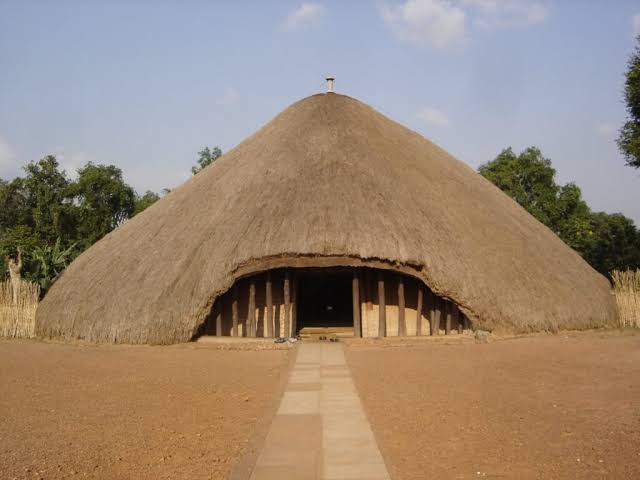
At Kasubi, Uganda's only cultural World Heritage Site has risen from its own ashes — and a kingdom is preparing to hand it back to the public
You hear Kasubi before you see it. Climb the red-earth rise off Masiro Road, four kilometres northwest of Kampala's clamouring centre, and the city's engine noise thins to something softer — the scuff of bare feet on packed earth, the low murmur of women in barkcloth seated in the shade, the creak of spear grass settling in the heat. Then the gate opens onto a courtyard, and the thing itself is in front of you: an enormous dome of golden thatch, rising in tiers like a hive, its ribbed flanks the colour of dry season grass. This is Muzibu Azaala Mpanga, the largest grass-thatched structure on earth, and beneath its roof lie four kings.
Visitors are asked to remove their shoes. The instruction is not ceremony for tourists — it is the same request made of any Muganda approaching the resting place of the Kabakas, and it sets the terms of everything that follows. Kasubi is not a monument. It is a working royal site, staffed by descendants of the clans who have kept it for a hundred and forty years, and it expects something of you in return for admission.
A Palace That Became a Grave
The hill was called Nabulagala until 1882, when Kabaka Muteesa I — the shrewd, restless monarch who ruled Buganda from 1856 and who received the first European visitors to the kingdom's court — built his palace here and renamed it Kasubi. He did not enjoy it long. Muteesa died in 1884, and in a decision that broke with Buganda custom, his body was buried in his own palace rather than separated from his jawbone and enshrined elsewhere. The house of the living became the house of the dead.
Three of his successors followed him into the same building. Mwanga II, whose reign collapsed into the religious wars and the persecutions that produced the Uganda Martyrs, was buried here after dying in exile in the Seychelles in 1903. Daudi Chwa II, who came to the throne as an infant and reigned through the colonial protectorate, was interred in 1939. And Sir Edward Muteesa II — Kabaka, and independent Uganda's first president, who died in a London flat in 1969 — completed the quartet. Four kings, four centuries of Buganda's collision with the outside world, under one roof of grass.
The architecture encodes the kingdom itself. The great dome rests on a frame of wooden poles and reed, its thatch layered over rings of palm frond — fifty-two of them, one for each of the traditional clans of the Baganda. Step inside and the light drops away. At the rear hangs a curtain of barkcloth, beaten from the ficus tree in a craft UNESCO separately recognises as intangible heritage. Behind it is the Kibira, the sacred forest: the actual burial chamber, which no ordinary visitor sees. Guides will tell you, without lowering their voices much, that the kings are not dead but present, and that the widows and royal ritual attendants who maintain the site are there to receive them.
UNESCO inscribed the Tombs of Buganda Kings at Kasubi on the World Heritage List in 2001, citing the site as a masterpiece of organic architecture and a place where living tradition and built form are inseparable. Nine years later, on the night of 16 March 2010, the great house burned to the ground.
The Long Rebuilding
What followed was one of Africa's most demanding heritage projects — and one of its most quietly instructive. The reconstruction could not be a matter of engineers and contractors alone, because the building is not only a building. Ritual specialists, clan leaders and craftspeople had to do work that only they were entitled to do: the cutting of specific poles, the beating of barkcloth, the laying of thatch in the prescribed order. Government, UNESCO, the Japanese government's heritage fund and the Buganda Kingdom shared the cost and the argument over method.
The rebuilt Muzibu Azaala Mpanga was completed in 2023, alongside the restoration of the Bujjabukula — the reed gatehouse where guards once watched arrivals through gaps in the woven wall, unseen. A modern fire suppression system went in, an addition the World Heritage Committee praised explicitly when it voted to remove Kasubi from the List of World Heritage in Danger. Since the main tomb reopened, the site has reported visitor numbers up by more than two hundred per cent.
The work has continued past the headline. In December 2025 the Katikkiro, Charles Peter Mayiga, confirmed that a perimeter wall now encloses the full 63-acre site, with the Muzibu Azaala Mpanga fenced independently inside it — a security measure aimed squarely at the vulnerability that 2010 exposed. What remains is not construction but ceremony. The kingdom is preparing kusala kisassi, the traditional cleansing and blessing that must precede a full return of the site to public and ritual life. For travellers planning the coming dry season, that is the date to watch.
Visiting Kasubi
Kasubi sits on Kasubi Hill along Masiro Road, roughly a twenty-minute drive from Kampala's city centre outside peak traffic — longer inside it, which is most of the working day. Any boda or taxi driver knows it. The site is generally open Monday to Saturday, from around 8:00 in the morning until 6:00 in the evening, though hours and access have shifted repeatedly during the restoration years and a phone call ahead remains sensible advice rather than excessive caution.
Entrance fees are modest and have been quoted anywhere from about UGX 10,000 to UGX 30,000 depending on the year and the visitor category, with the money going to the guides and caretakers who maintain the grounds. Published rates lag reality here; confirm on arrival. Whatever you pay, take the guide. Kasubi is a site where almost everything meaningful is invisible without narration — the significance of a curtain, of a doorway's height, of which clan is responsible for which task. Unguided, it is a large beautiful roof. Guided, it is a kingdom's constitution rendered in grass and reed.
Dress conservatively; shoes come off at the threshold of the main house. Photography is welcome in the courtyard and restricted inside. Allow ninety minutes. And go in the late afternoon if you can, when the low sun rakes across the thatch and turns the whole dome the colour of a struck match. Kasubi pairs naturally with a half-day Kampala cultural circuit — the Uganda Museum, the Lubiri palace ruins, and the Namugongo martyrs' shrine to the east all sit within the same story of a kingdom meeting the nineteenth century head-on.
This Week in Ugandan Tourism
18 September — Tourism operators pressed government and lenders for cheaper, more flexible credit at a stakeholder forum on financing tourism MSMEs. Uganda Tourism Board chairperson Pearl Kakooza argued that small operators cannot meet rising international demand without investment they can actually service, framing access to finance as the sector's binding constraint rather than marketing reach.
25–27 September — The Uganda Wildlife Authority stages its 2026 Open Park Days, waiving entrance fees at selected protected areas for three days. The programme runs into national World Tourism Day celebrations, hosted this year in Mbale, and is squarely aimed at domestic travellers who have historically been priced out of their own parks.
15–17 September — Ugandan operators worked the floor at IFTM Top Resa in Paris, where more than nine in ten French and Iberian buyers named the absence of a direct Paris–Entebbe service as a cost and time penalty on selling Uganda. The push for a direct route has become the trade's headline ask in the European market.
11 September — UWA and the Wildlife Conservation Society launched a ten-year Collaborative Management Partnership for the Ishasha sector of Queen Elizabeth Protected Area — home of the tree-climbing lions — committing to stronger anti-poaching capacity, more ranger staffing and deeper community engagement in a landscape whose lion population has been under sustained pressure.
Route watch — Uganda Airlines has scheduled new Entebbe services to Accra from 27 October and Kigali from 18 November, widening the national carrier's East–West African reach. Kenya, meanwhile, is targeting 300,000 Ugandan arrivals in 2026 on the back of denser Nairobi–Entebbe frequencies — a reminder that regional traffic, not only long-haul, is where the volume sits.
Permits — Uganda's gorilla permit holds at USD 800 for foreign non-residents, dropping to USD 600 in April, May and November. Two rule changes bite in 2026: full payment is now required at booking, and trekkers in Bwindi book a sector rather than a named gorilla family.
Uganda Tourism Daily · Site 16 of 20 in the national rotation · Compiled 18 September 2026



