Written By |
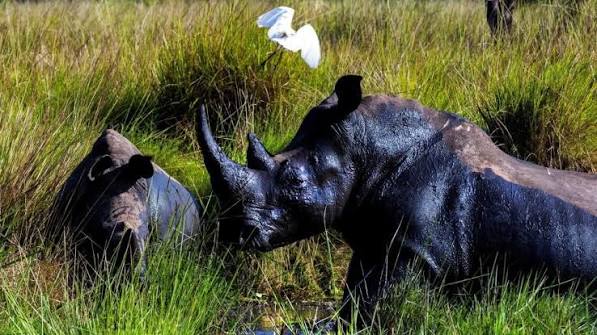
Twenty years after the last wild rhino vanished from the country, Ziwa Rhino Sanctuary has grown a herd big enough to start sending rhinos home
The rhino does not know it is a miracle. It stands knee-deep in the elephant grass of a former cattle ranch in central Uganda, grinding through a mouthful of grass, utterly indifferent to the eight people fifteen metres away who have gone quiet in its presence. A ranger's raised hand is the only thing holding the group at that distance. For a country that watched its last wild rhino disappear in the chaos of the 1980s, this ordinary, grazing animal is the payoff of a two-decade bet that a species could be brought back from zero.
That bet was placed at Ziwa Rhino Sanctuary, a 70-square-kilometre spread of woodland, swamp and savanna in Nakasongola district, about three hours north of Kampala on the road to Murchison Falls National Park. It is not a national park and it is not, strictly, wild — Ziwa is a private, fenced sanctuary, the only place in Uganda where rhinos exist at all. But what has happened here over the past twenty years is now feeding directly back into Uganda's wild spaces, and this month that story reached a new chapter.
From Cattle Ranch to Rhino Cradle
Uganda's rhinos were wiped out by a grim combination of poaching and civil conflict; by the late 1980s, not one remained in the wild. Rebuilding began not with a park but with an idea. Rhino Fund Uganda, a conservation NGO, was founded in 1997 to bring the species back, and in 2001 the first two southern white rhinos arrived at the Uganda Wildlife Education Centre in Entebbe as a starting point. The breakthrough came a few years later, when rancher Captain Joseph Charles Roy offered his Nakitooma cattle ranch — worked by his family for nearly two decades — as a home for a proper breeding sanctuary. In partnership with Rhino Fund Uganda, the ranch was converted, and in 2005 Ziwa Rhino Sanctuary was born, seeded with six more southern white rhinos: four from Kenya's Solio Game Reserve and two, improbably, from Disney's Animal Kingdom in Florida.
Two decades of round-the-clock ranger protection, careful breeding management and community engagement around the sanctuary's boundary have turned that founding handful into one of Africa's genuine conservation success stories. Ziwa's herd has grown many times over, with multiple generations now born on the land itself — animals that have never known anywhere else. The sanctuary's stated goal was never simply to hold rhinos safely behind a fence forever; it was to grow a population large enough to eventually repopulate Uganda's actual protected areas. This March, that goal stopped being theoretical: the first two of an initial group of eight southern white rhinos were loaded up and driven from Ziwa to Kidepo Valley National Park in Uganda's remote northeast, stepping out of their transport crates into a national park for the first time in roughly forty years. It was a quiet, unglamorous moment involving a truck, a crane and a lot of nervous logistics — and one of the more significant conservation milestones East Africa has produced in years.
What a Visit Looks Like
For visitors, Ziwa's headline activity is rhino trekking — a guided walk, not a game drive, and the sanctuary's entire draw. Rangers track the animals' rough location by vehicle, then lead guests in on foot for the final approach, holding the group to a respectful distance of around seven metres. The walks run one to two hours and suit most fitness levels; sturdy shoes, a hat and sun protection are the only real requirements. Early morning, between about eight and ten, and late afternoon, from four until dusk, tend to offer the most comfortable temperatures and the most active animals, though tracking runs daily from seven in the morning until five in the evening.
Rhinos are the reason people come, but they are not the only reason to linger. Ziwa's wetlands and woodland host more than 350 recorded bird species, drawing serious birders in pursuit of the prehistoric-looking shoebill stork alongside African fish eagles, great blue turacos and a scatter of kingfishers and weavers. Guided night walks reveal a different sanctuary entirely — leopards, bushbabies and owls that stay hidden through the heat of the day — and the grounds accommodate camping and simple nature walks for travellers who want to slow down rather than tick off sightings. Because Ziwa sits directly on the Kampala–Gulu highway, it works naturally as a stopover for travellers heading to or from Murchison Falls, breaking up a long drive with something genuinely worth stopping for rather than a forgettable rest stop.
Planning a Visit
Rhino tracking permits cost US$50 for foreign non-resident adults and US$30 for children, US$45 and US$20 respectively for foreign residents, and 40,000 and 10,000 Ugandan shillings for East African citizens; the fee covers sanctuary entry and an English-speaking ranger guide. The sanctuary lies roughly 176 kilometres north of Kampala, comfortably reached by private vehicle or as part of an organised Murchison Falls itinerary, and a range of budget to mid-range accommodation sits in and around the property for those who want to combine the trek with a night of birding or camping under Nakasongola's wide skies.
This Week in Ugandan Tourism
Uganda's tourism sector is having a busy August. Uganda Airlines confirmed it will launch direct flights to Kigali, Rwanda, and Accra, Ghana, starting in October, expanding the national carrier's network to sixteen destinations — a move tourism stakeholders say should widen visitor arrivals and strengthen regional connectivity for travellers combining Uganda with neighbouring gorilla and safari circuits.
Further afield, the Egyptian Travel Agents Association met with the Uganda Tourism Board this month to explore joint tourism programmes aimed at long-haul markets in the Far East, Australia and the Americas, part of a broader push to diversify Uganda's source markets beyond its traditional European and North American base.
Domestically, officials are framing 2026 as a shift from chasing raw arrival numbers toward tightening service standards: the sector now generates roughly UGX 4.8 trillion annually from about 1.5 million international arrivals, and the newly launched Pearl of Africa Tourism Expo Awards — a joint initiative between the Uganda Tourism Board and the European Union marking the programme's tenth anniversary — is explicitly built around rewarding sustainability, storytelling and service excellence rather than volume alone.
For anyone planning a trip, two practical notes are worth flagging. August is Uganda's single busiest safari month, stacking peak dry-season wildlife viewing against Northern Hemisphere summer holidays, so vehicles, lodges and gorilla trekking permits are booking out well in advance. And gorilla permits themselves carry 2026 pricing of US$800 per person in high season, dropping to US$600 in the low-season months of April, May and November, with the Uganda Wildlife Authority remaining the sole issuer and roughly 160 permits available daily across Bwindi Impenetrable and Mgahinga Gorilla National Parks — numbers worth building a Uganda itinerary around, whether or not a rhino trek at Ziwa makes the final cut.



