Uganda Tourism
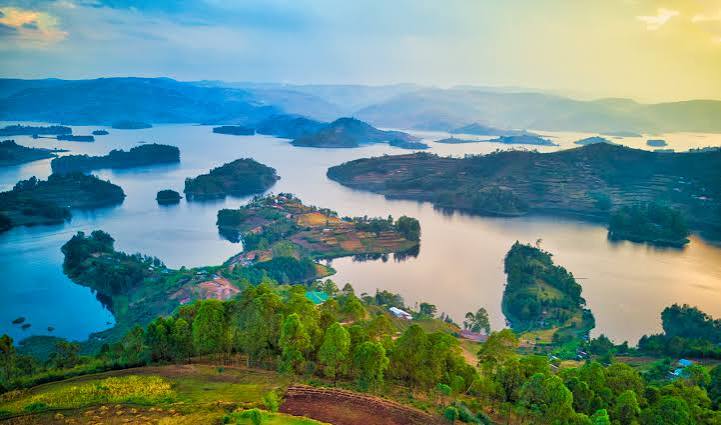
The dugout canoe barely makes a sound. It slides across water so still that the terraced hillsides of Kigezi — every ridge combed into vegetable gardens by generations of Bakiga farmers — lie doubled on the surface, upside down and undisturbed. This is Lake Bunyonyi, tucked into the far southwest corner of Uganda between the towns of Kabale and Kisoro, and if Uganda's national parks are built around adrenaline — gorillas in the undergrowth, hippos surfacing beside your boat, chimpanzees screaming through the canopy — Bunyonyi is built around its opposite. There is nothing here to run from. Tourists who arrive fresh off a Bwindi gorilla trek or a Queen Elizabeth game drive often say the same thing: this is the first place in the country where they stopped scanning the treeline and just breathed.
A Lake Built by Lava
Lake Bunyonyi's name translates loosely as "place of many little birds," and the birdlife — over 200 recorded species, from malachite kingfishers to the endangered grey crowned crane — is only the most visible layer of a much older story. Geologists date the lake's formation to roughly 18,000 years ago, when lava flows from the Virunga volcanic chain dammed the valley of the Ndego River, drowning a landscape of hills and leaving only their upper slopes exposed as islands. Twenty-nine of those islands now dot the lake's surface, each with its own name and, often, its own unsettling history. Akampene, "Punishment Island," was once used to strand unmarried pregnant girls, left to starve or be rescued — for a bride price — by a man willing to take them; it is now a quiet stop on canoe tours, its history relayed by local guides with the same matter-of-factness with which they point out a fish eagle. Bwama and Njuyeera islands carry a gentler legacy: in 1921, the missionary doctor Leonard Sharp established a leprosy treatment colony there, a facility that evolved over the following century into the schools and hospital that still serve the district today.
Depth is where the lake turns into local legend. Hydrological surveys put its maximum depth at a still-considerable 40 metres, but ask almost anyone in Kabale and you'll hear a different number — up to 900 metres, deep enough, they'll tell you, to be the second-deepest lake in Africa after Tanganyika. Scientists are skeptical; residents are not swayed. What both agree on is that Bunyonyi, unlike most East African lakes, is free of bilharzia and crocodiles, which makes it one of the only lakes in Uganda where visitors can swim without a second thought — a fact every lodge on its shores advertises within the first line of its brochure.

Life on the Water
The lake sits at 1,962 metres above sea level, high enough that evenings arrive with a chill most visitors don't expect on the equator, and locals wrap themselves in blankets on canoe rides at dusk. On the eastern shore lives a Batwa community, among Uganda's oldest indigenous peoples, evicted decades ago from the Echuya Forest Reserve and now sustaining themselves partly through cultural tourism — traditional dance, music, and storytelling that give visitors one of the more direct encounters with pre-agricultural Great Lakes culture anywhere in the region.
What draws most travelers, though, is simply the pace. Canoeing between islands — in a traditional dugout or a more stable modern fibreglass version — remains the signature activity, alongside swimming, island picnics, and birdwatching walks along the terraced shoreline. Bushara Island has built a small eco-tourism operation around nature trails and overnight camping; Kyahugye Island is the odd one out, stocked with zebra and antelope for visitors who want a taste of savannah wildlife without leaving the lake. More energetic operators now offer quad-biking, ziplining, and mountain-bike routes into the surrounding Kigezi hills, known locally as the "Switzerland of Africa" for their dense, cultivated ridgelines. For most visitors, though, Bunyonyi's real function is recovery: it sits an easy 25-minute drive from Kabale town and roughly two-and-a-half hours from Bwindi Impenetrable National Park, making it the natural place to decompress after the physical demands of gorilla trekking before continuing on to Rwanda or back toward Kampala.
Planning a Visit
Bunyonyi is a year-round destination, but the June-to-September and December-to-February dry seasons offer the clearest water and easiest hiking, while the wetter months bring a deeper green to the terraces and thinner crowds. Access is straightforward by regional standards: most visitors drive from Kampala (roughly seven to eight hours) or fly into Kihihi or Kisoro airstrips before continuing by road, though the far more common route is simply to fold Bunyonyi into a Bwindi gorilla-trekking itinerary, since the drive between the two takes only a couple of hours on now-improved roads. Accommodation spans the full range, from budget backpacker camps on Bushara and Byoona Amagara islands to lodges such as Arcadia Cottages and Birdnest that combine lake views with genuine comfort. There is no single park entry fee for the lake itself — most costs are wrapped into canoe hire, island transfers, and accommodation, typically a fraction of what a day inside one of Uganda's national parks costs. It is, in short, the rare Ugandan destination that rewards doing very little.
This Week in Ugandan Tourism
Uganda's tourism sector kept up a brisk pace of activity this week. On August 22, a delegation from the Uganda Tourism Board's Board of Directors met with the Egyptian Travel Agents Association (ETAA) to explore joint tourism programmes and long-haul market cooperation targeting the Far East, Australia, and the Americas — part of a broader push to diversify Uganda's source markets beyond its traditional European and North American base. Two days earlier, on August 23, Kampala's Lugogo Grounds hosted the Green Festival 2026, a day-long event pairing environmental conservation messaging with family entertainment and a headline performance from musician John Blaq, reflecting the tourism sector's growing efforts to link domestic audiences with conservation goals rather than treating wildlife tourism as an export product for foreigners alone.
On the conservation-hospitality side, this year's Ekkula Festival awards recognized Acacia Wilderness Mweya as Sustainable New Hotel/Eco-Lodge of the Year, Tabebuia Spa & Safari Resort as Sustainable Eco-Lodge of the Year, and Emburara Farm Lodge for excellence in agro-tourism — a signal that Uganda's lodge sector is competing increasingly on sustainability credentials as well as location. Permit economics remain in flux for travelers planning ahead: as of July 1, 2026, the standard gorilla trekking permit for foreign non-residents sits at $800, with low-season discounts of $600 introduced for April, May, and November bookings, though those discounted permits carry no rescheduling flexibility. Prospective trekkers should also note that permit prices are scheduled to rise to $1,000 from January 1, 2027, and that a March 2026 booking-policy change eliminated the old seven-day reservation hold, meaning full payment is now required at the time of booking. Finally, the Uganda Wildlife Authority has confirmed its Open Park Days for September 25–27, 2026, when selected protected areas will waive entrance fees entirely — a deliberate push to widen access for domestic and regional travelers ahead of the year's final quarter.
Published By | Features Editor