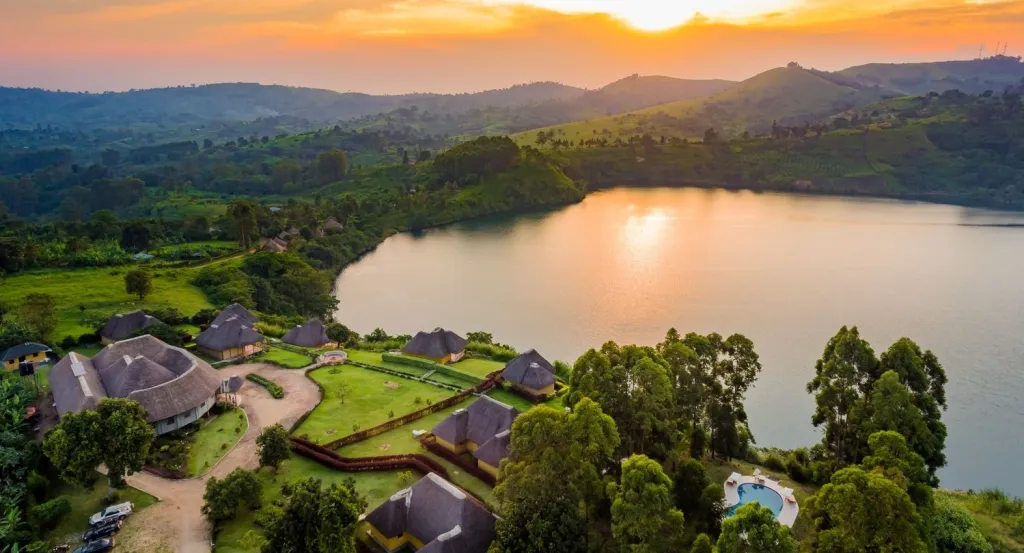
Fort Portal
The road west from Kampala climbs for roughly 290 kilometres, past tea estates and banana groves, until the land begins to ripple. Then the ripples become bowls: perfectly round hollows, some brimming with jade-green water, some cloaked in forest, each one the scar of a volcanic eruption that ended long before any kingdom was founded. This is Fort Portal and the Tooro region, a corner of western Uganda where the earth has been busy making beauty for a very long time.
The crater lakes are the headline. Local accounts count as many as 52 of them scattered across Kabarole and Bunyangabu districts, among them Nkuruba, Nyinabulitwa, Nyabikere, Kigyere, Ssaka, Mwitampungu and the much-photographed Kyaninga. Formed by volcanic activity, they sit in a landscape of fertile soil, rolling hills and, on clear mornings, the snow-tipped silhouette of the Rwenzori range far to the west. Some are fringed with lodges and treehouse camps; others are quiet enough that the loudest sound is a kingfisher working the shoreline. Ssaka and Mwitampungu draw anglers, while the lodge-lined shores of Kyaninga, Nyinabulitwa and the Ndali-Kasenda cluster draw travellers who simply want to sit on a veranda and watch the light change.
The town itself deserves a day. Fort Portal was founded in 1893 and named for Sir Gerald Portal, a British colonial official, and it later became the seat of the Tooro Kingdom, whose palace, royal tombs at Karambi and the Karuzika complex still anchor the cultural life of the region. Queen Elizabeth planted eucalyptus trees at the Tooro Botanical Gardens after her visit in 1952. In 2020 the government upgraded Fort Portal to city status and marked it out for tourism, and the effort shows: a walkable centre, a growing café scene, and a map of historical buildings produced by the Cross-Cultural Foundation of Uganda for anyone who wants to read the town like a book.

Outside town, the geology gets theatrical. At Amabere ga Nyina Mwiru, rock formations hang in a cave like cow udders, with a pale liquid seeming to drip from them. Local legend ties the caves to a princess, Nyinamwiru, and the breasts she is said to have cut off in a story of royal intrigue; geology students come for the science, and everyone else comes for the tale. One account of a visit lists an entry fee of about Sh5,000, though that figure may be dated.
Fort Portal is also the practical base for some of Uganda's best wildlife. Kibale National Park, home to chimpanzee trekking and a dense population of primates, lies a short drive away, and the region sits within reach of Semuliki, Queen Elizabeth National Park, Tooro-Semliki Wildlife Reserve and the Rwenzori Mountains. The Rwenzori summit trek, to Margherita Peak, is a nine-to-twelve-day commitment, but shorter hikes and village walks with Bakonzo guides offer a gentler window into mountain life. The combination of lakes, kingdom heritage and forest makes Tooro one of the few places in Uganda where a visitor can track chimpanzees at dawn, paddle a crater lake at noon and attend a cultural performance by dusk.
Planning Your Visit
Getting there is the first decision. Fort Portal is about 290 kilometres from Kampala, a journey of several hours by road. Commuter taxis and buses run the route with stops along the way, and many visitors prefer a private vehicle or a safari operator so they can linger at viewpoints. Inside town, boda bodas are the fastest way to move around, and a driver is worth hiring for the crater lake circuits, where roads narrow and climb.
What to do is largely a matter of pace. Guided hilltop views of the lakes, swimming and canoeing where lodges allow it, fishing, cave tours, craft shopping and homestead visits fill easy days. Treehouse camps near the water add the night sounds of the forest. For chimpanzee trekking in Kibale, published prices vary widely between operator websites, with figures from roughly US$150 to US$250 per person quoted by different sources, so confirm the current Uganda Wildlife Authority rate before you budget. Treks typically allow about an hour with the chimpanzees after the walk in.
When to go: the region is green and photogenic year-round, but the drier stretches, generally December to February and June to August, make for easier roads and clearer mountain views. October, when this story is published, sits in a rainy period, which means lush scenery and fewer crowds, but muddier tracks. Accommodation spans budget guesthouses in town to lakeside lodges, and booking ahead is wise in peak months. Prices change, so treat any figure in this story as a starting point and verify directly.
This Week in Ugandan Tourism
Tourism numbers keep climbing. On 30 April 2026 the Ministry of Tourism, Wildlife and Antiquities released the Tourism Statistical Abstract 2025: more than 1.6 million overseas arrivals and earnings of UGX 5.8 trillion (about US$1.62 billion), with tourism contributing an estimated 5.9 percent of GDP and supporting more than 876,000 jobs. Visitors stayed an average of 8.8 nights.
First-half 2026 figures point to continued growth. A report dated 11 October 2026 cites 793,815 international visitors in the first half of 2026, up 3.7 percent, with spending up 25.6 percent to US$631 million. The same report highlights the East Africa Tourist Visa, a US$100 multiple-entry visa reportedly valid for 90 days across Uganda, Kenya and Rwanda; the report cites no official source, so verify terms with immigration authorities.
Police act on safari and car-hire fraud. Police arrested a suspect on 2 October 2026 and announced the case on 6 October, following complaints from foreign tourists to the Uganda Tourism Board, including a reported US$2,215 payment for a vehicle never delivered. The allegations remain under investigation and no conviction has been reported. Travellers are urged to book gorilla permits and safaris only through verified channels.
Mombasa summit planned. The same 11 October report mentions a planned Uganda-Kenya Coast Tourism and Innovation Summit in Mombasa in late October 2026, aimed at finalising joint holiday packages.
Gorilla permit rules tighten. Tour operator guides describe 2026 changes to Bwindi gorilla trekking, including booking by sector rather than gorilla family, full payment required at booking since 1 March 2026, a 10-metre viewing distance and mandatory surgical masks. These come from operator blogs rather than UWA, so confirm with the authority.
Published By | Features Editor