Kasese, Uganda
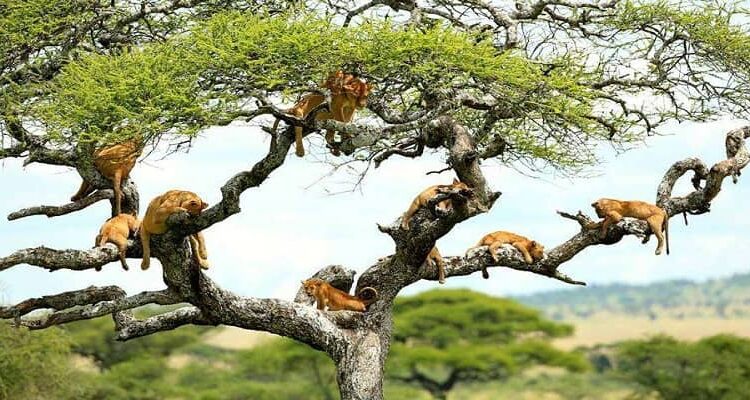
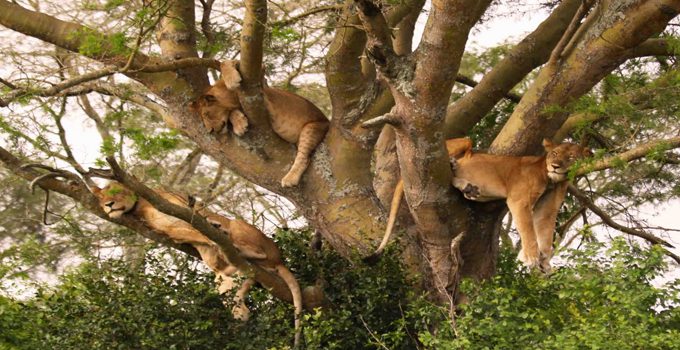
By late morning in the Ishasha sector of Queen Elizabeth National Park, the fig trees start doing something that unsettles first-time visitors and delights everyone else. A paw appears over a low branch, a tail swings loose beneath it, and then the whole languid weight of a lioness comes into view, stretched along a limb ten feet above the grass as though the tree had simply grown around her. Land Cruisers cut their engines. Cameras stop clicking. For a long moment nobody says anything at all. Ishasha is one of only two places on Earth where lions climb trees as an everyday habit rather than a curiosity — the other is Tanzania's Lake Manyara — and it is the single image most likely to appear on a Ugandan safari brochure. But it is only the opening scene in a park that, more than seventy years after it was first protected, remains the country's most visited and most ecologically layered wilderness.
A Park Built From Three Landscapes
Queen Elizabeth National Park sprawls across roughly 1,978 square kilometres of southwestern Uganda, stitched together from savanna, wetland, crater lake and lowland forest between the snow-capped Rwenzori Mountains and the shores of Lake Edward and Lake George. It was gazetted in 1952 as Kazinga National Park and renamed two years later to mark a visit by the newly crowned Queen Elizabeth II, and it now sits at the heart of the Albertine Rift, one of the most biologically rich regions on the continent. The park's geography is its defining trick: within a single day a visitor can watch elephants wading through papyrus swamp, track chimpanzees through a forested gorge, and cross an equator line marked by nothing more than two painted circles and a gift shop.
That geographic range shows up in the wildlife count. More than ninety-five mammal species have been recorded in the park, including elephant, Cape buffalo, leopard, Uganda kob and the tree-climbing lions of Ishasha, alongside one of Africa's densest hippo concentrations along the Kazinga Channel, the narrow, brown waterway connecting Lakes Edward and George. Birders treat the channel almost as a pilgrimage site: more than 610 species have been logged in the park, more than in some entire countries, and a slow boat cruise along its banks routinely turns up pelicans, African fish eagles, saddle-billed storks and kingfishers working the shallows alongside buffalo herds and basking crocodiles.
East of the main savanna, the Kyambura Gorge cuts an eleven-kilometre wound through the grassland, its steep walls dropping into a ribbon of tropical forest that locals and guides alike call the Valley of Apes. A habituated community of eastern chimpanzees lives in the gorge, and guided treks — capped at sixteen permits a day across two sessions — offer travelers a rainforest experience only a few hours removed from open plains and grazing kob.
Planning the Visit
The most reliable window for spotting the tree-climbing lions, and for road conditions generally, falls in the dry months of December through February and June through September — which puts mid-August squarely in season, with animals concentrated near dependable water sources and the Ishasha track passable without the mud that can strand vehicles in the rains. The park sits roughly five to six hours by road from Kampala via Mbarara or Fort Portal, with charter and scheduled flights also available into the Kasese and Mweya airstrips for travelers short on time.
Entry runs USD 40 per day for foreign non-residents, USD 30 for foreign residents, and UGX 20,000 for East African Community citizens, with children under fifteen admitted free; permits are issued at gates such as Kabatoro on presentation of valid identification. Chimpanzee tracking permits in Kyambura Gorge cost USD 100 for non-residents, USD 80 for residents and UGX 50,000 for EAC citizens in 2026, and given the sixteen-permit daily cap, advance booking through a licensed operator is close to essential in peak months. Accommodation spans the range from budget campsites and community bandas around Katunguru to the lakeside luxury of lodges overlooking the Kazinga Channel, with most itineraries built around a dawn or dusk game drive, a midday channel cruise, and either an Ishasha extension or a Kyambura trek.
This Week in Ugandan Tourism
The broader sector is having a genuinely eventful stretch. The Uganda Wildlife Authority has just rolled out a new five-year Strategic Plan, Client Charter and Service Delivery Standards covering 2025/26 through 2029/30, an ambitious roadmap meant to strengthen conservation funding and position Uganda among Africa's leading sustainable-tourism destinations, alongside a newly released State of Wildlife Resources in Uganda 2026 report that mixes encouraging population data with blunt warnings about habitat fragmentation from settlement expansion, agriculture and infrastructure projects pressing in on protected areas nationwide.
On the promotional side, the Uganda Tourism Board has been touring Europe under its Explore Uganda — The Pearl of Africa banner, running branded buses through Paris, hosting the country's inaugural Cultural and Tourism Festival in Munich in June, and courting travel-trade audiences in Türkiye, part of a push that has coincided with a reported 19.7 percent jump in international arrivals and tourism earnings rising from roughly UGX 4.85 trillion in 2024 to UGX 5.829 trillion in 2025. European arrivals alone are said to have more than doubled. Much of the industry's attention is now turning toward 2027, when Uganda is set to co-host the Africa Cup of Nations with Kenya and Tanzania — an event officials expect could triple visitor numbers to the region.
Travelers planning gorilla trekking elsewhere in the country should note a pricing shift that took effect in July: the gorilla habituation experience, which allows extended time with a research group in Bwindi, now costs USD 1,800 for foreign non-residents, even as the standard trekking permit holds at USD 800. And for domestic visitors priced out of daily entry fees, UWA has announced Open Park Days for September 25–27, when selected protected areas — likely to include high-traffic sites such as Queen Elizabeth — will waive entrance charges entirely in a bid to widen local access to the country's wildlife estate.
A Park Still Finding Its Balance
None of that policy machinery is visible from a boat gliding down the Kazinga Channel at sunset, past elephants drinking at the waterline and hippos surfacing in the amber light. But it shapes what the park will look like a decade from now — whether the tree-climbing lions of Ishasha, a population small enough that researchers can name individual cats, will have room to roam as farms and roads close in, and whether the revenue now flowing from Paris ad campaigns and AFCON anticipation actually reaches the rangers and communities holding the line at the boundary. For now, the lions are still climbing, the channel is still full of hippos, and Queen Elizabeth National Park remains, by any measure, one of the most complete wildlife experiences in East Africa.
Published By | Features Editor