Share
Commentary
In every city, land is more than soil. It is wealth. It is power. It is opportunity. It is survival.
And wherever land acquires value, a struggle inevitably emerges between those who possess it and those who merely depend upon it.
The story of Uganda's urbanisation is, at its core, a story about land.
It is impossible to understand the present wave of demolitions, evictions, and urban restructuring without understanding how land has shaped both privilege and poverty throughout Uganda's history.
Land has always occupied a unique position within Uganda's social and political life. Before colonial rule, land was largely governed through customary systems that emphasised communal access and social responsibility. The arrival of colonial administration transformed this relationship.
The 1900 Buganda Agreement introduced new forms of land ownership that fundamentally altered the distribution of economic power. Mailo land emerged. Large tracts of land were allocated to chiefs, religious institutions, and colonial collaborators. The foundations of land inequality were laid.
Independence inherited these complexities.
Successive governments introduced reforms, commissions, statutes, and policies intended to address land questions. Yet the tension between legal ownership and social need never disappeared.
As urbanisation accelerated, land became increasingly commercialised.
The poor required land to live. The wealthy required land to invest. Politicians required land to reward loyalty. Speculators required land to accumulate wealth. The result was inevitable conflict.
Across Kampala and other urban centres, rising land values transformed urban space into a battlefield of competing interests.
What was once considered peripheral land became prime property.
Wetlands became real estate opportunities.
Road reserves became commercial assets.
Public spaces became private fortunes.
The market value of urban land rose dramatically while the purchasing power of ordinary citizens stagnated.
The poor were priced out of formal housing markets long before they were physically removed from informal settlements.
In many respects, eviction begins long before demolition.
Eviction begins when a worker earning a modest income can no longer afford rent within reasonable proximity to employment.
Eviction begins when speculative land prices make home ownership impossible.
Eviction begins when affordable housing policies remain absent.
Eviction begins when urban growth benefits capital more than labour.
By the time bulldozers arrive, the process of exclusion has often been unfolding for years.
This reality reveals one of the greatest contradictions in Uganda's urban transformation.
Many of the people currently occupying informal settlements are not there because they reject planning laws.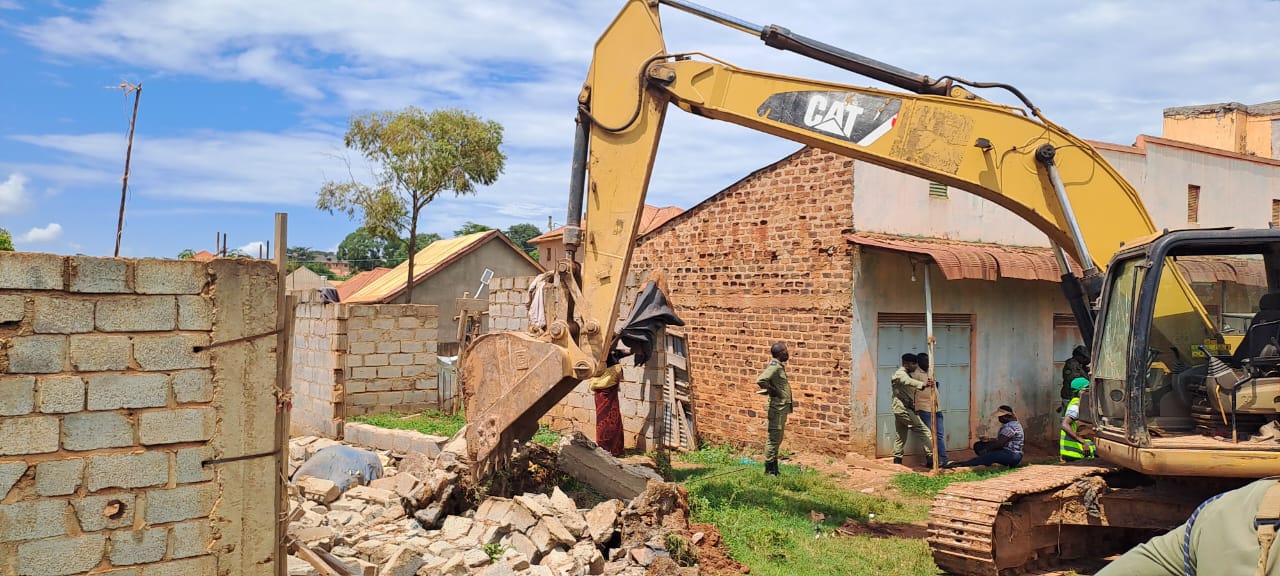
They are there because economic conditions left them with few alternatives.
Urban poverty is rarely a product of choice.
It is frequently the consequence of structural exclusion.
A cleaner employed in Kololo may earn too little to live there.
A security guard protecting luxury apartments may never afford one.
A market vendor feeding the city may be unable to access formal commercial space.
A builder constructing modern housing estates may spend his nights in a settlement vulnerable to demolition.
The city consumes their labour while denying them its benefits.
This contradiction should trouble any society committed to justice.
The Constitution of Uganda recognises property rights under Article 26.
The same Constitution commits the state to social justice and protection of vulnerable groups.
The challenge therefore lies not in choosing between development and rights.
The challenge lies in reconciling both.
Unfortunately, enforcement often appears selective.
For years, influential individuals have acquired public land, wetlands, and protected areas with minimal consequence.
Illegal developments associated with wealth frequently survive scrutiny. Meanwhile, informal structures associated with poverty often face swift enforcement. Whether real or perceived, this disparity undermines public confidence in urban governance. Citizens are more willing to accept sacrifice when they believe sacrifice is being shared equally. They are less willing when they perceive that the law is severe upon the weak and flexible towards the powerful. The philosopher Aristotle observed that the worst form of inequality is to treat unequal things equally and equal things unequally.
Urban governance requires more than legal authority. It requires legitimacy.
Legitimacy emerges when citizens believe that rules are applied fairly. No city can be sustainably governed through fear alone. History repeatedly demonstrates that cities flourish when citizens feel ownership of transformation rather than victimhood. The challenge confronting Uganda today is therefore larger than demolition. It concerns trust.
Can the poor trust that development includes them?
Can vulnerable communities trust that environmental restoration will not simply transfer wealth upward?
Can citizens trust that planning laws are motivated by public interest rather than private advantage?
These questions matter because urban development ultimately depends upon public cooperation.
The Physical Planning Act provides mechanisms for orderly urban development.
The Land Act establishes legal frameworks governing land relations.
The National Environment Act mandates environmental protection.
Yet laws derive their strength not merely from enforcement but from legitimacy.
A law that produces widespread perceptions of injustice may achieve compliance while simultaneously generating resentment. Development built upon resentment rarely endures.
The tragedy is that Uganda's current urban challenges were largely foreseeable.
Urban planners warned of uncontrolled growth. Environmental experts warned of wetland degradation. Economists warned of housing shortages. Civil society organisations warned about inequality.
Scholars repeatedly highlighted the dangers of delayed intervention.
For decades, these warnings received insufficient attention.
Today, the nation seeks rapid correction.
The poor now risk paying the price for failures they did not create.
Yet there remains an alternative path.
A path where environmental protection coexists with social protection.
A path where planning laws are enforced alongside affordable housing programmes.
A path where relocation precedes demolition.
A path where communities become partners in development rather than casualties of development.
The future of Uganda's cities depends upon whether such a path can be found. For a city is not judged merely by the order of its streets. It is judged by the fairness of its opportunities. And no city can claim greatness while those who built it remain excluded from its promise. To Be Continued in Part III: Learning from Kigali, Nairobi, Addis Ababa, Singapore, and the Search for Humane Urbanisation.
About the Writer
Evan Sande Ndahura is a Ugandan political and legal commentator, columnist, poet, and social justice advocate whose writings focus on governance, constitutionalism, democracy, and the political economy of power in Africa. He is widely published on issues of judicial accountability, electoral justice, human rights, and institutional reform, with particular emphasis on Uganda's political and legal systems. Ndahura writes from a Pan-African critical perspective, interrogating the failures of state institutions and the lived realities of ordinary citizens under entrenched systems of power. He believes that the liberation of Africa will occur through a mighty pen, not the gun.
Torch Media Africa



