TOURISM
A Kampala courtyard where fifty ethnic traditions share one stage — and why it matters for a country betting its future on tourism
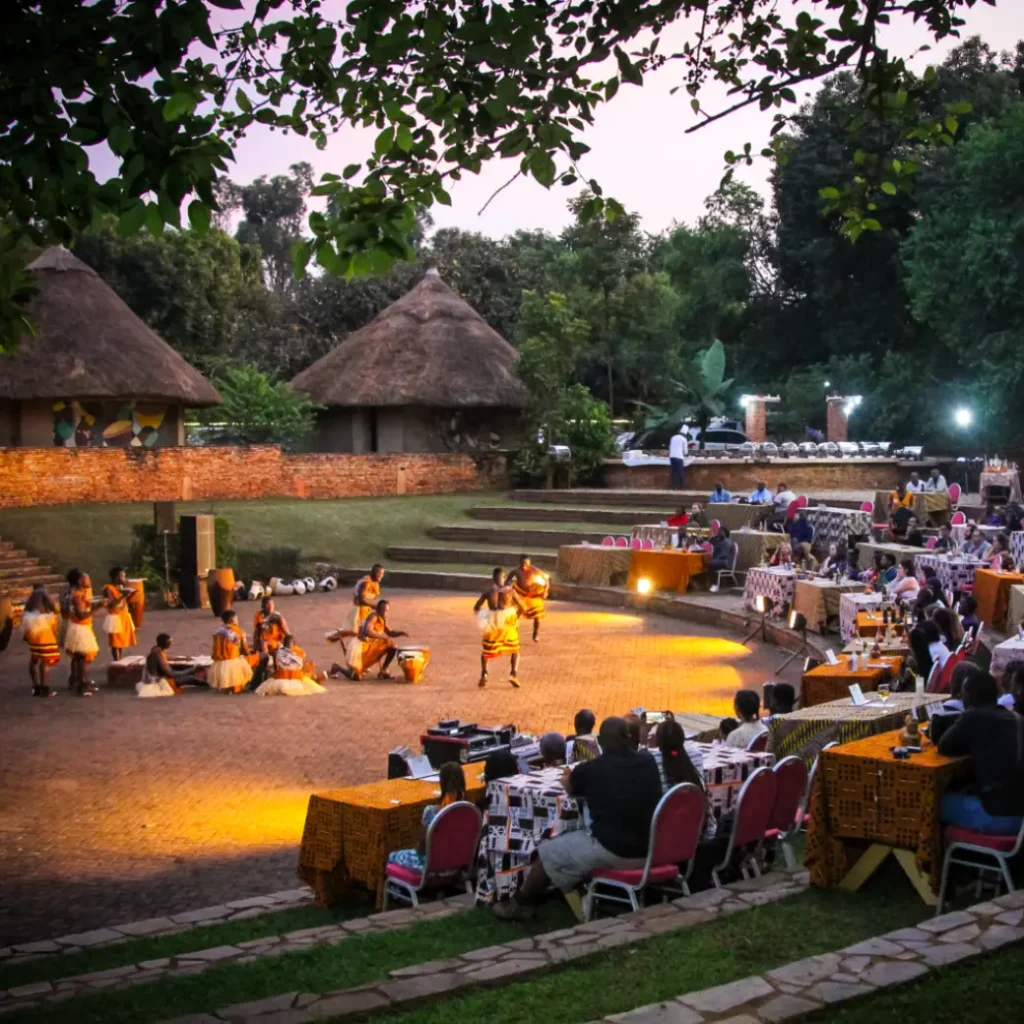
On a warm Ntinda evening, the drums start before the light fades entirely, and by the time the Sherehe Show reaches its second hour, a courtyard just seven kilometers from Kampala's traffic-choked roundabouts has transformed into a cross-section of the entire nation — Karamojong spear dances trading the stage with Baganda royal drumming, Acholi war dances following Rwenzori adungu harp melodies, all under string lights and a canopy of frangipani trees. This is the Ndere Cultural Centre, and for nearly four decades it has been quietly arguing that Uganda's fifty-plus ethnic groups are not a logistical inconvenience for a young nation but its single greatest tourism asset.
From a Mango Tree to a National Stage
The Ndere Cultural Centre's origin story is almost too tidy to be true, except that it is. In 1986, a young teacher and storyteller named Stephen Rwangyezi began gathering students under a mango tree at Lubiri Secondary School in Kampala, teaching them dances that decades of colonial and missionary influence had taught Ugandans to be ashamed of. Traditional performance had been dismissed by generations of schoolteachers and church leaders as backward, even "evil" — a stigma Rwangyezi set out, quite deliberately, to dismantle one rehearsal at a time. What started as an extracurricular club grew through the late 1980s and 1990s into the Ndere Troupe, a company that began appearing at state functions and international festivals across East Africa, carrying with it a simple but radical proposition: that Uganda's dozens of ethnic cultures were not fragments to be reconciled into a single national identity, but a repertoire worth performing intact, side by side.
By the early 2000s the troupe had outgrown borrowed halls and found a permanent home in Ntinda-Kisaasi, just northeast of central Kampala, where a purpose-built open-air amphitheatre now sits inside gardens dense with palm and mango trees. It is here, most nights of the week, that the Ndere Troupe performs a rotating repertoire of dances drawn from across the country — Bakisimba and Amaguju from the Buganda kingdom, Larakaraka courtship dances from the Acholi north, Ekitagururo from the cattle-keeping Ankole, Adungu harp music from the Alur and Lugbara west Nile region, Tamenhaibuga and Ekalu from Karamoja and Busoga respectively. Few single venues anywhere in East Africa attempt this range in one evening, let alone maintain it as a professional, self-sustaining enterprise for going on forty years.

What a Visit Looks Like
The centre runs three signature evening shows: the Sherehe Show on Wednesdays, Ndere Friday Night, and the Katika Sunday Family Show, each beginning around 6 or 7 p.m. and running roughly three hours. Performances weave live drumming, call-and-response singing, storytelling and costume changes into a single narrative arc rather than a loose variety show, and the amphitheatre's open-air design means the audience sits close enough to feel the bass line of a royal Baganda drum in the chest. Many visitors combine the show with the centre's buffet dinner, which leans on Ugandan staples — matoke, groundnut sauce, grilled tilapia, and barbecue — served before the lights dim and the first drummer takes the floor.
Beyond the marquee evening shows, Ndere increasingly functions as a broader cultural venue: school groups visit for daytime educational sessions on Ugandan heritage, and the grounds have hosted diplomatic receptions, corporate events and, this past May, a gala dinner for more than 200 international tour buyers and media as part of the Pearl of Africa Tourism Expo. For a country whose tourism marketing has long leaned almost entirely on gorillas and game parks, Ndere is something rarer: a two-hour drive from no safari vehicle required, a full immersion in Ugandan culture available on a Wednesday evening to anyone staying in Kampala for a single night between flights.
Practical Information
Ndere Cultural Centre sits at Plot 2872–9867, Ntinda-Kisaasi Road, about seven kilometers northeast of central Kampala — a 20 to 30 minute drive via Kira Road or the Bukoto-Ntinda Road, traffic depending. Ride-hailing services including Uber, Bolt and SafeBoda operate reliably in the area, with a one-way fare from the city center typically running UGX 15,000–25,000 (roughly $4–$6). Entrance rates are UGX 55,000 for Ugandan nationals, UGX 95,000 for international visitors, and UGX 30,000 for children aged three to twelve; an optional buffet and barbecue dinner adds UGX 60,000 per person. Advance booking is recommended for the Friday and Sunday shows, which draw both tour groups and Kampala residents celebrating birthdays and anniversaries. Because the venue is outdoors, the driest windows of the year — December through February and June through August — offer the most comfortable evenings, though performances continue through the rainy months under cover.

This Week in Ugandan Tourism
Uganda's tourism sector enters late July riding a wave of institutional momentum, even as day-to-day conservation work continues out of the headlines.
Destination Uganda was named “Best in Show – Africa” at the 2026 Travel & Adventure Show in New York earlier this year, a recognition the Uganda Tourism Board has continued to cite through the summer as validation of its “immersive, experiential” marketing push abroad.
The 10th edition of the Pearl of Africa Tourism Expo (POATE), held May 21–23 at Speke Resort Munyonyo under the theme “Wanderlust – It's Your Time to Thrive,” brought in more than 200 hosted international buyers and media and included a cultural gala staged at Ndere itself — a fitting link between this week's featured site and the sector's biggest recent trade event. The European Union's Uganda mission has since partnered with the Uganda Tourism Board to launch new POATE Awards recognizing sustainability and innovation, backed by a reported 40 million euros in associated investment commitments.
On the pricing front, new gorilla trekking fees took effect July 1: a standard permit for foreign non-residents now costs $800, while the more intensive Gorilla Habituation Experience — which places small groups with researchers and rangers for extended contact time with a semi-habituated family — rose to $1,800. The Uganda Wildlife Authority continues to cap permits at eight per habituated group per day, meaning Bwindi Impenetrable National Park releases just over 200 permits daily across its groups, alongside eight for Mgahinga Gorilla National Park.
On the conservation side, the Uganda Wildlife Authority this month relocated three Nubian giraffes from Murchison Falls National Park to Ajai Wildlife Reserve in West Nile, part of an ongoing push to rebuild giraffe populations outside their traditional stronghold and diversify wildlife-viewing options in the country's northwest. Separately, the International Gorilla Conservation Programme and UWA issued a joint call this week urging hotel and lodge operators to more consistently brief tourists on gorilla-trekking etiquette — including distancing and mask guidance — to reduce the risk of disease transmission from humans to the critically endangered mountain gorilla population, a reminder that the country's marquee wildlife product remains only as resilient as the behavior of the visitors who come to see it.
Taken together, the week's news captures the two halves of Uganda's tourism story that Ndere itself embodies: an industry increasingly confident on the international stage, and a set of conservation and cultural obligations that require constant, unglamorous maintenance to keep pace with that ambition.
Sources: Uganda Tourism Board (utb.go.ug); Uganda Wildlife Authority; SafariBookings; Kampala Tourism Portal; New Vision; Business Times Uganda; allAfrica.com; ChimpReports; Silverback Gorilla Tours; Uganda Gorilla Trekking.
Published By | Features Editor