Uganda Tourism
The lake announces itself before you ever see it. Somewhere past the roundabouts of Kampala, as the road curls south toward Entebbe, the air changes first — thicker, cooler, faintly mineral, carrying the sound of weaverbirds and the distant thrum of an outboard motor. Then the trees part and there it is: Lake Victoria, Africa's largest lake and the source of the White Nile, stretching to a horizon so wide it could pass for ocean. Fishing canoes bob in the shallows. A fish eagle folds its wings and drops. And along a shoreline dotted with palm-thatched bars, sunbeds, and the occasional rusting relic of the aviation age, Uganda quietly makes its case as a beach destination nobody expected.
This is Entebbe's real inheritance. Long before it became shorthand for "the airport town," Entebbe was the colonial capital of the Uganda Protectorate, chosen in the 1890s precisely because of this shoreline — a natural harbor, a temperate lakeside climate, and a position at the crossroads of trade routes reaching into the interior. The old State House still sits above the water. The Entebbe Botanical Gardens, laid out in 1898 as a testing ground for tropical agriculture and later a filming location for early Tarzan movies, spill down toward the lake in tangled, cathedral-canopy groves. And ringing all of it, more than eighty percent of Uganda's developed beaches sit within the Entebbe–Kampala stretch, a fact that surprises even many Ugandans.

Where the City Meets the Water
The beaches themselves are unpretentious by design, and that is precisely their charm. Aero Beach, a short boda-boda ride from Entebbe International Airport, has become the most photographed of the lot — not for postcard sand but for its strange, wonderful theme: a genuine airplane graveyard, decommissioned fuselages and propellers repurposed as sculpture and seating, a nod to Entebbe's long relationship with flight. Families spread out on the grass under casuarina trees, football matches break out in the shallows, and by late afternoon the beach bars fill with Nile Special in hand and Ugandan Afrobeat on the speakers. Entry runs around 10,000 Ugandan shillings, roughly three US dollars, a rounding error against what the same lakeside afternoon would cost almost anywhere else on the continent.
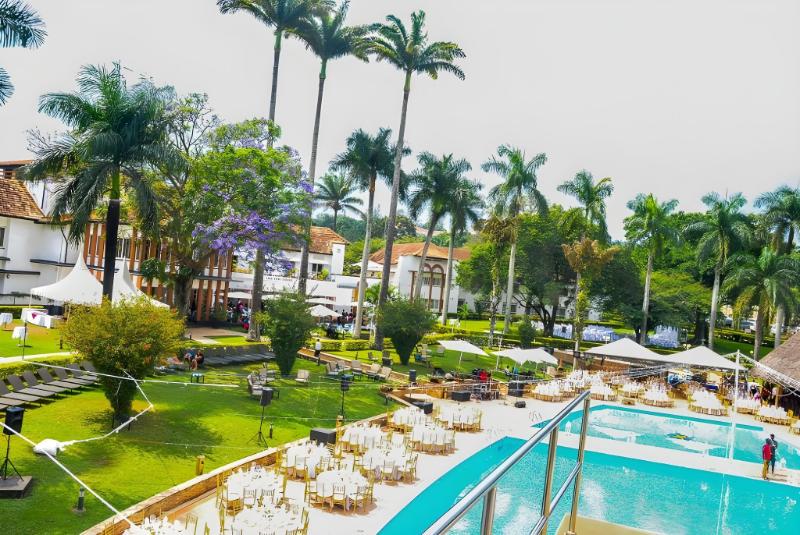
Further along, quieter stretches cater to a slower pace — hammocks strung between trees, fishermen mending nets, church groups singing at the water's edge on Sunday mornings. For visitors wanting the lake without the crowds, boat operators at Entebbe Pier and Kampala's Ggaba landing site run sunset cruises and day trips out to the Ssese Islands, an archipelago of more than eighty islands scattered across the Ugandan waters of the lake, where forest-fringed beaches and eco-lodges like Broader Beach Camp offer a genuine castaway feel only an hour or two from the capital by boat.
Beyond the Sand
The lake is also a wildlife corridor in its own right. A short boat ride from Entebbe delivers visitors to Ngamba Island, a sanctuary for orphaned and rescued chimpanzees run by the Uganda Wildlife Education Centre and partners, where guests can watch feeding sessions and, with advance booking, spend a night on the island itself. Back on shore, the Uganda Wildlife Education Centre — Entebbe's zoo and rehabilitation center — houses rescued shoebill storks, lions, and rhinos for visitors short on time for a full safari circuit. Birders linger longest of all: the papyrus-fringed shallows around Entebbe are prime habitat for African fish eagles, malachite kingfishers, and jacanas picking their way across lily pads, with dawn and dusk delivering the richest sightings.
Planning the Visit
The dry-season stretches of January through February and June through August offer the most reliable beach weather, with July and August doubling as peak season for European and North American visitors on school holidays — a convenient overlap for families building a lakeside stop into a wider Ugandan itinerary. Because Entebbe sits barely a twenty-minute drive from the international airport, it functions naturally as either a soft landing after a long-haul flight or a decompression stop before heading upcountry to the primate forests and savannah parks that anchor most Uganda itineraries. Accommodation spans the full range, from backpacker guesthouses steps from the sand to lakeside resorts with private jetties, and most beach clubs charge only a nominal day-entry fee, making Entebbe one of the most accessible attractions in the country regardless of budget.

This Week in Ugandan Tourism
Uganda's health authorities marked a milestone this month in the country's response to its recent Ebola outbreak: the last confirmed patient, treated in Kampala, was discharged on July 16, 2026, triggering the standard 42-day countdown health officials require before an outbreak can be formally declared over. Ugandan officials have stressed that all cases were confined to the capital with no evidence of onward community spread, though the U.S. State Department's Level 4 "Do Not Travel" advisory — issued in response to the outbreak and still in force in mid-July — continues to weigh on inbound travel planning and underscores how closely global health guidance now shapes Uganda's tourism recovery.
On the ground, the sector is pushing forward regardless. The Uganda Wildlife Authority's revised gorilla trekking tariffs took effect on July 1, 2026, setting standard permits at $800 for foreign non-residents and $700 for foreign residents, alongside new low-season discounts of $600 during April, May and November — part of a wider overhaul that also scrapped the old "soft hold" booking system in favor of immediate full payment to secure a permit. Ten days earlier, the habituation permit fee, which allows small groups to spend a full day with a gorilla family being acclimatized to human contact, rose from $1,500 to $1,800 for foreign non-residents.
Uganda's marketing push abroad has also picked up pace. On June 26, 2026, the country opened its first-ever Cultural and Tourism Festival in Munich, Germany — a three-day showcase of music, dance, cuisine and fashion that organizers billed as the largest Ugandan public gathering held outside the country to date, and which Uganda Tourism Board officials used to court German tour operators for expanded Uganda-focused travel packages. Back home, the tenth edition of the Pearl of Africa Tourism Expo launched at Speke Resort Munyonyo in Kampala, gathering regional operators, hoteliers and investors under one roof. And in early July, a delegation led by Roc Nation Sports International president Michael R. Yormark completed a multi-day site inspection of Ugandan venues, a step tied to the country's preparations to co-host the 2027 Africa Cup of Nations — a tournament tourism officials hope will put Entebbe's lakeside and Kampala's skyline in front of a continental television audience.
For now, though, the appeal of Entebbe needs no tournament or campaign to sell it. It is simply a lake, a shoreline, and an unhurried afternoon — the easiest and often most overlooked stop on Uganda's tourist map, and for many visitors, the first Ugandan sunset they will ever watch.
Published By | Features Editor