Jinja/Mayuge
A year ago, at a public meeting at Kityerera State Lodge in Mayuge District, President Yoweri Museveni told Uganda's sugar millers, in no uncertain terms, to stop docking cane farmers' pay for "trash." Twelve months on, growers say the order has been only selectively obeyed — and they are now demanding that government finally force compliance from the mills still pocketing an estimated Shs48 billion a year at their expense.
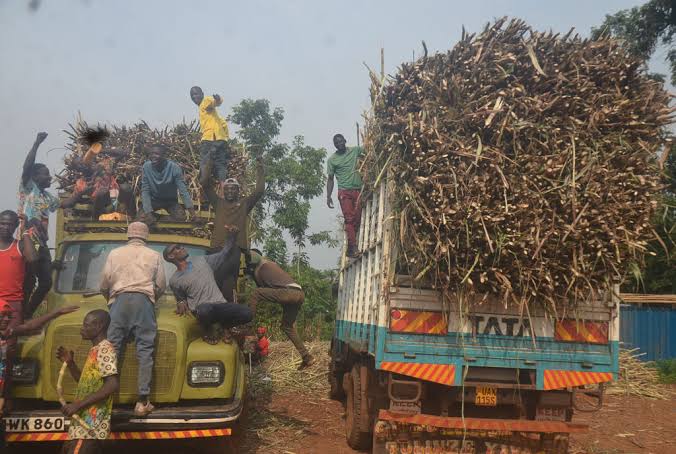
The dispute centres on a long-standing miller practice of deducting roughly 5 percent from the weight of sugarcane deliveries to account for "trash" — leaves, tops and other non-cane plant material that inevitably gets swept up with the harvested stalks. According to the Uganda National Association of Sugarcane Growers (UNASGO), that deduction costs individual farmers between Shs6,000 and Shs10,000 on every tonne of cane they deliver, a levy growers have long argued is applied arbitrarily, with no independent verification of how much genuine trash is actually present in any given load.
Museveni's August 2025 directive was meant to end the practice outright. Instead, UNASGO says, the country's sugar mills have split into two camps. Factories in the Bunyoro sub-region have complied and dropped the deduction. But mills in Busoga — Uganda's sugarcane heartland — and central Uganda have simply continued charging it, more than a year after the President ordered them to stop.
"We will escalate the matter"
The growers are not taking the continued deductions quietly. Robert Atugonza, a farmers' representative on the Uganda Sugar Industry Stakeholders Council for the Bunyoro and Tooro sub-regions, said growers intend to directly engage the non-compliant millers — naming Kakira Sugar Works and Lugazi Sugar Factory, two of the country's largest and most influential processors, as key targets for that engagement.
"If they fail to comply, we shall escalate the matter to a national meeting of farmers to decide the way forward," Atugonza said, adding that the trash-deduction dispute is also expected to be tabled before the Uganda Sugar Industry Stakeholders Council within 21 days. The threat of a national farmers' meeting is significant: it would mark an attempt to unify growers across Uganda's fragmented sugarcane belt — spanning Busoga, Bunyoro, Tooro and pockets of the west — behind a single bargaining position, something the sector's farmer associations have historically struggled to sustain.
UNASGO's revival itself is relatively recent. The association re-established itself as a national umbrella body specifically to strengthen growers' collective bargaining power against an industry historically dominated by a handful of vertically integrated milling conglomerates that control both processing capacity and, in practice, much of the price-setting power over the raw cane that smallholders and larger nucleus-estate farmers alike depend on for their income.
A sector already under strain
The trash-deduction fight is landing at a difficult moment for Uganda's cane growers. Farm-gate sugarcane prices have been sliding for years: a decade ago, farmers could expect to earn roughly Shs175,000 per tonne of cane delivered to the mill; by July 2024, that had fallen to around Shs140,000, and the government-set minimum price now stands at just Shs125,000 per tonne. Under the amended Sugar Cane (Amendment) Act, that minimum price is pegged to 50 percent of the prevailing value of refined sugar — a formula intended to protect growers from being paid below the cost of production, but one that still leaves them exposed whenever refined sugar prices soften.
Layered on top of falling prices are rising input and production costs, and the spectre of a regional trade dispute that could squeeze margins further still: Kenya's Finance Act 2026 raised excise duty on sugar to roughly $308 per tonne, a move the Uganda Sugar Manufacturers Association has warned could disrupt cross-border trade flows and depress domestic cane prices if millers respond by cutting what they pay growers. For farmers already losing thousands of shillings per tonne to unauthorised trash deductions, that combination of falling base prices, rising costs and external trade shocks leaves little room to absorb further losses.
The stakes are not trivial at the sector level either. Uganda's sugar industry generated an estimated Shs298 billion in revenue in 2023, up from less than Shs10 billion in 1986 — a testament to decades of expansion in cane acreage, particularly across Busoga, Bunyoro and parts of the west. But that growth has repeatedly been shadowed by governance disputes between millers and growers: earlier fights over irregular loan deductions by processors such as the Sugar Corporation of Uganda Limited (SCOUL), disputes over factory licensing delays that have left farmers in the Greater Kibaale area without a reliable buyer for their cane, and long-running complaints that the 2020 Sugar Act's promised regulatory body — the Uganda Sugar Board — was never fully operationalised, leaving a governance vacuum that growers say millers have been able to exploit.

Why "trash" is such a flashpoint
The trash deduction dispute is, on its surface, a narrow technical argument about how sugarcane is weighed and paid for. But it has become a proxy for a much larger and more persistent grievance among Uganda's cane growers: that the balance of power in the sugar value chain sits overwhelmingly with the milling companies, which control the scales, the testing, the payment schedules and, in the absence of a functioning independent regulator, much of the enforcement of whatever rules exist.
Unlike a formal excise tax or a negotiated commission, the trash deduction has never been transparently benchmarked against actual, measurable levels of non-cane material in each farmer's delivery. Growers argue that a flat 5 percent charge, applied uniformly regardless of how carefully a farmer has prepared their harvest for delivery, functions less as a quality-control mechanism and more as a de facto price cut — one that mills can adjust or maintain largely at their own discretion, and one that a presidential directive, on its own, has proven insufficient to eliminate.
That is precisely the frustration driving farmers back to Museveni's August 2025 order now, a year later: if a direct instruction from the head of state can be selectively honoured by some millers and quietly ignored by others for twelve months without consequence, growers say, it exposes just how little enforcement power exists to make Uganda's sugar millers answer to farmers — or, for that matter, to government — when it comes to how cane growers are paid.
What happens next
With the matter due before the Uganda Sugar Industry Stakeholders Council within three weeks, and UNASGO signalling a willingness to convene a national farmers' meeting if Kakira, Lugazi and other Busoga and central Uganda mills continue the deduction, the coming weeks are likely to bring renewed pressure on both the millers and on government to explain why a directive from the President himself has gone unenforced for a full year. For the hundreds of thousands of smallholder and out-grower families whose incomes depend on cane deliveries, the outcome will determine whether an estimated Shs48 billion a year stays in millers' hands — or finally starts flowing back into farmers' pockets, as Museveni ordered it should a year ago.
Published By | Features Editor