Written By | Staff Writer
Foot-and-mouth disease is not Uganda's deadliest livestock disease, but it may be its most economically corrosive. T
Agriculture
In Lyengoma village, Ntyazo Parish, in Sembabule District's Lwemiyaga County, cattle keepers have spent recent weeks watching their animals go lame. Foot-and-mouth disease (FMD) has moved through the herds again, and with it has come the familiar arithmetic of loss: sick calves that will not gain weight, cows that stop producing milk, and a market that will not buy meat or dairy from a quarantined zone. It is a scene that repeats itself somewhere in Uganda's cattle corridor most years — the country records between 17 and 37 FMD outbreaks annually, according to veterinary authorities — but this year the government believes it may finally be building its way out of the cycle.
On July 26, Uganda's Minister of Agriculture, Animal Industry and Fisheries, Frank Tumwebaze, travelled to Cairo for talks that officials on both sides are describing as the most advanced step yet in a two-year-old plan to manufacture FMD vaccines on Ugandan soil. "One of the most advanced cooperation projects that we hope to sign and finalize during this visit is the establishment of a timeline for launching construction of the foot-and-mouth disease vaccine manufacturing facility in Uganda," Tumwebaze said during the visit, according to local reporting. Within days, Egyptian and Ugandan officials were said to be finalising a construction timeline, and by August 1 industry publications were reporting that Uganda had "advanced plans" to begin domestic production — the clearest signal yet that a facility many farmers have been promised for two years is close to breaking ground.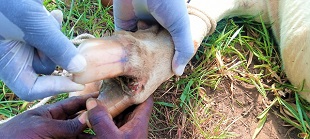
A disease that never really leaves
Foot-and-mouth disease is not Uganda's deadliest livestock disease, but it may be its most economically corrosive. The virus rarely kills adult cattle outright, but it is highly contagious, spreads rapidly through the country's free-ranging cattle corridor, and triggers immediate trade consequences: quarantines, halted markets, and export bans on meat and dairy from affected zones. According to research cited by Ugandan scientists, calf mortality during outbreaks has been estimated at 37.8 percent, while FMD episodes can cut household livestock income by as much as 63 percent and reduce sales of animal products by 70 percent. The Food and Agriculture Organization has recorded outbreaks in more than 40 Ugandan districts in a single recent year, with new cases continuing through 2024 and 2025.
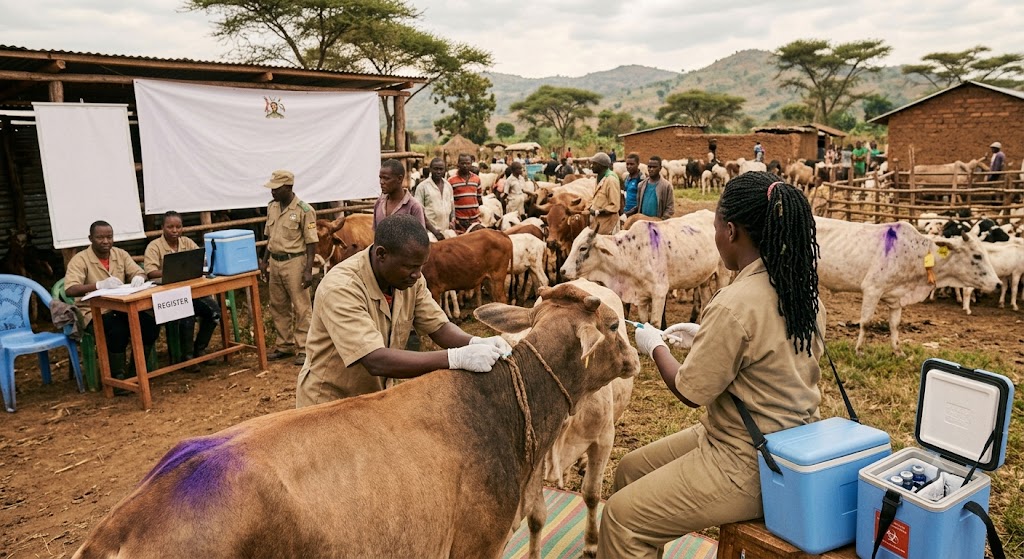
For a country where cattle-keeping underpins the livelihoods of millions of households in the cattle corridor stretching from Karamoja through Teso, Lango, Ankole and into the west, that toll compounds year after year. It is also why the government moved this year to launch its first-ever nationwide mass FMD vaccination campaign, targeting roughly 46.5 million susceptible animals — cattle, goats, sheep and pigs — through two rounds of vaccination annually, rolled out between July and August. The scale of that campaign has exposed a structural weakness that the new manufacturing plant is meant to fix: Uganda currently has no domestic capacity to produce the vaccine at all. Every dose used in the national campaign, and in routine control efforts before it, has had to be imported, principally from Egypt.
Why building locally matters
The vaccine partnership between Kampala and Cairo dates to 2024, when the two governments agreed that Uganda's National Agricultural Research Organisation (NARO) would combine forces with Egyptian veterinary science to establish local production. The division of labour reflects each country's existing strengths. Egypt already manufactures vaccine components covering three of the FMD virus serotypes circulating in East Africa — O, A and SAT 2 — and has agreed to transfer that technology and train Ugandan scientists at NARO. Uganda, meanwhile, is tasked with developing the component targeting the SAT 1 serotype, which also circulates in the country's herds. Combined, the partnership aims to produce a quadrivalent vaccine — one shot protecting against all four strains present in Uganda, rather than requiring farmers and veterinary officers to source multiple separate products.
The facility itself is planned for the Nakyesasa NARO campus in Wakiso District, sited next to an existing anti-tick vaccine facility, giving Uganda a cluster of livestock-vaccine manufacturing capacity in one location. Egypt has already sent about $700,000 worth of manufacturing equipment to Uganda to help establish the plant — reported locally as equipment worth roughly Shs2.5 billion — and has separately donated 1.5 million doses of finished FMD vaccine to help cover immediate gaps while the campaign rolls out. An Egyptian firm has also been reported as set to establish a related FMD vaccine facility in Wakiso, underscoring how central private Egyptian expertise has become to Uganda's plans.
The economic logic for going local is straightforward. Import dependency means every outbreak response is hostage to shipping timelines, foreign currency availability and a single supplier relationship. It also means Uganda pays a premium for a product it could, in principle, manufacture more cheaply at scale once a plant is running. More importantly for farmers, local production promises faster response times: rather than waiting for an international order to clear, veterinary authorities could theoretically draw on domestic stock the moment an outbreak is confirmed, containing the disease before it spreads across district lines the way it did this year from Sembabule outward.
What still has to happen
Two years after the partnership was first announced, officials are only now finalising a construction timeline — a reminder that vaccine manufacturing facilities, particularly ones handling live or attenuated pathogens, require far more than equipment donations to get running. Facilities of this kind typically need biosafety certification, quality-control laboratories capable of batch-testing vaccine potency, and a trained technical workforce, none of which can be conjured on the timeline of a single ministerial visit. The training component of the deal — Egyptian scientists working with NARO researchers on specialised FMD vaccine production techniques — is likely to be the long pole in the tent, since regulatory approval for any vaccine produced will depend on demonstrating consistent manufacturing quality to both domestic regulators and, eventually, potential export markets in the region.
There is also the question of financing the facility's ongoing operating costs once it is built. Uganda's agriculture ministry has faced budget pressure across several fronts this year, from drought response in Karamoja to a national agrochemical phase-out program, and a vaccine manufacturing plant will require sustained public investment in maintenance, cold-chain logistics and quality assurance long after the ribbon-cutting. Whether the facility can scale beyond meeting Uganda's own 46.5-million-animal vaccination need to eventually supply neighbouring East African Community markets — an ambition officials have hinted at but not detailed — will depend on how quickly the plant can prove its vaccine meets international standards.
What it means for farmers now
For cattle keepers in Sembabule watching their animals go lame this month, the vaccine plant is not an immediate fix — construction has not yet begun, and even an accelerated timeline would likely put a functioning facility years away. What has changed is the visibility of a nationwide response: the ongoing mass vaccination campaign, even reliant on imported doses, represents the first time Uganda has attempted to vaccinate its susceptible livestock population at this scale in a single coordinated push. If the Cairo talks translate into a firm construction start date, it would mark a shift in Uganda's approach to livestock disease from reactive outbreak response toward the kind of vaccine sovereignty the government has pursued more explicitly in crop agriculture, where seed self-sufficiency has been a policy priority for years.
The stakes extend beyond individual herds. Uganda's cattle population underpins a domestic beef and dairy sector that officials have repeatedly flagged as a growth area for export earnings, including recent efforts to expand milk exports to markets such as Nigeria and to position Ugandan beef for Gulf markets. Persistent FMD outbreaks complicate both ambitions, since trading partners scrutinise disease status before opening market access. A credible, functioning local vaccine industry would not just reduce losses for smallholder cattle keepers — it would remove one of the recurring obstacles to Uganda's broader livestock export strategy.



