Written By | Staff Writer
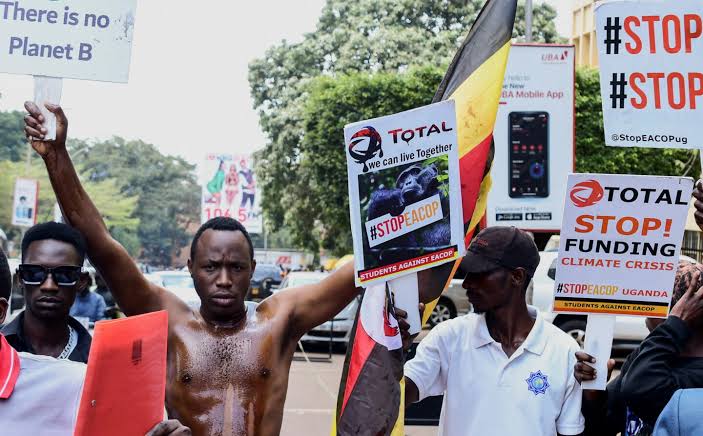
Demonstration in London
AGRICULTURE
Racheal Tugume stood before reporters in London earlier this month and described a version of home that no longer exists for her. She said she had been displaced from her land by construction of the East African Crude Oil Pipeline (EACOP), which she says has damaged the rivers, wildlife and ecosystems her community once relied on for its living — just as erratic, climate-driven weather was already making farming harder. "I am very happy that there are people in countries like the UK who are listening to us, who are behind us and who have come to support us," she told the press conference, adding that she hoped the case would deliver justice to communities affected by the pipeline.
Tugume is one of four Ugandan farmers who, on July 7, filed a case at London's High Court seeking to stop EACOP from beginning operations. It is a crowdfunded, long-shot legal effort — but one that could reshape how disputes over Africa's biggest energy infrastructure projects are fought, and one with direct consequences for the tens of thousands of Ugandan farming households whose land sits along the pipeline's route.
Rachael Tugume
A pipeline months from opening, and a lawsuit racing the clock
EACOP is a 1,443-kilometre pipeline designed to carry crude oil from Uganda's Lake Albert oilfields across Tanzania to the port of Tanga on the Indian Ocean. Majority-owned by the French energy giant TotalEnergies, with smaller stakes held by the Uganda National Oil Company, Tanzania Petroleum Development Corporation and a Chinese state oil firm, the project is roughly 80% complete, according to its developers. First oil exports are expected as soon as October this year.
That timeline is precisely what the new lawsuit is racing against. The claim, filed by the London law firm Leigh Day on behalf of the four farmers, targets EACOP Ltd — the project's operating company, registered not in Kampala or Dar es Salaam but at an office in London's Canary Wharf financial district. That single fact of corporate registration is what allows the case to be heard in a British court at all, and it is central to the farmers' legal strategy.
Rather than arguing UK law, the claim asks London's High Court to apply Uganda's own constitution, its 2019 environmental law and the National Climate Change Act of 2021 — legislation that gives Ugandans standing to sue when an entity threatens the country's ability to respond to climate change — against a UK-registered company. Leigh Day describes it as the first attempt to have Uganda's own climate and environmental protections enforced in a foreign court. The farmers are seeking an injunction to halt the pipeline before operations start, alongside compensation and other remedies. If the pipeline is already moving oil by the time the case is heard, lawyers say they will seek to halt it from that point onward.
"We will be doing what we can to expedite matters, but it is possible that EACOP will have started operating the pipeline before the claim is heard," said Matthew Renshaw, a partner at Leigh Day. "If that is the case, the claim would intend to halt operations from that point. For example, the pipeline may operate for just one year rather than 30-plus, resulting in far less harm." Renshaw estimates it could take around 12 months to reach a first hearing and 18 months before the case goes to trial — meaning the pipeline will very likely be pumping oil long before a judge rules.
Why farmers, and why land
The case is built around the human cost of the pipeline's route, which cuts through the Lake Victoria basin — a freshwater system that around 40 million people across the region depend on — and, according to a May 2026 report from the environmental research group Earth Insight, threatens 158 wetlands, 11 rivers, 44 protected areas and seven key biodiversity zones across roughly 2,000 square kilometres of wildlife habitat.
For farming communities along the route, the more immediate issue has been land. Campaigners and affected residents say the project's land acquisition process has displaced or disrupted access to fertile agricultural land for well over 100,000 people, many of them smallholder farmers who depended on that land for food and income. Uganda's compensation programmes for affected households have drawn sustained criticism from residents who say payments have been slow, undervalued or poorly matched to the land and livelihoods lost — grievances that have simmered since construction began and that feed directly into the farmers' current legal claim.
The lawsuit's backers frame the stakes in stark terms. Avaaz, the campaign group supporting the crowdfunded case, has called it "one final chance to stop one of the worst oil pipelines on the planet," pointing to projections from the non-profit BankTrack that the pipeline, at peak production, would carry 216,000 barrels of crude a day and release more than 33 million tonnes of carbon emissions annually — an estimated 379 million tonnes of greenhouse gases over its projected 25-year lifetime, including construction, refining and end use. Leigh Day's legal adviser Marc Willers has described the project as a "carbon bomb."
Not the first attempt — and unlikely to be the last
This is not the farmers' first run at the courts. A climate lawsuit filed inside Uganda by a group of young people more than a decade ago has still not concluded. A separate case at the East African Court of Justice, brought by campaign groups against Uganda and Tanzania, was thrown out on procedural grounds last November. In France, TotalEnergies' home market, a refiled lawsuit is seeking damages for affected communities, though it cannot stop the pipeline from proceeding. Lawyers acknowledge that concerns about whether a fair hearing is possible inside Uganda's own courts are part of why this claim was brought in London instead — echoing legal precedents such as Nigerian communities' pollution case against Shell, which showed that claims against British-registered firms for harms committed overseas can succeed in UK courts.
The Ugandan government and the oil industry have pushed back hard. The African Energy Chamber, which represents the continent's oil and gas sector, dismissed the London case as "colonialism 2.0." Its executive chairman, NJ Ayuk, argued that "for generations, Africa was told what resources it could exploit and how it should develop. Today, some of those same pressures are being repackaged through foreign-funded litigation and ideological campaigns that seek to dictate Africa's energy choices from thousands of kilometres away." That framing — sovereignty versus accountability — has become the defining fault line in Uganda's oil debate, and it is likely to shape political reaction to the case at home even as the legal process grinds forward in London.
What it means for farmers, markets and the wider economy
For Uganda's agriculture sector, the significance of this case extends well beyond the four named claimants. Oil and farming interact along the pipeline corridor in ways that are rarely spelled out in national economic statistics: land taken out of cultivation for right-of-way, water sources shared between crude infrastructure and irrigation, and rural households whose compensation payouts are meant to replace years of harvests. Uganda has staked significant hopes on oil revenue to fund the roads, processing plants and power infrastructure needed to modernise its farm economy — a point the African Energy Chamber and government officials have repeatedly stressed in public commentary on the pipeline. But farmers along the route argue that the immediate costs of construction have been borne disproportionately by them, while the promised benefits remain years away.
There is also a market dimension. Should the case succeed even partially in constraining the pipeline's operating life, it would affect projected government oil revenues at a time when independent analysts already warn that Uganda may see lower-than-expected returns from crude exports because of rising costs and softening global demand. Any shortfall in anticipated oil revenue would likely increase pressure on agriculture — still the sector employing the largest share of Uganda's workforce and now contributing an estimated 27.4% of GDP — to keep carrying the weight of rural incomes and export earnings.
For now, the practical reality is that EACOP's construction will almost certainly continue, and oil is likely to begin flowing through the pipeline before any UK judge issues a ruling. But the case has already succeeded in putting a spotlight on a question Uganda has largely tried to keep domestic: whether communities who lose farmland to a multibillion-dollar energy project have any meaningful recourse when they believe national compensation and environmental safeguards have failed them. For Tugume and the three other claimants, that question is no longer confined to Uganda's courts — it now sits with a judge in London, whatever the eventual result.



