DESIGN
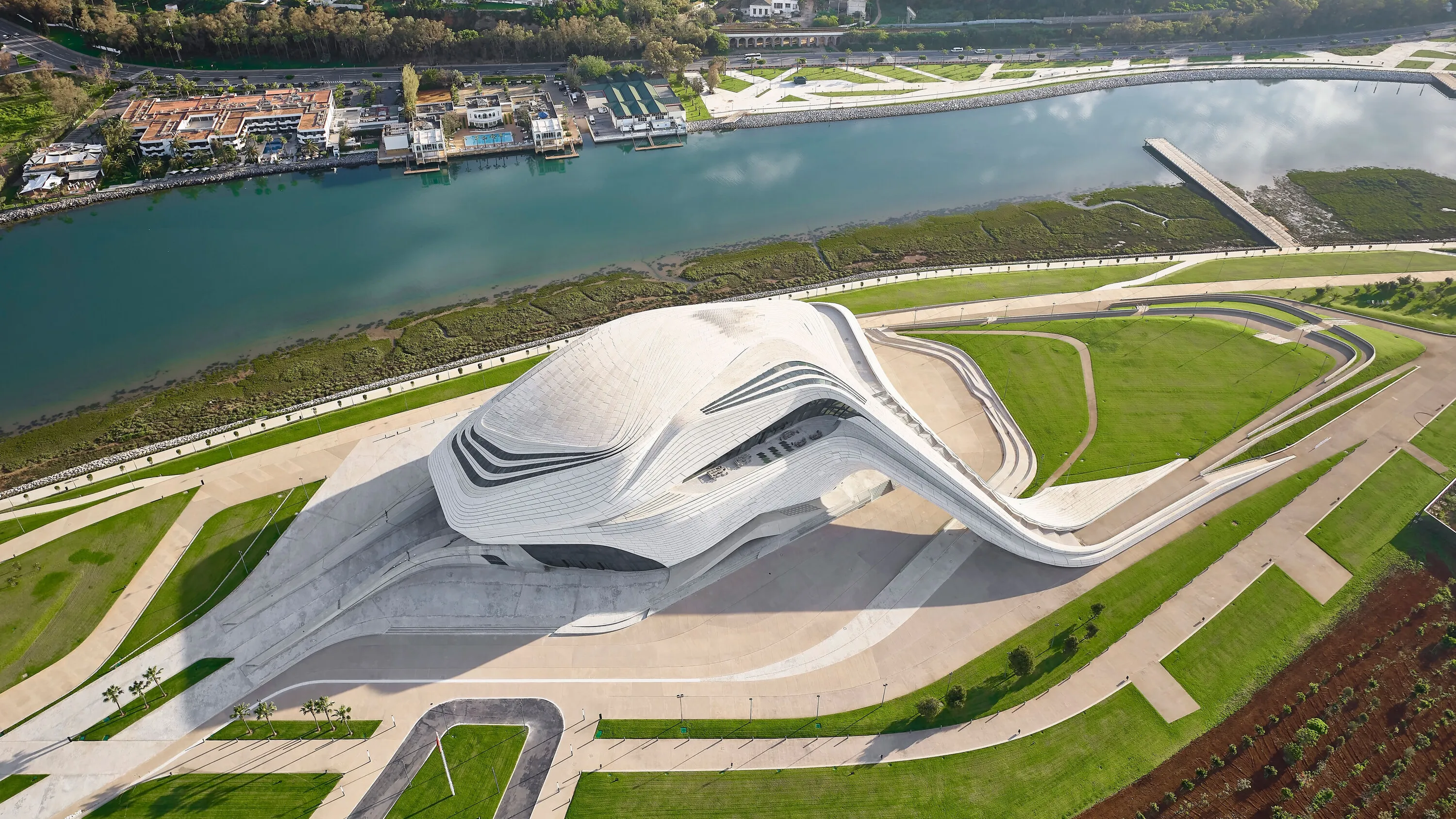
More than a decade after construction began, and ten years after its architect's death, one of Zaha Hadid's last designs is complete and performing, a steel-and-concrete crest rising between Rabat and Salé.
RABAT, Morocco
Some buildings arrive all at once. The Théâtre Royal de Rabat has arrived in acts.
This weekend, Dezeen published its coverage of the completed theatre by Zaha Hadid Architects (ZHA), on November 21, bringing renewed international attention to a building whose long journey from drawing board to stage has become one of contemporary architecture's more dramatic stories. Designed by Hadid before her death in 2016, the theatre is now finished, open to the public and hosting performances, and it has quickly become a symbol of Morocco's cultural ambitions.
Fourteen Years in the Making
The project's timeline reads like a play in several acts. Planning began in 2010, as part of a vast development of the Bouregreg valley launched by King Mohammed VI. Construction officially started on October 7, 2014, with completion initially expected in late 2019.
It did not go to plan. Hadid died in March 2016, and the building, among the last she designed, carried on without her. The architecture magazine Domus reported in 2024 that works were completed in 2021 "amidst delays and difficulties," citing the death of the designer, a change of team, variations during construction and soaring costs.
Then came a strange limbo. Writing in October 2024, Domus described Africa's largest theatre as still behind closed doors, surrounded by a "diplomatic silence." The building had by then appeared on Morocco's 20-dirham banknote, yet audiences could not get inside.
That changed in stages. The theatre was officially inaugurated on October 29, 2024, by Princess Lalla Hasnaa and French First Lady Brigitte Macron, but without a programme of performances. The real curtain-up came on April 22, 2026, when the building, now named the Théâtre Royal de Rabat, opened to the public with an opening show attended by Princesses Lalla Khadija, Lalla Meryem and Lalla Hasnaa, accompanied by Brigitte Macron, according to the Moroccan news site Le360.

River, Calligraphy and a Wave of Steel
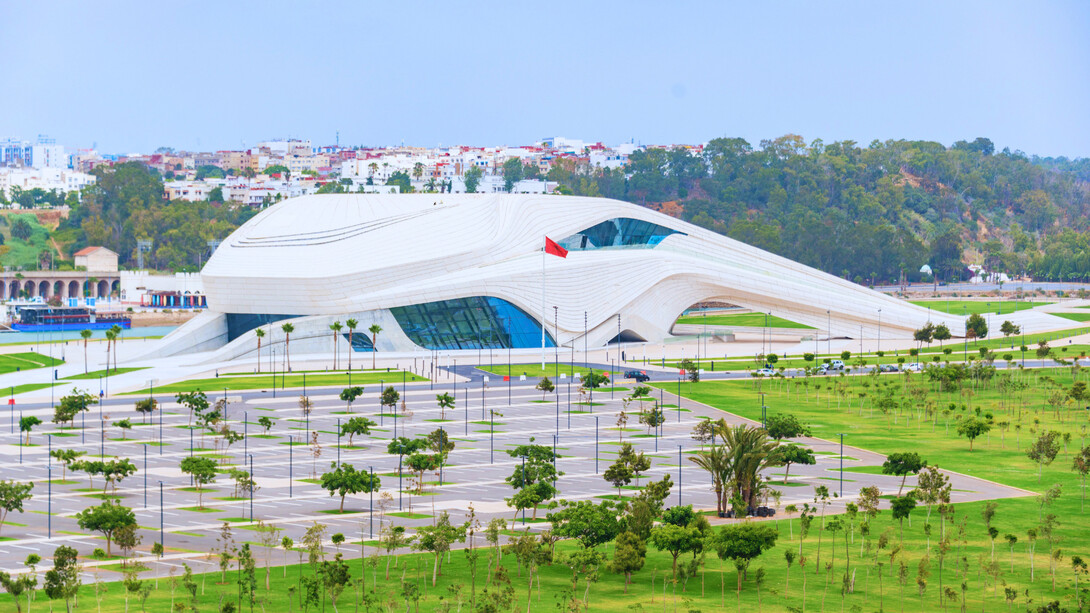
The building's form is classic late Hadid: fluid, continuous and apparently weightless. Its curving shape is inspired both by the winding course of the nearby Bouregreg river and by the aesthetics of Arabic calligraphy, with other elements drawing on Islamic architecture. Domus described it as standing "like a wave of steel in the landscape."
Reviewing the building for The New York Times in July 2026, critic Joseph Giovannini called it a true architectural feat, according to Moroccan coverage of the review. As translated from Le360's and the state news agency MAP's French-language reports, he described the structure as a wave that swells and breaks over the performance halls before descending toward an entrance that opens onto canyon-like lobbies, and likened the whole to an ocean sculpted by Brancusi. The review placed Rabat alongside Sydney, Oslo and Bilbao as a city whose cultural architecture is worth travelling for.
By the Numbers
The scale is considerable. According to Le360, the complex occupies a 7.1-hectare site with 25,400 square metres of built space. The main auditorium seats more than 1,800 people, a second hall seats 250, and an outdoor amphitheatre can hold 7,000. The investment came to no less than two billion dirhams, Le360 reports.
Inside, the acoustics were engineered with a movable, reflector-style ceiling and faceted geometric surfaces on walls and ceilings. The theatre sits in the heart of the Bouregreg valley, close to two of Rabat's most important monuments, the Hassan Tower and the Mausoleum of Mohammed V, and Le360 reports its overall form was designed to merge with the dynamism of the site and blend into the surrounding landscape.
The theatre is run by artistic director Brahim El Mazned under the oversight of the Bouregreg Valley Development Agency. Quoted in the Times review, El Mazned said the building reflects the country's broader commitment to culture and the creative industries as drivers of development.

Why It Matters
For architecture watchers, the theatre is a rare chance to judge one of Hadid's final major works in use, rather than as renderings or construction photographs. Posthumous completions are always tricky; buildings shift as they are value-engineered and as new teams take over. That the Rabat theatre has emerged so recognisably Hadid, and to such warm critical reception, is a credit to ZHA's continuity after her death.
It also matters for the region. Domus has called it the African counterpart to Jørn Utzon's Sydney Opera House, and Morocco has clearly positioned it as a flagship: a building on banknotes, inaugurated by royalty and pitched internationally as a destination. It joins a growing wave of major cultural buildings across North Africa and the Gulf aimed at both local audiences and cultural tourism.
For Hadid's legacy, it is a fitting coda. The first woman to win the Pritzker Prize, in 2004, she spent her career pushing architecture toward flowing, unbroken form. A theatre shaped by a river and by script, in a city where both have deep meaning, is a fine place to end.
What This Means for You
If you are travelling to Morocco, the theatre is now a genuine destination rather than a building to admire through a fence. Check its programme before you go; with a 1,800-seat hall, a 250-seat studio and a 7,000-seat amphitheatre, the venue can host everything from intimate recitals to large open-air concerts. Its location near the Hassan Tower makes it easy to combine with Rabat's historic sites in a single walk.
For design lovers further afield, it is a reminder to look past the opening-day headlines. Many of the most interesting buildings take years to settle into use, and the story of how they finally open can be as revealing as their form.
Curtain Call
The Théâtre Royal de Rabat took longer than planned, outlived its architect and spent years in silence. Now it is full of sound. As Dezeen's latest coverage underlines, the wave in the Bouregreg valley has finally broken.
Published By | Features Editor