From Accra to Dar es Salaam, Kampala, Addis Ababa and Harare, central banks have been buying home-mined gold to rebuild reserves. With bullion now at a one-year low, the harder questions are about losses, liquidity and who carries the risk.
A new kind of reserve policy
For most of the past two decades, African central banks treated gold as something the country dug up and shipped abroad, not something they kept. That has changed quickly. A World Gold Council survey published on 16 June 2026 found that more than half of the central banks it polled worldwide now run programmes to buy part of their country's own gold output, and another 12% are considering one. Half of those planning to add gold said they intend to pay for it in local currency through domestic purchase schemes. Africa, where gold is mined at scale but foreign-exchange buffers are often thin, has become the clearest test of the idea.
The logic is simple. A central bank that buys gold from local miners with its own currency gets a hard reserve asset without spending scarce dollars. The metal can be held, sold or swapped later. In a world of heavy official demand (central banks bought about 1,000 tonnes a year over the past four years, twice the pace of the previous decade, and roughly 321 tonnes in the third quarter of 2026 alone, up about 42% year on year according to the WGC), the strategy has looked well timed. African gold reserves have risen sharply in dollar terms as prices climbed; one BusinessDay analysis of eight countries put their combined gold holdings at US$66.6 billion in the second quarter of 2026, up 113.5% on a year earlier, largely because of price.
November has brought a reminder that price works in both directions. Spot gold fell to about US$3,725 an ounce on 18 November, a one-year low, as hawkish signals from the US Federal Reserve lifted the dollar. That is well below the levels at which several African banks bought much of their metal. The question is changing. It used to be whether to accumulate gold. Now it is whether these programmes can strengthen reserves without weakening the balance sheets of the institutions that run them.
Ghana: the most ambitious, and most exposed, model
Ghana has gone furthest. Its domestic gold purchase programme, launched in 2021, has grown into a multi-agency system built around the Ghana Gold Board (GoldBod), which aggregates artisanal and small-scale gold, and a requirement that large-scale miners sell a share of output to the Bank of Ghana. In May 2026 that share was raised from 20% to 30%. The Ghana Gold Reserve Act Programme (GANRAP), passed by parliament in February 2026, separates the two streams. Gold bought from large mines must go into physical reserves and can only be sold with government and parliamentary approval. Artisanal gold handled by GoldBod is mainly sold to earn dollars, which are then transferred to the central bank. GANRAP targets purchases of about 3.02 tonnes a week and 15 months of import cover by the end of 2028.
The holdings have swung a lot. Bank of Ghana data showed gold reserves falling from 37.1 tonnes in September 2025 to 18.6 tonnes in December, a drop the bank described as deliberate rebalancing. They then recovered to 20.8 tonnes in March 2026, 24.4 tonnes in June and 25.2 tonnes in August. Reuters noted that June's figure was still down from about 33 tonnes a year earlier, reflecting 2025 sales and lower-than-targeted purchases from large miners. GoldBod paused exports in August before resuming them, and banned exports of unrefined doré from 1 September 2026. On 23 September Governor Johnson Asiama told the Monetary Policy Committee that a weaker current account, falling reserves and the export pause called for "a careful look at our buffers" ahead of the usual rise in fourth-quarter demand for foreign exchange.
The cost side is now public. According to the Bank of Ghana, the Gold-for-Oil and Gold-for-Reserves schemes produced cumulative net losses of GH¢7.11 billion (about US$629 million) between 2022 and 2024, covering fuel-import barter, artisanal-gold resale and price effects. The IMF credits the programme with helping Ghana beat its reserve targets, but has warned that it exposes the central bank to price and liquidity risk. It has asked for losses to be recognised in the budget rather than absorbed by the bank, and for purchases to be scaled back gradually. At US$3,725 an ounce, Ghana's 25.2 tonnes are worth roughly US$3.0 billion. A 10% move in price changes that figure by about US$300 million.

Tanzania and Uganda: East Africa's steadier builders
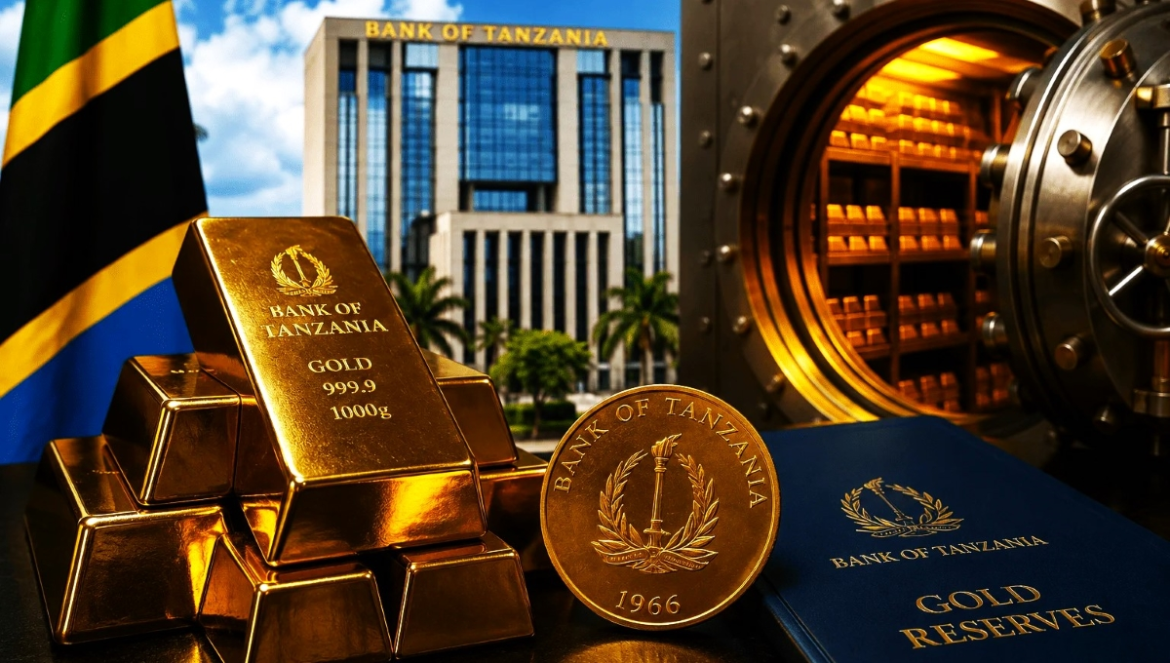
Tanzania has taken a more conventional path. The Bank of Tanzania stopped adding gold in 2002 and returned to buying in 2023. In September 2024 the mining regulator ordered all gold exporters and traders to set aside at least 20% of output for sale to the central bank, which pays at the day's London price and settles within 24 hours. The bank says official gold reserves reached 27.5 tonnes by 10 June 2026. In July Governor Emmanuel Tutuba said it had bought about 28 tonnes over 18 months, worth US$3.68 billion at the time. He also said the scheme had led more than 4,000 mineral traders and small-scale miners to open bank accounts, a financial-inclusion gain that is easy to overlook. Total reserves were about US$6 billion, or 4.3 months of imports.
Tanzania also shows the political pull to spend gold. Early in 2026 President Samia Suluhu Hassan directed the bank to sell part of its holdings. The bank later suspended the planned sale when prices dipped and publicly denied that the gold would fund infrastructure. The July valuation implied an average price above US$4,000 an ounce. At today's US$3,725, the same 28 tonnes would be worth about US$3.35 billion, so roughly US$330 million in paper value has gone in four months.
Uganda is at an earlier stage. The Bank of Uganda, which held no gold at all, made its first domestic purchase on 17 April 2026 under a three-year pilot. It buys from licensed, prequalified miners at international prices, pays in shillings, and sends the metal to approved refineries for assay before it enters reserves. The pilot is meant to test pricing, logistics, storage and compliance before any expansion. Those are the right questions in a sector where artisanal miners are estimated to produce most of the output and where Uganda's financial intelligence authorities have flagged money-laundering exposure.
Ethiopia and Zimbabwe: when gold becomes monetary policy
Ethiopia shows the macroeconomic side effects. To pull gold away from smugglers, the National Bank of Ethiopia has paid premiums of roughly 5–15% above world prices. Gold exports rose from just over 4 tonnes in 2023/24 to nearly 39 tonnes in 2024/25, and gross reserves climbed to about US$4.4 billion. But the purchases are paid for by creating birr. Reported spending on gold rose from single-digit billions of birr to several hundred billion in 2024/25 (estimates range from Br315 billion to Br421 billion depending on the measure), and the bank booked about Br57 billion in losses on gold sales and write-downs. Analysts have linked the purchases to rapid growth in reserve money. The IMF's fifth review of Ethiopia's Extended Credit Facility, published in July, says the NBE will adopt a plan to phase out the premium by end-September 2026 and develop an exit strategy from direct participation in the gold market by end-December 2026, with private banks taking over buying. The IMF also notes that the premium may itself help set the parallel exchange rate.
Zimbabwe uses gold most directly. Its currency, the Zimbabwe Gold (ZiG), launched in April 2024, is backed by a mix of gold and foreign-exchange reserves. The Reserve Bank's gold holdings rose from 1.5 tonnes at launch to 4.03 tonnes at end-2025 and about 4.48 tonnes in May 2026, with later reports above 4.5 tonnes and a stated goal of five tonnes by year-end. Total reserves backing the ZiG are put at more than US$1.4–1.5 billion. In this model a falling gold price is not just an accounting issue. It directly reduces the cover behind the currency.
The BCEAO alternative
West Africa's eight-country monetary union shows another approach. The Central Bank of West African States (BCEAO) holds a common stock of about 1.52 million ounces (roughly 47 tonnes) that does not come from domestic mining in Côte d'Ivoire, Mali or Burkina Faso. Since 2023 it has lent part of that stock to earn income and can swap it for currency. The amount used this way rose from 200,000 ounces in 2024 to 541,751 ounces at the end of 2025. Here gold is managed as a yield-bearing reserve asset, kept apart from national mining policy.
What good practice looks like
These experiences point to a set of design principles for central banks that want gold to stay a buffer and not turn into a fiscal backdoor:
- Separate reserve gold from quasi-fiscal gold. Ghana's GANRAP split between ring-fenced large-mine gold and tradable artisanal gold is a sound start, but barter schemes such as gold-for-oil should run through the budget.
- Pay world prices. Premiums above market, as in Ethiopia, inflate the money supply, invite round-tripping and distort the exchange rate.
- Sterilise the local-currency injection. Buying gold with newly created money is monetary easing unless it is offset through open-market operations or reserve requirements.
- Disclose holdings, purchase prices and realised gains or losses regularly. Monthly tonnage reporting, as Ghana and Tanzania now provide, should become standard.
- Diversify, don't concentrate. IMF reserve-adequacy work favours liquid assets. A gold share that climbs during a rally can leave a bank short of dollars when it needs to defend the currency.
- Invest in traceability and refining. Uganda's assay-first pilot and Ghana's doré export ban show that integrity of supply is a reserve-quality issue, not just a mining one.
Outlook
The case for some domestic gold buying remains reasonable. It mobilises a resource that would otherwise leave through informal channels, it builds reserves without borrowing, and in Tanzania it has brought thousands of small miners into the banking system. But the 2026 price turn shows that gold is a volatile asset, not a free one. The central banks that come through this cycle in better shape will be those that bought at world prices, kept purchases off the fiscal books, and told the public what they hold and what it cost. Those that used gold to stand in for missing dollars, budget space or exchange-rate credibility may find that the metal increases their risks.
Published By | Business News Editor